
100 dollar bill slang includes informal names that people use when talking about a $100 bill. The best known terms include Benjamin, Benji, C note, and sometimes a hundred or a hundo. Each term can sound slightly different depending on the speaker and situation.
People often search for 100 dollar bill slang after hearing a word like “Benjamin” in a song, movie, text, or casual conversation. The meaning may seem unclear if you do not know the connection between the nickname and the money.
This guide explains the most common names for a $100 bill, where people use them, and when you should choose a more formal term.
Quick Answer
- 100 dollar bill slang refers to informal names for a $100 bill. The most famous term is Benjamin or Benji, which refers to Benjamin Franklin’s portrait on the bill. C note also means $100 and comes from the Roman numeral C, which represents 100.
What Does 100 Dollar Bill Slang Mean?
100 dollar bill slang gives people a quicker or more colorful way to talk about money. Instead of saying “one hundred dollars,” someone might say “a Benjamin” or “a C note.”
These words usually describe the amount of money rather than a special type of payment. For example, someone may say:
“I only have a Benjamin in my wallet.”
The person means they have one $100 bill.
Context still matters. A person might also say “a hundred bucks” without holding an actual $100 note. In that case, they mean the amount of $100, not necessarily one physical bill.
Common Names for a $100 Bill
Several slang terms can refer to a $100 bill. Some appear more often in certain regions, age groups, or types of media.
Benjamin or Benji
Benjamin is one of the most widely recognized slang names for a $100 bill. People also shorten it to Benji or Benny.
The nickname comes from Benjamin Franklin, whose portrait appears on the front of the U.S. $100 bill.
For example:
“Can you break a Benjamin for me?”
This means, “Can you exchange my $100 bill for smaller bills?”
The term often appears in songs, movies, social media posts, and everyday American conversation.
C Note
C note also means $100. The letter C represents 100 in Roman numerals, so a C note literally refers to a 100 dollar note.
For example:
“He handed me a C note and told me to keep the change.”
C note sounds slightly old fashioned to some speakers, but many people still understand it.
A Hundred
Sometimes people simply say a hundred.
For example:
“I found a hundred in my jacket pocket.”
The speaker may mean a $100 bill or simply $100 in cash. The rest of the conversation usually makes the meaning clear.
Hundo
Hundo is an informal and playful shortening of “hundred.” People may use it for $100 or for the number 100 in other situations.
For example:
“That jacket cost me a hundo.”
This sentence means the jacket cost $100. The speaker does not need to mean one $100 bill.
What Does a Benjamin Mean in Slang?
In slang, a Benjamin means $100 or a $100 bill. The term comes directly from Benjamin Franklin’s image on the bill.
People often use “Benjamin” when they want to sound casual, playful, or expressive. You may hear it in phrases such as:
- “Make that Benjamin.”
- “I spent a Benjamin.”
- “I have a couple of Benjamins.”
- “He pulled out a Benjamin.”
When someone says “Benjamins” in the plural, they usually mean multiple $100 bills.
Is 100 Dollar Bill Slang Rude or Offensive?
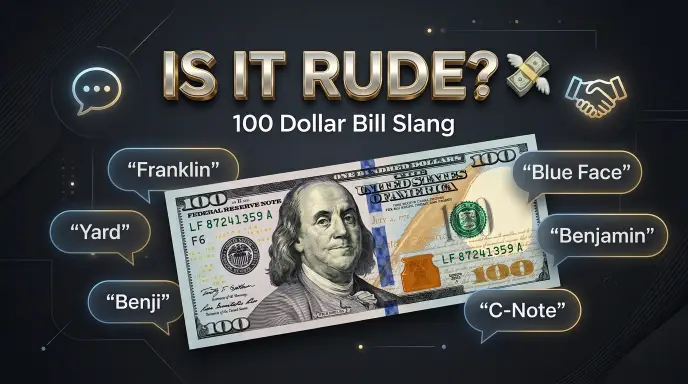
No, most slang for a $100 bill is not rude or offensive. Terms like Benjamin, Benji, and C note are generally harmless.
However, slang still depends on the setting. A casual nickname for money may sound out of place in a serious financial conversation.
For example, this works well with a friend:
“I need to save a few Benjamins.”
However, this sounds more professional:
“I need to save several hundred dollars.”
The meaning stays the same, but the tone changes.
Where Is 100 Dollar Bill Slang Commonly Used?
People mainly use these terms in casual conversations about money. You may hear them in person or see them online.
Everyday Conversations
Friends may use money slang because it feels faster and more relaxed.
For example:
“I only brought one Benji with me.”
Music and Entertainment
Songs and movies often use money slang because the terms can add personality and fit a rhythm. “Benjamins” has become especially familiar in American popular culture.
Still, lyrics do not always reflect how every person speaks in daily life.
Social Media
Users may write “Benji” or “a hundred” in captions, jokes, and posts about spending or earning money.
A post might say:
“Spent a whole Benji on snacks this week.”
The writer uses humor to describe spending $100.
Texting and Messaging
In texts, people often choose the shortest phrase that their friends understand.
For example:
“Can you lend me a hundo until Friday?”
The tone remains casual and friendly.
Real Life Examples of 100 Dollar Bill Slang
The meaning of money slang can change slightly with tone. Here are examples from different situations.
Friendly Example
Friend 1: “How much did you win?”
Friend 2: “Just one Benjamin, but I’ll take it!”
Here, “Benjamin” sounds light and positive.
Casual Text Example
“I spent a Benji at the store today 😭”
The person means they spent about $100. The emoji adds frustration or surprise.
Argumentative Example
“You still owe me a hundred dollars. Don’t act like you forgot.”
In an argument, people often use direct language instead of playful slang. A serious tone can make “Benjamin” sound less natural.
Social Media Example
“Saving every C note I get this year.”
The writer means they plan to save every $100 amount they receive.
Casual Shopping Example
“This isn’t worth a hundo.”
The speaker thinks an item does not deserve a $100 price tag.
Benjamin vs. C Note: What Is the Difference?
Both terms can mean $100, but they come from different ideas.
| Slang Term | Meaning | Why People Use It |
| Benjamin | $100 or a $100 bill | Refers to Benjamin Franklin |
| Benji | $100 or a $100 bill | Shorter and more casual |
| C note | A $100 bill | C represents 100 in Roman numerals |
| Hundo | $100 in many contexts | Playful shortening of “hundred” |
| A hundred | $100 | Simple and widely understood |
Benjamin and C note usually connect more directly to a $100 bill. Hundo can describe any amount of 100, so context matters more.
The Origin and Background of These Terms
The nickname Benjamin has a clear connection to the design of the U.S. $100 bill. Benjamin Franklin appears on the note, so people began using his first name as a casual way to refer to the bill.
The word Benji simply shortens Benjamin. Speakers often shorten names in casual English, and the same habit works with money slang.
C note comes from the Roman numeral C, which means 100. The word “note” refers to a banknote or paper bill.
These terms did not all become popular at the same time or through one single group. Their use has spread through everyday speech, entertainment, and popular culture. Usage can also vary by region and generation.
Why Do People Use Slang for a $100 Bill?
People use money slang for several simple reasons.
It Saves Time
“A Benji” can feel quicker than saying “a one hundred dollar bill.”
It Adds Personality
Slang can make a conversation sound more relaxed and expressive.
It Creates a Casual Tone
Friends often use informal words to make a conversation feel natural.
It Reflects Shared Culture
Some slang terms become familiar through music, films, sports, and online conversations. Using a term can show that the speaker understands the same cultural reference.
That said, you never need slang to talk about money clearly. “One hundred dollars” always works.
When Should You Avoid Using 100 Dollar Bill Slang?
Avoid money slang when clarity or professionalism matters more than style.
For example, use standard language in:
- Bank conversations
- Legal documents
- Business contracts
- Formal emails
- School assignments
- Professional reports
- Serious financial discussions
You should also avoid slang when you do not know if the other person understands it.
Instead of saying:
“I’ll pay you a Benji.”
You can say:
“I’ll pay you $100.”
The second version leaves no room for confusion.
Can You Use These Terms at Work?
You can use them in a casual workplace conversation with people you know well. However, Benjamin, Benji, and hundo do not fit every professional setting.
For example, a coworker might say:
“That dinner cost almost a Benjamin.”
That can sound friendly during a lunch break.
However, a business invoice should say $100, not “one Benjamin.” Professional writing needs clear and standard language.
A good rule is simple: match your words to the situation.
Why Context Matters With Money Slang
Context tells you if a person means a physical bill or simply an amount of money.
Consider these examples:
“I have a Benjamin in my pocket.”
This strongly suggests one physical $100 bill.
Now consider:
“That repair cost me a Benjamin.”
This means the repair cost $100, but the person may have paid with a card, cash, or another method.
The same slang term can therefore describe either the bill or the amount. The surrounding words usually explain which meaning fits.
Common Misunderstandings About 100 Dollar Bill Slang
One common mistake involves assuming every nickname refers to a different amount. In reality, Benjamin, Benji, and C note can all refer to $100.
Another mistake involves confusing a hundred with a $100 bill. Someone can have $100 in several smaller bills, so “a hundred dollars” does not always mean one $100 note.
Some people also assume that everyone uses the same money slang. That is not true. A term may sound familiar to one person and unusual to another.
If you feel unsure, use the standard amount.
Similar Slang for Other Amounts of Money
English has slang for other amounts of money too. Some terms have clear meanings, while others depend heavily on region and context.
| Term | Common Meaning | Usage Note |
| Buck | One U.S. dollar | Very common and casual |
| Five bucks | Five dollars | Common everyday phrase |
| Grand | $1,000 | Common in informal speech |
| K | $1,000 | Often used in texting and online |
| Benjamin | $100 | Linked to Benjamin Franklin |
| C note | $100 | Refers to the number 100 |
Always check the context before assuming a slang term has one fixed meaning.
Is 100 Dollar Bill Slang Safe to Use on Social Media?
Yes. 100 dollar bill slang is generally safe to use on social media because these terms do not carry an offensive meaning by themselves.
Still, avoid sharing sensitive financial details online. Saying “I spent a Benji on shoes” is different from posting private banking information.
Tone also matters. A joke about money may work with friends but confuse a wider audience.
The Impact of Slang in Communication
Slang can make a message feel personal and natural. It can also create confusion when people come from different places or age groups.
Money slang works best when both people understand the term. For example, “Benji” may sound fun to one reader but unfamiliar to another.
Clear communication does not require slang. Slang simply gives people another way to express the same idea.
The best choice depends on your audience.
FAQ’S
Q1:What is slang for a $100 bill?
Common slang for a $100 bill includes Benjamin, Benji, and C note. People may also say “a hundred” or “a hundo” when the context involves $100.
Q2:Why is a $100 bill called a Benjamin?
People call a $100 bill a Benjamin because Benjamin Franklin appears on the bill. The nickname uses his first name.
Q3:What does C note mean?
A C note means a $100 bill. The letter C represents 100 in Roman numerals, and “note” means a paper bill.
Q4:Is Benji slang for $100?
Yes. Benji is a casual shortening of Benjamin, so people often use it to mean $100 or a $100 bill.
Q5:Does hundo always mean $100?
Not always. Hundo means one hundred, and the context decides what the number refers to. In a money conversation, it often means $100.
Q6:Can I use 100 dollar bill slang in formal writing?
It is better to use $100 or one hundred dollars in formal writing. Slang works best in casual conversations and informal content.
Conclusion
100 dollar bill slang gives people several casual ways to talk about $100. Benjamin, Benji, and C note are among the best known terms, while hundo and a hundred can also appear in everyday conversations.
The most important thing to remember is context. Some terms refer directly to a physical $100 bill, while others simply describe an amount of $100. Tone and audience also matter.
Use these slang terms when the setting feels casual and the people around you understand them. When you need complete clarity or a professional tone, simply say $100. That choice always communicates the amount clearly.
Discover More About!
- Acere Cuban Slang: What Does Acere Mean?
- Green Out Meaning Slang: What Does It Mean?
- Penis in Spanish Slang: Meaning, Terms, and Usage