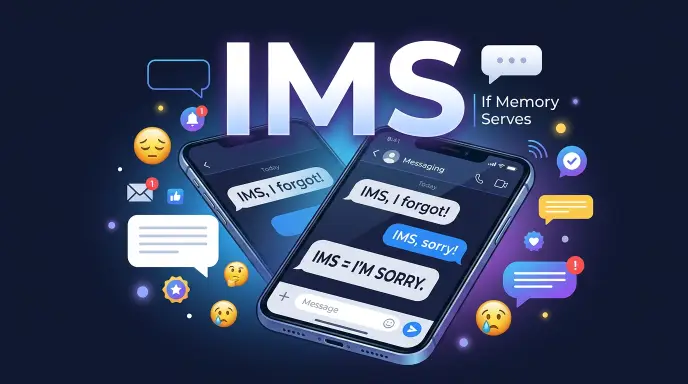
IMS slang meaning can seem confusing when you first see these three letters in a text. You might see “IMS, I forgot” in a chat and wonder if IMS represents a phrase, a typo, or some kind of internet slang. Short forms can change meaning based on the conversation, so context matters.
In casual texting, IMS often means “I’m sorry” or “I am sorry.” People use it as a quick apology when they make a small mistake, forget something, reply late, or cause a minor inconvenience. Some slang references also list “If Memory Serves” as another meaning, so you should check the surrounding words before deciding what IMS means.
Quick Answer:
- In casual text slang, IMS usually means “I’m sorry” or “I am sorry.” In some conversations, it can mean “If Memory Serves,” so context helps you choose the right meaning.
What Does IMS Mean in Text?
When someone uses IMS in a casual text, the most likely meaning is “I’m sorry.” The sender uses the abbreviation to give a short apology without typing the complete phrase.
For example:
“IMS, I forgot to call you.”
This means:
“I’m sorry, I forgot to call you.”
Another example:
“IMS for being late.”
This means:
“I’m sorry for being late.”
The expression usually fits casual conversations between friends, family members, classmates, or people who already communicate informally.
However, IMS does not have one universal meaning. Slang dictionaries also list “If Memory Serves” as a possible meaning.
For that reason, look at the words around IMS before you reply.
IMS Full Form in Text
The most common casual texting expansion of IMS is:
IMS = I’m Sorry
Some references write the full phrase as:
IMS = I Am Sorry
Both versions communicate the same idea.
The abbreviation does not follow a strict letter by letter pattern like many acronyms. It reflects the way people shorten spoken phrases in fast digital communication. Some references explain the form as a hybrid abbreviation because “I’m” contributes the first two letters while “sorry” contributes the final letter.
Simple Breakdown
| IMS | Meaning |
| IMS | I’m sorry |
| I’m sorry | A quick apology |
| Tone | Casual and informal |
| Common setting | Texts and online chats |
For example:
“IMS, I didn’t see your message.”
The sender wants to apologize quickly for missing the message.
Other Meanings of IMS
Context can give IMS a different meaning. You should know the main alternatives before assuming that every message uses IMS as an apology.
1. I’m Sorry
This meaning fits casual texting when someone wants to apologize.
“IMS, I was busy earlier.”
Meaning:
“I’m sorry, I was busy earlier.”
This remains the most useful meaning to consider when the conversation involves a mistake, delay, or apology.
2. If Memory Serves
Some online slang references use IMS to mean “If Memory Serves.” People use this phrase when they want to share information that they remember but do not claim with complete certainty.
For example:
“IMS, we met in high school.”
That means:
“If memory serves, we met in high school.”
This meaning works very differently from “I’m sorry.”
3. Technical Meanings
IMS also appears outside slang. In technology and business, the letters can represent specialized terms. For example, telecommunications uses IP Multimedia Subsystem, while organizations may use IMS for terms such as Integrated Management System.
These meanings do not usually fit a casual text between friends.
If someone writes:
“The IMS needs an update.”
you should not automatically read IMS as “I’m sorry.” The professional or technical context points toward a different meaning.
Is IMS Rude, Offensive, or Neutral?
IMS is generally neutral. When it means “I’m sorry,” it expresses an apology rather than an insult.
The tone can change based on the message around it.
For example:
“IMS 😭 I completely forgot!”
This sounds friendly and apologetic.
Now compare:
“IMS. Whatever.”
This can sound annoyed, dismissive, or sarcastic.
The abbreviation itself does not create that attitude. The surrounding words, punctuation, emojis, and conversation create the tone.
IMS usually sounds:
- Casual
- Friendly
- Informal
- Quick
- Apologetic
For a serious apology, however, a full sentence usually works better.
“I’m truly sorry for what happened.”
sounds more sincere and thoughtful than:
“IMS.”
Where Is IMS Commonly Used?
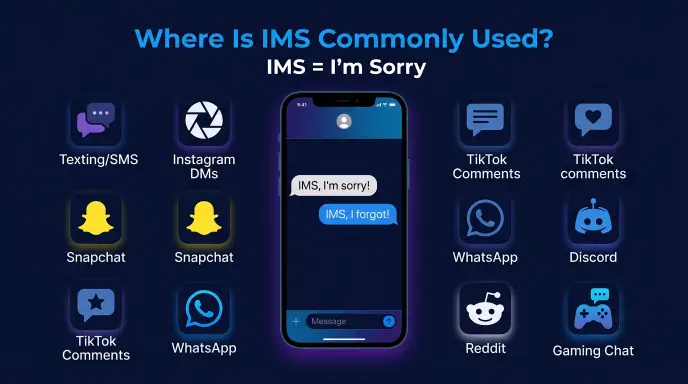
When IMS means “I’m sorry,” it fits informal digital communication. People may use it in text messages, DMs, group chats, and online conversations. Some sources also mention social media use.
Text Messages
A person may use IMS after forgetting something.
“IMS, I forgot about our plans.”
Someone may use IMS in a casual DM or comment when they want to apologize.
“IMS, I didn’t reply earlier.”
Snapchat
Short messages fit Snapchat’s quick communication style.
“IMS, wrong snap 😂”
TikTok
Users may use short slang in comments or replies.
“IMS I missed this trend!”
Discord
Gaming and community chats often use short forms.
“IMS, I left the match early.”
Friends and family members may use IMS when they want a quick apology.
“IMS, I’ll call you later.”
The term does not belong to one specific platform. The relationship between the people and the context matter more than the app.
Real Life Examples of IMS
The best way to understand slang involves seeing it in natural situations. Here are examples with different tones.
Friendly Example
Alex: “Why didn’t you tell me about the party?”
Sam: “IMS! I thought you already knew.”
Here, IMS means:
“I’m sorry.”
The sender gives a quick, friendly apology.
Casual Example
“IMS, I was watching a movie and didn’t see your message.”
The sender apologizes for a late response.
Minor Mistake
“IMS, I sent the wrong photo.”
The abbreviation keeps the apology short.
Late Reply
“IMS for taking so long to reply.”
The sender apologizes for responding late.
Gaming Example
“IMS, I accidentally left the game.”
Here, IMS means “I’m sorry.”
Social Media Example
“IMS 😂 I forgot to post it yesterday.”
The emoji makes the message feel lighter and more casual.
Argumentative Context
“IMS, but I still disagree with you.”
Here, IMS still means “I’m sorry,” but the rest of the sentence shows that the sender does not agree.
More Serious Situation
“IMS for hurting your feelings.”
This message uses IMS for an apology, but a full sentence may communicate sincerity better.
IMS Meaning: “If Memory Serves”
Now consider a different conversation.
Person A: “When did we first meet?”
Person B: “IMS, it was in 2020.”
Here, IMS means:
“If memory serves.”
The sender does not apologize. Instead, the sender signals uncertainty about a memory.
This meaning appears less often than the apology meaning in ordinary casual texting. Slang.net lists “If Memory Serves” as one of the meanings of IMS and notes that relatively few people use the abbreviation.
How to Spot This Meaning
Look at the words that follow IMS.
If the message discusses:
- A memory
- A date
- A past event
- A place
- A fact someone remembers
then “If Memory Serves” may make more sense.
For example:
“IMS, her birthday is in July.”
The writer means:
“If memory serves, her birthday is in July.”
IMS vs I’m Sorry
These two forms obviously connect because “I’m sorry” represents the main casual texting meaning.
| Expression | Meaning | Tone |
| IMS | I’m sorry | Very casual |
| I’m sorry | Apology | Neutral |
| Sorry | Apology | Casual |
| My bad | Informal apology | Very casual |
| I apologize | Apology | More formal |
If you talk with a close friend, “IMS” may fit.
If you write to a teacher, manager, customer, or client, write “I’m sorry” or “I apologize.”
IMS vs IMY
Do not confuse IMS with IMY.
IMY commonly means “I miss you.”
For example:
“IMY ❤️”
means:
“I miss you.”
IMS and IMY look similar because both begin with “IM,” but they communicate very different messages.
| Slang | Meaning |
| IMS | I’m sorry |
| IMY | I miss you |
| IMO | In my opinion |
| IMHO | In my humble opinion |
| IIRC | If I recall correctly |
Checking the final letter can help you avoid confusion.
IMS vs My Bad
Both IMS and my bad can express an apology, but they do not sound exactly the same.
“IMS, I forgot.”
sounds like a short apology.
“My bad, I forgot.”
sounds more relaxed and conversational.
“My bad” often works well between friends. IMS can work in similar casual situations.
IMS vs Sorry
“Sorry” remains much clearer than IMS.
For example:
“Sorry, I forgot.”
almost everyone understands the message.
“IMS, I forgot.”
requires the reader to know the abbreviation.
If you communicate with someone who may not know internet slang, sorry gives you the safer choice.
Why Do People Use IMS?
People use abbreviations because digital conversations often favor speed and convenience.
IMS can help someone:
Save time
Typing three letters takes less effort than typing a complete phrase.
Keep the message casual
A short abbreviation can make an apology feel less formal.
Match the other person’s style
Friends often develop shared texting habits. If both people understand IMS, they may use it naturally.
Add emotional softness
An abbreviation can make a small apology feel light.
For example:
“IMS lol, I totally forgot.”
The “lol” makes the situation feel less serious.
Keep messages short
Texting does not always require complete sentences. Short forms allow people to communicate quickly.
When Should You Avoid Using IMS?
IMS works best in informal conversations. You should avoid it when the audience expects professional or formal English.
Avoid IMS in:
- Job applications
- School essays
- Academic assignments
- Business emails
- Formal complaints
- Official documents
- Professional apologies
- Important customer messages
Instead of:
“IMS for the delay.”
write:
“I’m sorry for the delay.”
For a more formal message, write:
“I apologize for the delay.”
The longer version gives the message more clarity and weight.
Is IMS Appropriate for a Serious Apology?
Usually, a full apology works better for a serious situation.
Imagine that you seriously hurt someone’s feelings. Sending only:
“IMS.”
may look too short or careless.
A better message could say:
“I’m really sorry for what I said. I understand why it hurt you.”
This message explains your feelings and shows that you understand the situation.
IMS can work well for small mistakes, but important situations need more than three letters.
Polite Alternatives to IMS
IMS does not carry an offensive meaning, so you do not need a “polite” replacement. However, you can choose a clearer alternative depending on the situation.
Casual
“Sorry!”
Friendly
“My bad!”
Neutral
“I’m sorry.”
More sincere
“I’m really sorry about that.”
Formal
“I apologize for the mistake.”
Professional
“I apologize for the inconvenience.”
These choices help you match your tone to your audience.
Impact of IMS on Communication
Text slang can make conversations faster and more relaxed. At the same time, abbreviations can create confusion.
IMS provides a good example because different sources list different meanings. Some references identify “I’m sorry” as the casual texting meaning, while others list “If Memory Serves” as another online meaning.
That difference shows why context matters.
If a friend sends:
“IMS, I forgot.”
you can understand the apology.
If someone writes:
“IMS, we met there in 2019.”
the second meaning may fit better.
When you feel unsure, ask the sender what they mean. A quick question can prevent a misunderstanding.
Is IMS Safe for Social Media?
Yes. IMS does not normally contain offensive or harmful content.
People can use it in casual texts, social media comments, DMs, group chats, and gaming conversations when they want to express a quick apology.
However, social media slang can confuse people outside the community. If you want everyone to understand your message, write the complete phrase.
For example:
“I’m sorry I missed your message.”
works for almost any audience.
Common Mistakes With IMS
Assuming IMS has only one meaning
IMS can have multiple meanings. Context helps you identify the intended one.
Using IMS for a serious apology
A three letter abbreviation may not show enough sincerity for a serious issue.
Using IMS in formal writing
Professional and academic writing usually needs complete words and clear sentences.
Confusing IMS with IMY
IMS usually relates to an apology in casual texting, while IMY commonly means “I miss you.”
Treating every online definition as universal
Slang changes across communities. One group may use an abbreviation differently from another group.
Quick Comparison Table
| Slang | Meaning | Common Tone | Example |
| IMS | I’m sorry | Casual | “IMS, I forgot.” |
| IMS | If memory serves | Uncertain | “IMS, we met in 2020.” |
| IMY | I miss you | Emotional | “IMY so much.” |
| My bad | My mistake | Casual | “My bad!” |
| IMO | In my opinion | Neutral/casual | “IMO, it’s better.” |
| IIRC | If I recall correctly | Informal | “IIRC, she lives here.” |
FAQ’S
Q1:What does IMS mean in texting?
IMS usually means “I’m sorry” or “I am sorry” in casual texting. People use it as a short apology for a mistake, delay, or minor problem.
Q2:What does IMS stand for in slang?
In casual texting, IMS commonly stands for “I’m sorry.” Some online slang references also list “If Memory Serves” as another meaning.
Q3:Is IMS a bad word?
No. IMS does not normally count as a bad or offensive word. When it means “I’m sorry,” it simply expresses an apology.
Q4:What does IMS mean on Instagram?
In a casual Instagram DM or comment, IMS can mean “I’m sorry.” However, context can change the meaning, so check the rest of the conversation.
Q6:Can IMS mean “If Memory Serves”?
Yes. Some slang references list “If Memory Serves” as a meaning of IMS. This use fits conversations about memories, dates, and past events.
Q7:Should I use IMS in a formal email?
No. Use “I’m sorry,” “I apologize,” or another complete phrase in a formal email. These options provide clearer and more professional communication.
Conclusion
The IMS slang meaning can change with context, but “I’m sorry” stands out as the main meaning in casual texting references. People use it to give a quick apology when they make a small mistake, reply late, forget something, or cause a minor inconvenience.
IMS can also mean “If Memory Serves.” This version fits conversations about memories or facts that someone recalls. Technical fields can give IMS completely different meanings, so the setting matters.
For casual chats, IMS can keep an apology short and relaxed. For serious situations, a complete sentence usually shows more care. In formal writing, choose “I’m sorry” or “I apologize” instead.
The easiest rule to remember is simple: look at the context before you decide what IMS means. That small step can help you understand the message correctly and choose the right response.
Discover More About!
- What Does Fin Mean in Slang? Fin Meaning in Text
- What Does Finna Mean in Slang? Finna Meaning in Text
- What Does HMB Mean in Slang? HMB Meaning in Text