Chinese slang words can make online chats, comments, videos, and everyday conversations much easier to understand.
If you learn Mandarin from a textbook, you may know many standard words but still feel confused when native speakers use casual internet expressions. That happens because Chinese slang often uses short phrases, pinyin initials, numbers, jokes, and creative wordplay.
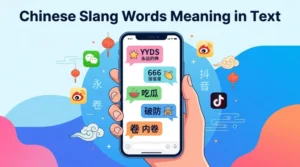
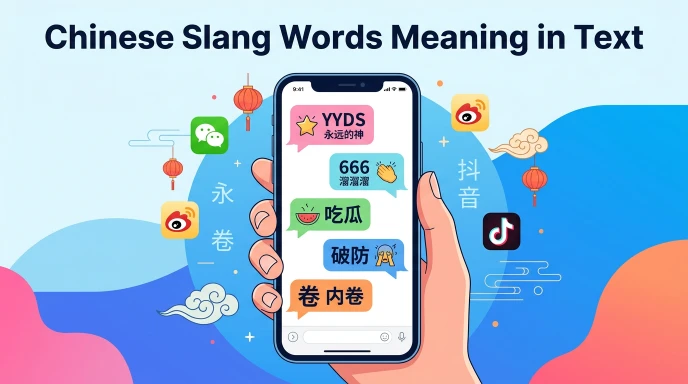
Popular examples include YYDS, 666, 绝绝子 (juéjuézi), 吃瓜 (chīguā), and 内卷 (nèijuǎn). These expressions can show praise, surprise, humor, frustration, or agreement. Many appear on Chinese social platforms, messaging apps, forums, gaming communities, and video comments. Chinese internet language also changes quickly, so context matters. Some terms work well with friends but may sound too casual in formal settings.
Quick Answer:
- Chinese slang words are informal expressions that people use in casual speech, texting, online comments, gaming, and social media. They can include shortened Chinese phrases, pinyin abbreviations, numbers, memes, and playful expressions.
What Does “Chinese Slang Words” Mean in Text?
Chinese slang words in text are informal Chinese expressions that people use to communicate quickly, casually, humorously, or emotionally.
These terms do not always follow the style you find in a traditional Chinese textbook. Some use the first letters of pinyin. Others use numbers because the numbers sound similar to Chinese words. Some expressions use ordinary Chinese words in a new internet related way.
For example, YYDS comes from the first letters of 永远的神 (yǒngyuǎn de shén), meaning “eternal god.” People use it to praise someone or something they consider outstanding.
Another example is 520, which people use to represent “I love you” because the number sequence sounds similar to 我爱你 (wǒ ài nǐ).
So, Chinese slang does not have one single format. It includes many forms of informal language.
Popular Chinese Slang Words and Their Meanings
Here are some common Chinese slang words and expressions that you may see online or hear in casual conversations.
| Chinese Slang | Pinyin | Common Meaning |
| YYDS | yǒngyuǎn de shén | The best / amazing |
| 666 | liù liù liù | Impressive / skilled |
| 吃瓜 | chī guā | Watch drama or gossip |
| 绝绝子 | juéjuézi | Extremely good or, sarcastically, extremely bad |
| 破防 | pò fáng | Emotionally affected |
| 内卷 | nèijuǎn | Intense internal competition |
| 躺平 | tǎng píng | Give up competing / “lie flat” |
| 吐槽 | tǔcáo | Complain, roast, or criticize |
| 套路 | tàolù | Trick, tactic, or predictable method |
| 键盘侠 | jiànpánxiá | Keyboard warrior |
| 吃土 | chī tǔ | Be broke after spending money |
| 牛 | niú | Awesome or impressive |
| AWSl / AWSL | ā wǒ sǐ le | “Ah, I’m dying” from cuteness or excitement |
| 520 | wǔ èr líng | I love you |
| 比心 | bǐ xīn | Make a finger heart gesture / show affection |
These expressions come from different parts of Chinese internet culture and casual communication. Pinyin abbreviations, for example, appear widely in social media, instant messaging, forums, and online games.
What Does YYDS Mean in Chinese Slang?
YYDS means 永远的神 (yǒngyuǎn de shén), which roughly means “eternal god” or “the greatest.”
People use YYDS to strongly praise a person, product, performance, food, song, game, or other favorite thing.
For example:
“This restaurant is YYDS!”
The speaker means:
“This restaurant is amazing!”
The expression became especially popular through Chinese online culture and gaming communities. Chinese internet slang lists connect YYDS with praise for an exceptional person or thing.
Tone: Positive and enthusiastic.
What Does 666 Mean in Chinese Slang?
666 often means “impressive,” “skilled,” or “well done.”
The number comes from the Chinese pronunciation of six, liù, and online users use it as a short way to praise someone’s skill.
You may see 666 in gaming chats, livestream comments, videos, and social media.
For example:
“You won that game with one move. 666!”
The meaning here is similar to:
“That was seriously impressive!”
Context still matters. Someone can also use 666 jokingly or sarcastically.
Tone: Usually positive, playful, or humorous.
What Does 吃瓜 Mean in Chinese Slang?
吃瓜 (chī guā) literally means “eat melon,” but online it usually refers to watching drama, gossip, controversy, or an interesting event without taking part.
The phrase connects with 吃瓜群众 (chī guā qúnzhòng), which describes people who watch what happens from the sidelines.
For example:
“I don’t know what happened. I’m just here to 吃瓜.”
In natural English, the idea sounds like:
“I’m just here to watch the drama.”
You may see this expression in comment sections when a public argument, celebrity story, or online controversy attracts attention.
Tone: Usually playful and informal.
What Does 绝绝子 Mean?
绝绝子 (juéjuézi) works as an enthusiastic internet expression. People can use it to mean something like “absolutely amazing” or “so good.”
However, context can change the meaning. People may also use it sarcastically to suggest that something went extremely badly.
For example:
“This cake is 绝绝子!”
This can mean:
“This cake is incredible!”
But someone might use the same expression sarcastically after a terrible experience.
That makes tone especially important.
Tone: Positive, playful, or sarcastic.
What Does 破防 Mean in Chinese Slang?
破防 (pò fáng) literally relates to the idea of “breaking through a defense.”
Online, people often use it when something affects them emotionally.
For example:
“That ending really 破防了.”
The speaker may mean:
“That ending really got to me.”
Someone can use it after seeing something sad, touching, embarrassing, or emotionally powerful.
Chinese internet language lists include 破防 among notable online expressions that gained attention in recent years.
Tone: Emotional and informal.
What Does 内卷 Mean in Chinese Slang?
内卷 (nèijuǎn) describes intense internal competition where people keep working harder because everyone around them does the same.
The idea often involves pressure, comparison, and competition without a clear improvement in overall results.
For example:
“Everyone studies until midnight, so I feel caught in 内卷.”
In English, you might explain it as:
“Everyone keeps competing, so I feel pressured to do more.”
People can use 内卷 when discussing school, work, careers, exams, social expectations, or online discussions.
Tone: Usually serious, critical, or humorous.
What Does 躺平 Mean in Chinese Slang?
躺平 (tǎng píng) literally means “lie flat.”
As internet slang, it describes stepping away from intense competition or refusing to chase constant achievement.
It often contrasts with 内卷.
Someone who talks about 躺平 may express the idea that they no longer want to compete endlessly or follow extreme social pressure. Chinese internet language references commonly describe 躺平 as the opposite of 内卷.
Tone: Often humorous, critical, or reflective.
Is Chinese Slang Rude, Offensive, or Neutral?
Chinese slang can be neutral, friendly, humorous, sarcastic, or offensive. The specific term and context decide the tone.
Some expressions are harmless.
For example:
- 666:usually praise
- YYDS:strong praise
- 吃瓜:casual and playful
- 比心:friendly or affectionate
Other expressions can insult someone.
For example, NMSL represents a highly offensive insult in Chinese internet language. You should not use it casually, especially with people you do not know. Chinese internet language references identify it as an offensive phrase rather than a harmless abbreviation.
When you learn a slang term, always check its tone before using it.
Where Are Chinese Slang Words Commonly Used?
Chinese slang appears in many informal communication settings.
Social Media
People use slang in posts, comments, captions, memes, and short videos.
Messaging
Friends may use slang in casual messages on Chinese messaging platforms such as WeChat and QQ.
Gaming
Gamers often use short expressions because they need to communicate quickly during a match.
Online Forums
Chinese internet communities use slang to react to news, entertainment, trends, and controversial topics.
Video Comments
Short slang expressions can make comments faster and more emotional.
Pinyin abbreviations have a particularly strong connection with Chinese social media, instant messaging, forums, games, and online meme culture.
Real Life Examples of Chinese Slang Words
Chinese slang can express different emotions. Here are some simple examples.
Friendly Example
Chinese:
这家店YYDS!
Meaning:
“This place is amazing!”
The speaker uses YYDS to show strong approval.
Casual Example
Chinese:
我先吃瓜。
Meaning:
“I’m just going to watch the drama.”
This works well in an informal online conversation.
Gaming Example
Chinese:
你这个操作666!
Meaning:
“That move was impressive!”
Here, 666 praises someone’s gaming skill.
Emotional Example
Chinese:
这个结局让我破防了。
Meaning:
“That ending really got to me.”
The speaker uses 破防 to describe a strong emotional reaction.
Humorous Example
Chinese:
买完这个手机,我要吃土了。
Meaning:
“After buying this phone, I’m going to be broke.”
吃土 uses humor to describe having very little money after spending too much. Mandarin HQ gives this expression as an informal way to describe being broke.
Why Do People Use Chinese Slang?
People use slang because it makes communication faster, more expressive, and more social.
It Saves Time
Pinyin abbreviations can turn a long phrase into a few letters.
For example, YYDS takes much less space than writing 永远的神.
It Adds Emotion
A slang term can communicate excitement, humor, frustration, or sarcasm in a compact way.
It Creates Community
People who understand the same slang can share jokes and cultural references.
It Fits Online Culture
Internet conversations move quickly. Short expressions work well in comments, chats, games, and memes.
Chinese pinyin abbreviations serve exactly this kind of purpose. They offer a fast and informal way to communicate online.
What Is the Difference Between Chinese Slang and Standard Chinese?
Standard Chinese focuses on widely accepted vocabulary and grammar. Slang focuses more on casual communication, humor, trends, and group culture.
For example:
| Standard Expression | Slang or Informal Expression | Main Difference |
| 很厉害 | 666 / 牛 | More casual praise |
| 永远的神 | YYDS | Pinyin abbreviation |
| 看热闹 | 吃瓜 | Internet style expression |
| 激烈竞争 | 内卷 | Modern social meaning |
| 不再竞争 | 躺平 | Informal social concept |
This difference matters because a phrase that works perfectly in a chat may not work in a formal report.
When Should You Avoid Chinese Slang?
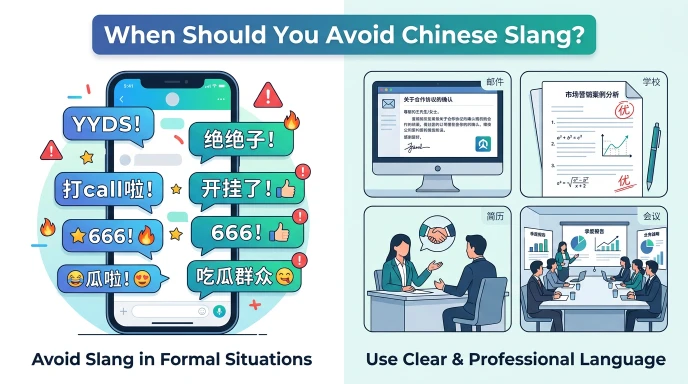
You should avoid slang when the situation requires formal or careful communication.
For example, use standard Chinese instead of slang when writing:
- Formal business emails
- Academic assignments
- Official documents
- Job applications
- Professional reports
- Formal presentations
- Communication with someone you do not know well
You also need caution with slang that carries an insult or offensive meaning.
If you are unsure about a term, learn its meaning and tone before using it.
What Are Polite Alternatives to Chinese Slang?
You do not always need slang to sound natural.
For formal situations, use standard Chinese expressions that communicate your meaning clearly.
For example, instead of a highly casual abbreviation, you can write the complete Chinese phrase.
This approach works better when your reader may not understand internet slang.
A simple rule helps:
Use slang with people who understand the context. Use standard Chinese when clarity and professionalism matter most.
Can Chinese Slang Have More Than One Meaning?
Yes. Context can change the meaning of Chinese slang.
绝绝子 provides a good example. People can use it to praise something as excellent, but they can also use it sarcastically to describe something terrible.
Tone also matters.
A short message may look positive when you read the words alone. However, the surrounding conversation may reveal sarcasm.
That is why you should not translate Chinese internet slang word by word.
Look at:
- The words around the slang
- The speaker’s tone
- The situation
- The platform
- The relationship between the speakers
These clues can reveal the intended meaning.
Are Chinese Slang Words Safe for Social Media?
Most harmless Chinese slang words are fine for casual social media use. Expressions such as 666, YYDS, 吃瓜, and 比心 can appear in informal online communication.
However, not every slang expression carries a friendly meaning.
Some terms insult people, while others contain profanity or controversial references. You should understand a term fully before using it publicly.
Also remember that slang changes quickly. A phrase that feels popular today may sound outdated later.
Chinese Slang Words vs. English Internet Slang
Chinese and English internet slang share several similarities.
Both languages use:
- Abbreviations
- Numbers
- Memes
- Short phrases
- Wordplay
- Gaming expressions
- Social media trends
- Humorous meanings
The main difference comes from the writing systems and language structure.
Chinese internet users often create abbreviations from pinyin initials. English speakers may shorten words or phrases directly.
For example:
Chinese: YYDS
English: GOAT
Both can praise someone as exceptionally good, although they come from different language systems.
Common Mistakes When Learning Chinese Slang
New learners often make a few mistakes when they first encounter Chinese internet language.
Translating Every Word Literally
A literal translation may sound strange or completely miss the slang meaning.
Using Slang Everywhere
A casual expression may not suit a formal email or school assignment.
Ignoring Tone
Some slang sounds funny among friends but rude in another situation.
Assuming Every Abbreviation Has One Meaning
Context can change how people understand an abbreviation.
Treating Internet Slang as Standard Chinese
Slang can help you understand real conversations, but you still need standard Chinese for formal communication.
FAQ’S
Q1. What are Chinese slang words?
Chinese slang words are informal expressions used in casual speech, texting, social media, online communities, gaming, and everyday communication.
Q2. What does YYDS mean in Chinese slang?
YYDS comes from 永远的神 (yǒngyuǎn de shén) and expresses strong praise for someone or something considered excellent.
Q3. What does 666 mean in Chinese slang?
666 usually means something like “impressive,” “skilled,” or “well done.” People often use it in gaming and online conversations.
Q4. What does 吃瓜 mean?
吃瓜 (chī guā) means watching drama, gossip, or an interesting event without getting involved.
Q5. Is Chinese slang appropriate in formal writing?
Usually, no. Formal Chinese works better for business, academic, official, and professional communication.
Q6. Why does Chinese internet slang change so quickly?
Online communities constantly create new jokes, abbreviations, memes, and expressions. Popular terms can spread quickly and later become less common.
Conclusion
Chinese slang words make online and casual Chinese more expressive and interesting. They can show praise, humor, emotion, sarcasm, frustration, or agreement in only a few characters.
Common examples include YYDS, 666, 吃瓜, 绝绝子, 破防, 内卷, 躺平, and 520. Some terms use pinyin abbreviations, while others rely on numbers, wordplay, or new meanings for familiar Chinese words.
The most important thing to remember is context. A slang word may sound friendly in a group chat but inappropriate in a formal setting. Some expressions can also carry offensive meanings.
If you want to understand modern Chinese conversations, learning common slang can help you follow social media posts, gaming chats, comments, memes, and casual conversations more naturally. Just learn the meaning, tone, and context before you use a new expression yourself.
Dig More About!
- Locked In Meaning Slang: What Does Locked In Mean?
- ATP Definition Slang: What Does ATP Mean in Text?
- LYK Meaning Slang: What Does LYK Mean?