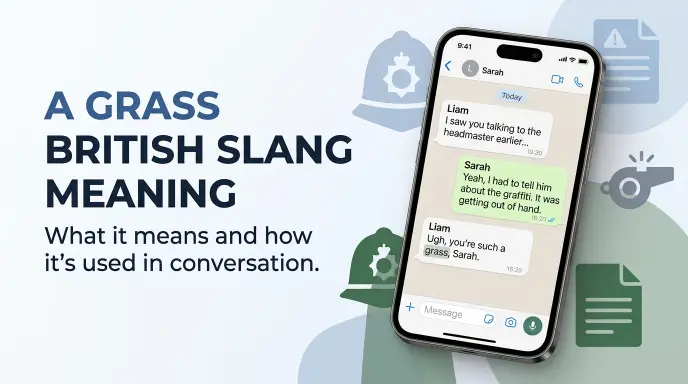
A grass British slang refers to a person who tells the police or another authority about someone else’s wrongdoing. In simple terms, a grass means a snitch, informer, or person who tells on someone. The word usually carries a negative tone in British English.
You may hear this word in British films, TV shows, everyday conversations, school settings, or online chats. You may also see phrases such as “Don’t grass on me” or “He grassed me up.” These phrases mean that someone told another person, often an authority figure, about something they did.
The word can sound serious in some situations and playful in others. Context matters. A child might call a classmate a grass for telling a teacher about a small rule break, while a crime story may use the word for someone who gives information to the police.
Quick Answer
- In British slang, a grass means someone who tells the police, teachers, or another authority about someone else’s actions. It is similar to snitch, informer, rat, or telltale, and it usually sounds negative.
What Does “A Grass” Mean in British Slang?
A grass is a person who tells on someone else. The term often refers to someone who gives information to the police, especially about criminal activity. British dictionaries mark this meaning as informal and disapproving.
For example:
“He’s a grass.”
This means:
“He tells the police or other authorities about people.”
The word can also appear in less serious situations. Someone might call another person a grass after they report a rule break to a teacher, parent, boss, or other authority figure.
The key idea stays the same: one person tells an authority figure about another person’s actions.
A Grass Meaning in Text
When you see “grass” in a British text message, the meaning depends on the conversation.
For example:
“Don’t be a grass.”
This usually means:
“Don’t tell on me.”
Another example:
“Who grassed me up?”
This means:
“Who told someone about what I did?”
The word often suggests that the speaker feels betrayed. However, friends may also use it jokingly.
For example:
“You told Mum I ate the last biscuit? You grass!”
That situation has a much lighter tone than a conversation about someone reporting a serious crime.
What Does “Grass” Stand For?
Grass does not stand for a longer phrase or acronym. It works as a slang noun and verb.
As a noun:
“He’s a grass.”
Here, grass means an informer or snitch.
As a verb:
“He grassed on his mate.”
Here, grassed means told on his friend.
You may also hear:
- grass on someone
- grass someone up
- grass someone
- grassed
- grassing
- grasser
- supergrass
These forms share the same basic idea.
The Verb “To Grass”

British speakers can use grass as a verb when someone reports another person to the police or another authority. Collins gives the pattern “grass on someone” and also lists “grass up” with the same general meaning.
Example
“He grassed on his friends.”
This means:
“He told the authorities about his friends.”
You can also say:
“She grassed him up.”
That means:
“She told someone in authority about him.”
The verb often carries a strong sense of betrayal.
What Does “Grass Someone Up” Mean?
“Grass someone up” means to tell an authority figure about something that person has done. In British English, the phrase often refers to police or other authorities.
For example:
“Don’t grass me up to the teacher.”
This means:
“Don’t tell the teacher what I did.”
Another example:
“Someone grassed him up to the police.”
This means:
“Someone gave the police information about him.”
The phrase sounds informal, so you will usually hear it in casual speech rather than formal writing.
Is “Grass” Rude, Offensive, or Neutral?
Grass usually sounds negative and can work as an insult. Cambridge describes the slang noun as a person who tells the police about other criminals, while Collins labels the usage informal and disapproving.
Still, the strength of the word depends on context.
Light use
A child might say:
“You’re such a grass!”
They may simply mean:
“You told the teacher!”
That use can sound childish or playful.
Stronger use
Someone involved in criminal activity may use grass for a person who gives information to the police.
That situation can carry much more weight.
So, the word does not always have the same level of seriousness. Context and tone matter.
Where Is “Grass” Commonly Used?
The term has strong roots in British informal speech. You may hear it in:
- Everyday UK conversations
- Text messages
- British TV shows
- Crime dramas
- Films
- School conversations
- Online British communities
- Social media discussions
- Gaming chats with British users
You do not need to belong to a criminal group to understand or use the word. British speakers can use it in ordinary situations when someone tells on another person.
For example:
“My little brother grassed me up to Mum.”
That sentence does not suggest serious crime. It simply means the brother told their mother about something.
RealLife Examples of “A Grass”
The tone changes with the situation. These examples show how British speakers can use the term.
Friendly or Playful
“You told Sarah about the surprise? You’re a grass!”
The speaker may say this jokingly.
Casual
“Don’t grass on me. I’ll clean it up.”
Here, the speaker asks someone not to report them.
School Context
“Tom told the teacher about the broken window. Everyone called him a grass.”
This example uses the word for someone who reports another person.
Family Context
“My sister grassed me up to Dad.”
This means the sister told Dad about something the speaker did.
Serious Context
“The gang thought he was a grass because he spoke to the police.”
Here, the word has a much more serious meaning.
Gaming or Online Chat
“Who grassed us up to the admin?”
In this context, grass can describe someone who reports another player or group member to an administrator.
Origin and History of “Grass” in British Slang
The exact origin of grass in this slang sense remains debated. Reliable language sources agree on the meaning, but the etymology does not have one completely certain explanation.
One widely discussed theory connects grass to Cockney rhyming slang.
The proposed chain involves “grasshopper,” which had a rhyming connection with “copper,” an old British slang term for a police officer. Another explanation connects the term with “shop” or “shopper,” because to shop developed a slang meaning related to informing on someone.
The evidence does not support presenting one simple origin as proven fact.
Historical sources show that grass had the informer meaning by the early 20th century. A languagehistory source notes that the noun appears in print in the 1920s, with the verb appearing a few years later.
That makes one thing clear: this meaning has a long history in British slang.
What Is a “Supergrass”?
A supergrass refers to a particularly important informer, especially one who gives evidence against several people in a serious criminal case.
The term became especially well known in Britain during the 1970s. Journalists used it for major informers who gave evidence against former associates.
For everyday conversation, however, you usually do not need the word supergrass.
Grass works as the general slang term for an informer.
Grass vs. Snitch vs. Rat
Several English slang words have a similar meaning, but their regional use differs.
| Term | Main meaning | Common association | Tone |
| Grass | Person who tells on someone | British English | Negative |
| Snitch | Person who tells on someone | Common in American English and online | Negative |
| Rat | Person seen as a traitor or informer | General informal English | Strongly negative |
| Telltale | Person who reports another person | Children or everyday situations | Mild |
| Informer | Person who gives information to authorities | Formal/general English | More neutral |
Grass has a particularly strong British identity. Cambridge specifically labels this meaning as UK slang.
Is “Grass” the Same as “Snitch”?
The meanings overlap, but the words have different regional associations.
British speakers often use grass where an American speaker might choose snitch.
For example:
British:
“Don’t be a grass.”
American:
“Don’t be a snitch.”
Both sentences tell someone not to report another person.
Still, real speakers may choose different words depending on their country, age, social group, and personal style.
When Should You Avoid Using “Grass”?
You should avoid calling someone a grass when you do not know the relationship or context.
The word can sound insulting because it suggests disloyalty.
Avoid it especially when:
- You are speaking in a formal setting.
- You are talking to someone you do not know well.
- You are discussing a serious legal matter.
- You do not know if the person reported something for safety reasons.
- The person may interpret the label as a serious accusation.
For example, calling someone a grass because they reported dangerous behavior may unfairly attack them.
A person can report wrongdoing for many reasons. The slang term adds a judgment about their loyalty.
Polite Alternatives to “Grass”
If you want a neutral description, choose a more formal word.
You can say:
- Informer
- Person who reported it
- Someone who told the authorities
- Someone who reported the incident
- Witness
- Reporter
These alternatives do not carry the same insulting tone.
For example:
Slang:
“He’s a grass.”
Neutral:
“He reported the incident to the police.”
The second sentence gives the information without judging the person.
Why Do People Use “Grass”?
People use grass because it quickly communicates a social judgment.
Calling someone a grass can suggest:
- They told on someone.
- They broke an informal code of silence.
- They betrayed someone’s trust.
- They gave information to an authority.
- The speaker dislikes their decision.
In casual speech, one word can communicate all of these ideas.
That emotional meaning explains why grass often sounds stronger than simply saying “reported.”
Common Misunderstandings About “Grass”
Grass does not always mean marijuana
In some Englishspeaking contexts, grass also means marijuana. MerriamWebster lists that separate slang meaning.
However, a grass in British slang usually refers to an informer when the sentence describes a person.
For example:
“He’s a grass.”
This normally means he is an informer or snitch in British slang.
Context tells you which meaning fits.
Grass does not always mean a police informer
The word can describe someone who tells a teacher, parent, boss, or another authority figure.
For example:
“She grassed me up to my teacher.”
The situation does not involve police.
The common idea remains telling on someone.
Is “Grass” Safe to Use on Social Media?
Yes, the word itself does not create a safety problem. However, grass can sound insulting or aggressive, especially when someone uses it during an argument.
On TikTok, Instagram, Reddit, Discord, or other platforms, the meaning usually depends on the surrounding conversation.
For example:
“Bro, you’re a grass 😂”
may sound playful among friends.
But:
“You’re a grass. Everyone knows you told the police.”
has a much more serious tone.
If you use the word online, consider the audience and context before calling someone a grass.
Can You Use “Grass” at Work?
Grass is usually too informal for professional communication.
In a workplace, use clearer language such as:
- “reported the issue”
- “informed the manager”
- “raised a concern”
- “reported the incident”
For example:
Informal:
“Sarah grassed on him.”
Professional:
“Sarah reported the issue to the manager.”
The second version sounds more neutral and appropriate for workplace communication.
FAQ’S
Q1:What does “a grass” mean in British slang?
A grass means a person who tells the police or another authority about someone else’s wrongdoing. It often means snitch or informer.
Q2:Is calling someone a grass an insult?
Usually, yes. The word often suggests that the person betrayed someone by giving information to an authority.
Q3:What does “grass someone up” mean?
Grass someone up means to tell an authority figure about something that person did. British speakers often use it in informal conversation.
Q4:Is grass British slang?
Yes. Grass has a wellestablished British slang meaning for an informer or snitch. Cambridge and Collins both identify this usage as British slang.
Q5:Where did the slang word grass come from?
The exact origin remains uncertain. One major theory connects it with Cockney rhyming slang and grasshopper, while other explanations have also appeared. Reliable language sources do not treat one simple explanation as completely proven.
Q6:Is grass the same as snitch?
They have very similar meanings. Grass has a strong British association, while snitch appears widely in American English and online speech.
Conclusion
A grass British slang means a person who tells the police or another authority about someone else’s actions. In everyday British speech, it can mean snitch, informer, or telltale, depending on the situation.
The word can sound playful when friends use it over a small issue. It can also sound serious when someone talks about police or criminal activity. That difference makes context important.
You may also hear “grass on,” “grass someone up,” or “grassed up.” These forms describe the act of telling on someone.
The word has a long history in British slang, but its exact origin remains uncertain. The most discussed explanations involve older British slang and Cockney rhyming slang.
If you need a neutral phrase, use “reported,” “informed,” or “told the authorities.” Save grass for casual situations where you understand the tone and audience.
Dig More About!
- What Does ATM Stand for Slang?
- Rico Slang Meaning in Text: What Does Rico Mean?
- Yayo Slang Meaning: What Does Yayo Mean in Text?