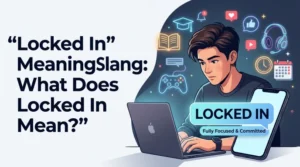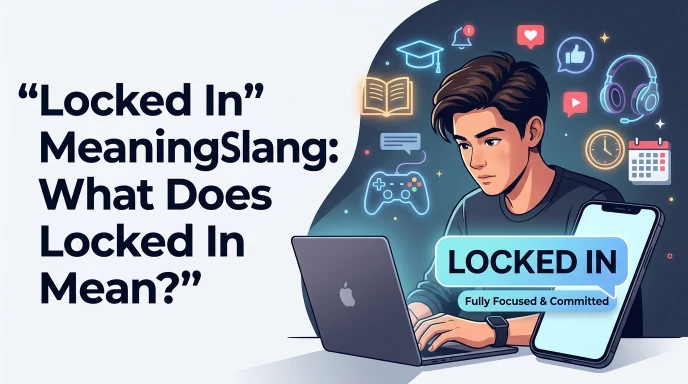
Locked in meaning slang refers to being fully focused, serious, and committed to something. When someone says, “I’m locked in,” they usually mean they have stopped getting distracted and are giving their full attention to a task, goal, game, workout, or challenge.
You may see locked in in texts, TikTok videos, Instagram posts, gaming chats, sports discussions, and study content. People often use it when they want to show determination or describe someone who performs with strong focus.
For example, a student might say, “I’m locked in for finals.” This means the student plans to focus seriously on studying.
The phrase can also describe someone who performs extremely well. A friend might say, “She was locked in during the whole game.” That means she stayed focused and played with strong concentration.
In this guide, you will learn the locked in meaning slang, where it came from, how people use it, whether it sounds rude, and when you should use or avoid it.
Quick Answer
- “Locked in” means fully focused, committed, or mentally prepared for something. People use it when they want to show that they are taking a task, goal, game, workout, or challenge seriously and are blocking out distractions.
What Does “Locked In” Mean in Slang?
In slang, locked in means being deeply focused on something.
Think of it as a mental switch from casual to serious.
Someone may spend the first part of the day scrolling, talking, or relaxing. Then they decide it is time to work. They put their phone away, concentrate, and start giving the task their full attention.
They can say:
“Okay, I’m locked in now.”
This means:
“I’m ready to focus and take this seriously.”
The phrase can describe a person, a group, or even a short period of intense effort.
For example:
- “I’m locked in for my exam.”
- “We need to lock in for this game.”
- “She has been locked in all week.”
- “He finally locked in and finished the project.”
- “I’m locked in at the gym today.”
The common idea stays the same: strong focus and commitment.
What Does “Locked In” Mean in Text?
In text messages, locked in usually means fully focused or committed.
Someone may text:
“Can’t talk right now. I’m locked in.”
They mean they need to concentrate on what they are doing.
Another person might send:
“I’m locking in tonight.”
This means they plan to focus hard during the evening.
The phrase can also describe another person’s performance:
“You were locked in during that match.”
Here, the speaker praises the person’s focus and performance.
Common texting meanings
| Phrase | Meaning |
| “I’m locked in” | I am fully focused |
| “I need to lock in” | I need to start focusing |
| “Lock in” | Focus and take it seriously |
| “He’s locked in” | He is highly focused |
| “We’re locked in” | We are committed and focused |
Does “Locked In” Have More Than One Meaning?
Yes. The slang phrase has a few related uses, but they all connect to focus, commitment, or strong involvement.
1. Fully Focused
This is the main modern slang meaning.
Someone who is locked in gives strong attention to a task or activity.
Example:
“I’m locked in for my chemistry exam.”
The person means they are ready to study seriously.
2. Performing Extremely Well
People can also call someone locked in when that person performs at a very high level.
Example:
“He was locked in during the second half.”
This means he stayed highly focused and performed well.
Sports and gaming provide natural examples of this use. Slang references commonly describe “locked in” as a state where distractions fall away and someone concentrates strongly on what they are doing.
3. Fully Committed
Locked in can also describe strong commitment.
For example:
“I’m locked in on this goal.”
This means the person intends to stay committed and keep working toward the goal.
The meaning can move beyond simple attention. It can show determination and dedication.
Where Is “Locked In” Commonly Used?
You can find locked in across many casual settings.
It appears in:
- Text messages
- TikTok
- Discord
- Gaming chats
- Sports conversations
- Study communities
- Gym content
- Self-improvement posts
- Everyday conversations
The phrase became especially visible in online meme culture and short-form content. Viral “lock in” memes and motivational posts helped push the expression into wider internet use during the 2020s.
Locked In on TikTok
TikTok users often use the phrase in videos about studying, working out, sports, productivity, and personal goals.
For example:
“Finals are next week. Time to lock in.”
The speaker means it is time to stop wasting time and focus on studying.
Locked In on Instagram
You may see captions such as:
“New month. New goals. Locked in.”
Here, the phrase signals commitment and determination.
Locked In on Discord
Gamers may use it when a match becomes serious:
“We’re down by one. Lock in!”
The speaker tells the team to focus and play carefully.
Locked In on Reddit
A Reddit user might write:
“I’m locked in until I finish this project.”
The phrase sounds casual and shows strong commitment.
Is “Locked In” Rude or Offensive?
No. “Locked in” is normally harmless and neutral.
It does not contain an offensive meaning.
However, the command “lock in” can sound slightly blunt when someone tells another person to focus.
For example:
“Bro, lock in.”
Depending on the relationship, this could sound:
- Motivational
- Playful
- Teasing
- Slightly critical
It usually does not sound seriously insulting.
The phrase becomes sharper when someone uses it to criticize another person’s lack of effort.
For example:
“Stop messing around and lock in.”
That sounds more direct than:
“Come on, let’s lock in.”
So, tone matters.
Is “Locked In” Positive or Negative?
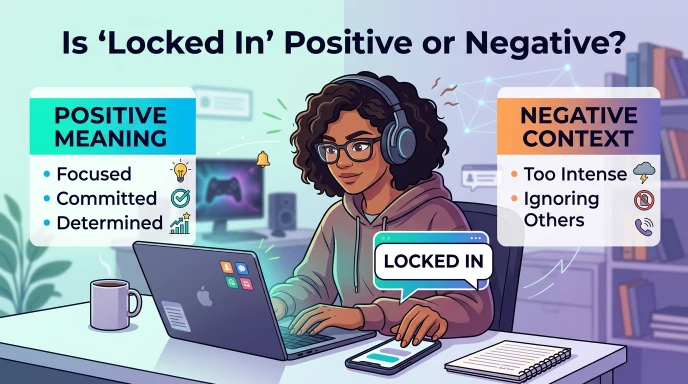
Most uses are positive or neutral.
People often use it to praise focus, discipline, effort, or performance.
Positive example
“You were completely locked in during that presentation.”
This praises the person’s concentration.
Neutral example
“I’m locked in until Friday.”
The speaker simply describes their current focus.
Slightly negative example
“You need to lock in.”
This can suggest that someone is distracted or not taking something seriously.
The phrase itself does not create the negative tone. The speaker’s wording and situation do that.
Real Life Examples of “Locked In”
Here are natural examples from different situations.
1. Studying
Friend 1: Want to hang out tonight?
Friend 2: Maybe tomorrow. I’m locked in for my exam.
Meaning: I need to focus on studying.
2. Gaming
Player 1: We can still win this.
Player 2: Everyone lock in!
Meaning: Everyone needs to focus and play seriously.
3. Gym
“I’m locked in at the gym this month.”
Meaning: I am fully committed to my fitness routine.
4. Work
“I need to lock in and finish this report.”
Meaning: I need to concentrate and complete the report.
5. Sports
“The team was locked in during the final quarter.”
Meaning: The team stayed focused and played with strong concentration.
6. Social Media
“No distractions. I’m locked in.”
Meaning: I am focusing on my goal and avoiding distractions.
7. Friendly Conversation
Friend 1: You actually finished everything already?
Friend 2: Yep. I locked in for three hours.
Meaning: I focused hard for three hours and got the work done.
“Lock In” vs. “Locked In”
These expressions have a small grammar difference.
Lock in usually works as the action or command.
“I need to lock in.”
Locked in describes a person’s current state.
“I’m locked in.”
Simple comparison
| Phrase | Use | Example |
| Lock in | Action or command | “It’s time to lock in.” |
| Locked in | Current state | “I’m locked in.” |
| Locking in | Action in progress | “I’m locking in tonight.” |
All three relate to the same basic idea.
Why Do People Use “Locked In”?
People use locked in because it expresses more than simple attention.
If someone says:
“I’m working.”
they only tell you what they are doing.
If they say:
“I’m locked in.”
they also communicate serious focus and commitment.
The phrase can create a stronger sense of determination.
It works especially well when someone has a clear goal.
For example:
“I’m locked in until I finish this project.”
This tells the reader that the person plans to stay focused instead of getting distracted.
The phrase also fits short social media captions because it communicates a strong idea in only two words.
Where Did “Locked In” Come From?
The modern slang use of locked in did not suddenly begin on TikTok.
The exact origin remains uncertain. A 2009 Urban Dictionary entry already used “lock in” for intense focus, and documented posts from the early 2010s also show people using the phrase in this sense. That evidence suggests that the modern slang meaning existed online before its recent viral rise.
Some sources connect the phrase with AAVE, but the evidence does not establish a single confirmed origin or a specific person who coined it. It is safer to describe that connection as a reported influence rather than a settled fact.
The phrase became much more visible during the 2020s.
In 2023, “lock in” memes spread widely online. These memes often showed a person becoming suddenly serious or focused after being distracted.
The expression continued to grow through TikTok, gaming, sports, study content, gym content, and self-improvement communities.
By 2024, the American Dialect Society selected “lock in” as its Most Useful term for 2024, defining it around entering a state of deep focus and concentration.
That history matters because it shows that TikTok helped popularize the phrase but did not necessarily invent it.
Is “Locked In” Still Popular?
Yes. The phrase remains widely recognizable in online slang and casual speech.
Its popularity grew strongly through TikTok, memes, gaming, sports, study content, and self-improvement culture. The Great Lock In trend of 2025 also gave the phrase another major boost.
However, slang can change quickly. Some people may use “locked in” seriously, while others may use it as a joke or meme.
For example:
“I’m locked in.”
could mean genuine concentration.
But someone might also post:
“Locked in for my 10-minute workout.”
as a joke about a very small amount of effort.
So, always consider the tone of the post.
“Locked In” vs. Similar Slang
Several expressions have a similar meaning, but they are not identical.
| Slang | Meaning | Main Difference |
| Locked in | Fully focused or committed | Strong focus and dedication |
| In the zone | Deeply focused | Often describes peak performance |
| Dialed in | Highly focused | Similar to locked in |
| Grinding | Working hard for a goal | Emphasizes repeated effort |
| Lock in | Start focusing seriously | Often works as a command |
| On lock | Secure or under control | Usually means something is certain or secured |
For example, someone can be grinding without feeling especially focused.
Someone who is locked in usually shows a stronger sense of mental commitment.
Is “Locked In” Appropriate at Work?
Yes, but context matters.
In casual workplace conversations, “locked in” can sound natural.
For example:
“I’m locked in on this report today.”
That works in an informal team chat.
However, a formal email to a client should use clearer professional language.
Instead of:
“We’re locked in on the project.”
you might write:
“We are fully focused on the project.”
The slang phrase can work among coworkers who use casual language, but professional communication often benefits from direct standard English.
Best choice by setting
| Setting | Recommendation |
| Friends | ✅ Fine |
| Texting | ✅ Fine |
| TikTok | ✅ Fine |
| Gaming | ✅ Very common |
| Sports | ✅ Natural |
| Casual team chat | ✅ Usually fine |
| Formal email | ⚠️ Use standard English |
| Academic writing | ❌ Avoid slang |
| Job application | ❌ Avoid slang |
When Should You Avoid Using “Locked In”?
You should avoid the slang form when your audience expects formal or traditional English.
Avoid it in:
- Academic essays
- Job applications
- Formal reports
- Official documents
- Formal business letters
- Professional presentations for unfamiliar audiences
You should also avoid telling someone to “lock in” when you do not know how they may react to a blunt command.
For example:
“You need to lock in.”
can sound critical.
A softer alternative is:
“Let’s focus on this part first.”
The second sentence sounds more cooperative.
Polite Alternatives to “Lock In”
If you want a more professional or polite expression, try:
- Let’s focus.
- Let’s concentrate on this.
- Let’s stay focused.
- Let’s get serious about this.
- Let’s give this our full attention.
- I’m going to focus on this now.
- I’m fully committed to this goal.
The best choice depends on your audience.
For friends, “lock in” sounds natural.
For teachers, clients, managers, or formal situations, a standard phrase usually works better.
Common Misunderstandings About “Locked In”
One common misunderstanding is that locked in means physically trapped.
The phrase can have a literal meaning in normal English. For example:
“The door is locked, and we are locked in.”
That means people cannot leave.
The slang meaning works differently:
“I’m locked in for finals.”
Here, nobody is physically trapped. The speaker means they are highly focused.
Another misunderstanding involves the phrase’s origin.
Some people assume that TikTok created the slang. Current evidence points to earlier online uses, including a dated 2009 Urban Dictionary entry and early-2010s social media examples. TikTok and meme culture later helped make the phrase much more mainstream.
FAQ’S
Q1. What does “locked in” mean in slang?
Locked in means fully focused, committed, or serious about something. People often use it for studying, sports, gaming, work, fitness, and personal goals.
Q2. What does “I’m locked in” mean?
“I’m locked in” means “I’m fully focused and committed.” It can also suggest that the person plans to ignore distractions.
Q3. What does “lock in” mean on TikTok?
On TikTok, lock in usually means to focus seriously on a task, goal, workout, study session, or challenge. Memes and motivational videos helped spread the phrase widely.
Q4. Is “locked in” a compliment?
It can be. Saying someone is locked in often praises their focus, effort, or performance.
Q5. Is “lock in” rude?
Not usually. However, “lock in” can sound slightly blunt when someone uses it as a command. Tone and the relationship between the speakers matter.
Q6. Is “locked in” appropriate at work?
It can work in casual workplace chats, but formal emails and documents should use phrases such as “fully focused” or “fully committed.”
Q7. Is “locked in” Gen Z slang?
It is strongly associated with modern Gen Z and Gen Alpha internet culture, but the focus-related phrase predates the current generations’ viral use. Documented online examples go back to at least the late 2000s and early 2010s.
Q8. What is the opposite of being locked in?
The opposite can mean being distracted, unfocused, distracted by other things, or not taking the task seriously. Online slang may use different words depending on the situation.
Conclusion
The locked in meaning slang is simple: it means fully focused, serious, or committed to something.
People use the phrase when they want to show that they have entered a strong focus mode. You may hear it during gaming, sports, studying, workouts, work projects, or conversations about personal goals.
The phrase can also describe someone who performs very well:
“She was locked in today.”
That means she stayed focused and performed strongly.
Although TikTok and meme culture helped make locked in much more popular, the modern slang use appeared online years before its recent viral growth. Evidence points to documented uses from at least 2009 and the early 2010s, while memes helped push it into mainstream internet culture during the 2020s.
For casual conversations, locked in works well. In formal writing, phrases such as “fully focused” or “fully committed” usually sound better.
The easiest way to remember it: when someone is “locked in,” they have stopped drifting and started giving something their full attention.
Dig More About!
- ATP Definition Slang: What Does ATP Mean in Text?
- LYK Meaning Slang: What Does LYK Mean?
- Mérida Meaning Spanish Slang: What Does Mérida Mean?