TM in text usually means “trust me” or “trademark,” depending on the conversation. People may use it in text messages, on TikTok, Snapchat, Instagram, and other social platforms. The exact meaning depends on the words around it and the topic being discussed.
If someone sends you “tm,” they might be using a short form to save time while chatting. However, if you see the symbol next to a brand name, it refers to a trademark.
Understanding the context helps you figure out which meaning fits the message. In this guide, you’ll learn the common meanings of TM, how people use it online, real chat examples, and how to reply when someone sends it to you.
TM Meaning in Text
The meaning of TM in text depends on the conversation. It can stand for different words in casual chats, and it also has a well known meaning in branding.
Here are the meanings you may come across:
- Tomorrow: Some people use “tm” as a quick abbreviation for tomorrow, especially when discussing plans.
- Trust me: In some informal conversations, people use “tm” as shorthand for trust me. This meaning is less standardized, so context matters.
- Trademark: The symbol identifies a trademark associated with a name, logo, slogan, or product.
- Text message: In some contexts, TM may refer to a text message, although “text” or “SMS” may be clearer.
These meanings are not equally common in every community. For example, if someone writes “see you tm,” they probably mean “see you tomorrow.” If a company places beside its name, it refers to a trademark.
Is TM Slang, an Acronym, or an Abbreviation?
TM is usually an abbreviation or initialism, rather than a slang word with one fixed meaning.
People often shorten words when they type on their phones. This helps them send messages quickly without writing every word in full.
The meaning also depends on capitalization and punctuation. In everyday chats, people may type “tm,” “TM,” or “tmrw” when referring to tomorrow. In branding, the symbol has a more specific purpose.
Why Do People Write TM Instead of the Full Word?
Online conversations move quickly. People often use short forms to save time, especially when making plans or replying to friends.
For example:
- “Call me tm” means “Call me tomorrow.”
- “We can finish it tm” means “We can finish it tomorrow.”
- “This is our new brand name” uses the trademark symbol to identify the name as a trademark.
Still, not everyone uses the same abbreviations. If the message is unclear, asking the sender what they mean is perfectly fine.
Where People Use TM
People use short forms across many messaging apps and social platforms. However, the meaning of TM can change depending on the platform and the conversation.
TM on TikTok
On TikTok, people may use abbreviations in comments, captions, and direct messages. If someone writes “I’ll post it tm,” they likely mean they will post it tomorrow.
For example:
Comment: “Part 2 coming tm!”
Meaning: Part two is coming tomorrow.
The platform itself does not give TM one universal slang meaning. Always read the full caption or comment before deciding what the letters mean.
TM on Snapchat
Snapchat conversations often include short replies, abbreviations, and casual language. Someone might use TM when discussing plans with a friend.
For example:
Friend: “Are we still meeting tm?”
Meaning: Are we still meeting tomorrow?
If the conversation is about a brand, a product, or a logo, TM could have a different meaning. The surrounding messages usually provide the best clue.
TM on Instagram
On Instagram, TM may appear in comments, captions, Stories, or direct messages.
For example:
Message: “I’ll send you the photos tm.”
Meaning: I’ll send you the photos tomorrow.
You may also see the trademark symbol in a business profile, promotional post, or product announcement. In that situation, it relates to a brand or name rather than a casual conversation.
TM on WhatsApp
WhatsApp users often shorten words when chatting with friends, relatives, or colleagues. Someone might write “talk tm” instead of “talk tomorrow.”
For example:
Message: “I’m busy today. Let’s talk tm.”
Meaning: I’m busy today. Let’s talk tomorrow.
However, not everyone understands every abbreviation. If you are messaging someone who prefers standard English, writing “tomorrow” in full can make your meaning clearer.
TM in SMS and Regular Text Messages
In regular SMS messages, TM can also be used as a shortcut when arranging plans.
For example:
Message: “I’ll pick you up tm at 10.”
Meaning: I’ll pick you up tomorrow at 10.
In professional messages, it is usually better to write the full word. That reduces confusion, especially when discussing appointments, deadlines, or important arrangements.
Real Chat Examples of TM
The easiest way to understand TM is to see how it might appear in a real conversation. These examples show common contexts, especially when TM stands for tomorrow.
Making Plans
A: Are you free tomorrow?
B: Yes, I’m free tm.
A: Great, let’s meet after lunch.
Meaning: B uses “tm” as a short form of tomorrow.
Schoolwork
A: When is the assignment due?
B: We have to submit it tm.
A: Okay, I’ll finish mine tonight.
Meaning: The assignment is due tomorrow.
Talking to a Friend
A: Want to play a game later?
B: Can’t today. Maybe tm?
A: Sure, just message me.
Meaning: B suggests playing tomorrow.
Social Media Post
A: When are you uploading the next video?
B: Probably tm!
A: I’ll keep an eye out.
Meaning: The person expects to upload the video tomorrow.
Family Conversation
A: Can you bring my book home?
B: I’ll bring it tm.
A: Thanks!
Meaning: The person will bring the book tomorrow.
Work Chat
A: Can you review this document?
B: I’ll look at it tm morning.
A: Sounds good. Thank you.
Meaning: The review will happen tomorrow morning. In a formal workplace, writing “tomorrow” in full may be clearer.
Making an Appointment
A: Did you book the appointment?
B: Not yet. I’ll call them tm.
A: Okay, let me know what they say.
Meaning: B plans to make the call tomorrow.
A Casual Reminder
A: Don’t forget to return my charger.
B: I won’t. I’ll bring it tm.
A: Perfect!
Meaning: B will return the charger tomorrow.
An Unclear Abbreviation
A: What did you mean by tm?
B: I meant tomorrow.
A: Oh, got it!
Meaning: The sender explains the abbreviation because the recipient did not understand it.
Brand or Business Context
A: Why is there a next to the product name?
B: It indicates that the name is being identified as a trademark.
A: Oh, that makes sense.
Meaning: Here, TM refers to the trademark symbol, not tomorrow.
These examples show why context matters. Most of the casual examples above use TM to mean tomorrow, while the last example uses the formal trademark meaning.
How to Reply When Someone Says TM
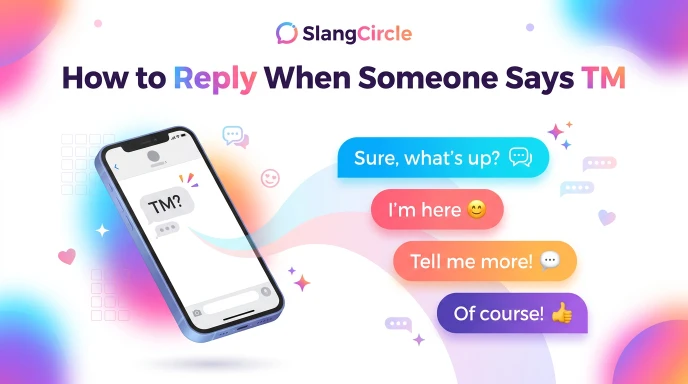
Your reply depends on what the sender means. If they use TM to mean tomorrow, you can answer naturally without mentioning the abbreviation itself.
Funny Replies
Use these replies when you are chatting with a friend who enjoys jokes.
- “Tomorrow it is, then!”
- “Okay, I’ll wait patiently… maybe.”
- “Tomorrow better not turn into next week!”
- “Deal, see you in the future!”
These responses work best in relaxed conversations. Avoid jokes if the other person is discussing something serious.
Casual Replies
If you understand the message, a short answer is usually enough.
- “Okay, sounds good.”
- “Sure, see you tomorrow.”
- “Alright, that works.”
- “Cool, talk then.”
These replies are useful when someone is arranging plans or telling you when they will do something.
Friendly Replies
If you want to sound warm and interested, try one of these:
- “Perfect! Looking forward to it.”
- “Sure, just let me know.”
- “Great, see you tomorrow!”
- “No problem at all.”
A friendly response keeps the conversation moving without making a simple abbreviation feel complicated.
Neutral Replies
For a conversation with a classmate, colleague, or someone you do not know very well, neutral replies may fit better.
- “Okay, thank you.”
- “Understood.”
- “That works for me.”
- “I’ll keep that in mind.”
If you cannot work out the intended meaning, ask a direct question instead.
For example: “Just checking, do you mean tomorrow by TM?”
This avoids misunderstandings and helps you respond correctly.
Is TM Rude or Offensive?
No, TM is not generally considered rude or offensive. When it means tomorrow, it is simply a convenient abbreviation. When it refers to a trademark, it has a separate business related meaning.
Still, the tone of a message depends on the full sentence and the relationship between the people communicating.
Is TM Safe to Use With Friends?
Yes, using TM with friends is generally fine if they understand the abbreviation.
For example, “See you tm!” is a casual way to say goodbye when you expect to meet the next day.
However, some people may not recognize the abbreviation. If the other person seems confused, spell out the word.
Is TM Appropriate at School?
In a casual message to a classmate, TM can work well.
For example, “Are we meeting tm to study?” is understandable to someone familiar with the abbreviation.
For assignments, essays, presentations, or messages to teachers, use complete words instead. Formal writing usually benefits from clear and standard language.
Is TM Appropriate at Work?
That depends on your workplace and the message.
Coworkers who regularly use abbreviations may understand TM without any problem. However, emails to clients, managers, or new contacts should use “tomorrow” in full.
For example, instead of writing “I’ll send the report tm,” write “I’ll send the report tomorrow.”
This small change makes the message more professional and easier to understand.
Who Uses TM?
TM can appear in conversations among people of different ages. Its use depends more on the person’s habits, platform, and communication style than on their age.
Do Gen Z Users Say TM?
Gen Z users often use short forms and abbreviations in digital conversations. They may shorten words to make messages quicker and more casual.
However, there is no single abbreviation that every Gen Z user understands or uses. Some people write “tm,” while others prefer “tomorrow,” “tmrw,” or another familiar short form.
It is best to treat TM as a context dependent abbreviation rather than a slang term used by everyone.
Do Teenagers and Adults Use TM?
Both teenagers and adults may use TM when chatting about plans, deadlines, or appointments. People who regularly send quick messages may prefer shorter forms, while others choose complete words.
For example, a student might text “See you tm at school,” while an adult might write “I’ll call you tomorrow.”
Both messages communicate the same idea.
Where Is TM Most Likely to Appear?
You may encounter TM in:
- Text messages between friends.
- WhatsApp conversations about plans.
- Snapchat messages and Instagram DMs.
- TikTok comments and captions.
- Informal group chats.
- Business names and product branding, where has a trademark meaning.
There is no reliable universal figure for how frequently people use TM as slang. Its meaning and popularity can vary across online communities.
Origin of TM
TM does not have one confirmed origin as an internet slang term with a single meaning. The letters have different uses, and each meaning has a different background.
The Use of TM for Tomorrow
People have shortened words in written communication for a long time. Text messaging made short forms especially convenient because people often wanted to type quickly using mobile phones.
Abbreviations such as “tm,” “tmrw,” and “tom” may appear in informal conversations about future plans. However, these forms are not identical, and their use varies from person to person.
It is difficult to identify one person, website, or platform that first used TM to mean tomorrow.
The Origin of the Trademark Symbol
The symbol has a more established role in branding. Businesses use it to identify a word, phrase, logo, or other mark as a trademark.
In general, the symbol signals a claim to a trademark. Its use does not, by itself, prove that the mark has been registered. The registered trademark symbol, ®, has a different legal significance.
For example, a business might display its brand name followed by to identify the name as a trademark.
Did TikTok Create the Meaning of TM?
There is no clear evidence that TikTok created TM or established one universal slang meaning for it.
Social media can spread abbreviations quickly, but a term appearing in a popular comment does not prove that the platform invented it.
The safest approach is to look at the sentence, the topic, and the people involved before deciding what TM means.
TM vs. IDK, IDC, IMO, and BRB
TM belongs to the wider world of online abbreviations. However, unlike IDK, IDC, IMO, and BRB, TM can have several different meanings depending on context.
The table below compares these common short forms.
| Term | Meaning | Type | Usage | Popularity |
| TM | Often tomorrow in informal chats; also trademark | Context dependent abbreviation or symbol | Plans, messages, branding | Varies by meaning |
| IDK | I don’t know | Initialism | Expressing uncertainty | Widely recognized |
| IDC | I don’t care | Initialism | Expressing indifference | Widely recognized |
| IMO | In my opinion | Initialism | Sharing an opinion | Widely recognized |
| BRB | Be right back | Initialism | Briefly leaving a conversation | Widely recognized |
What Makes TM Different?
IDK, IDC, IMO, and BRB each have a commonly recognized meaning in online conversations. TM is less predictable because the letters can refer to different things.
For example:
- “I’ll see you tm” most likely means tomorrow.
- “IDK what happened” means the person does not know what happened.
- “IDC about the result” expresses indifference.
- “IMO, this is the best option” introduces an opinion.
- “BRB, getting water” means the person will return shortly.
If you remember one thing, remember that TM needs more context than many familiar texting abbreviations.
Real World Usage Example
Imagine that two classmates are planning a study session before an exam.
One student sends a message:
Maya: “Are you coming to the library today?”
Alex: “Can’t today. I’ll come tm.”
Maya: “Okay, let’s meet at 10 in the morning.”
In this conversation, Alex uses TM to mean tomorrow. Maya understands the abbreviation and makes a plan for the following day.
Now imagine a different situation. Alex is helping Maya design a logo for a small online shop. Maya notices a symbol beside a brand name and asks what it means.
In that case, the symbol identifies the name as a trademark. It has nothing to do with tomorrow.
These examples show why you should consider the subject of the conversation before interpreting TM. The same letters can communicate different ideas in different situations.
FAQ’s
Q1. What does TM mean in text messages?
TM can mean tomorrow in informal text messages, especially when people discuss plans. It can also have other meanings, including trademark. Read the full message to understand which meaning fits the conversation.
Q2. What does TM mean on TikTok?
On TikTok, TM may mean tomorrow when it appears in a casual caption or comment, such as “New video tm.” However, it does not have one universal meaning on the platform. The surrounding words provide the best clue.
Q3. Is TM slang?
TM can function as an informal abbreviation in texting, but it is not a slang word with one fixed definition. People may use it for tomorrow, while the symbol has a specific meaning in branding.
Q4. Is TM rude or offensive?
TM is not generally rude or offensive. When used to mean tomorrow, it is simply a shortcut. The trademark symbol is also neutral. The tone of the surrounding message determines whether a conversation sounds friendly, serious, or disrespectful.
Q5. How should you reply to TM?
If someone uses TM to mean tomorrow, you can reply with “Sure, see you tomorrow,” “Okay, sounds good,” or “That works for me.” If you are unsure what they mean, ask, “Do you mean tomorrow?”
Conclusion
TM can have different meanings in texts and online conversations. It may stand for tomorrow in informal messages, while the symbol identifies a trademark in branding. Some people may also use TM for other phrases, depending on their community or personal texting habits.
When you see TM on TikTok, Snapchat, Instagram, WhatsApp, or in an SMS, read the entire message before deciding what it means. If the meaning remains unclear, asking the sender is the easiest way to avoid confusion.
Use abbreviations freely in casual chats when the other person understands them. For school assignments, professional emails, and important messages, writing complete words is usually the clearer choice.
Dig More About!
What Does TG Mean in Text? Examples & Social Media Use
What Does TD Mean in Text?Examples & Social Media Use
What Does TB Mean in Text? Real Meaning& Social Media Use