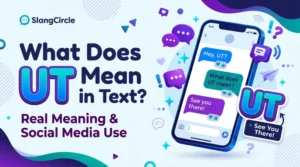
UT usually means “you there?” in text messages. People may use it to check if someone is available or still paying attention to a conversation. However, UT can have other meanings depending on the chat, platform, and topic. The surrounding message helps you understand what the sender means.
The abbreviation is short and easy to type. You might see it in private messages, group chats, or casual conversations on apps like Snapchat, Instagram, WhatsApp, and TikTok.
If someone sends you “UT?”, they may simply want to know if you are online or ready to talk. Still, it is best to check the full conversation before assuming its meaning.
This guide explains the common interpretation, shows realistic chat examples, and shares simple ways to reply.
UT Meaning in Text
In casual texting, UT can mean “you there?” It is a short way to ask someone if they are available, online, or still following the conversation.
For example:
- “Hey, UT?”
- “UT? I need to ask you something.”
- “UT or did you leave?”
In these messages, the sender wants to know if the other person is present and able to respond.
UT is an abbreviation, not a full word. People may use it to save time when typing a quick message. It is informal, so it fits casual chats better than formal writing.
Is UT an Acronym or an Abbreviation?
UT is best described as an abbreviation when someone uses it to mean “you there?” It shortens a phrase into two letters.
It is not a universally recognized texting term. Some people may understand it right away, while others may not know what it means.
That is why context matters. A message like “UT?” in a private chat may suggest “you there?” However, the same letters can mean something completely different in another conversation.
What Does UT Mean in Everyday Chat?
People may send UT when they are waiting for a reply or want to start a conversation.
For example, imagine that you are chatting with a friend. You stop replying for a few minutes. Your friend sends:
“UT?”
They are likely asking if you are still there.
The phrase can also appear before an important question. Someone might send “UT? Need your help” to check if you are available before explaining the situation.
It does not automatically mean the sender is angry. Their tone depends on the relationship and the rest of the conversation.
Other Possible Meanings of UT
Although “you there?” is one possible texting interpretation, UT does not have one fixed meaning in every situation.
The letters can also refer to names, places, organizations, or subject specific terms.
Here are a few examples:
- Utah: UT is the official postal abbreviation for the U.S. state of Utah.
- University of Texas: People may use UT as a short name for the University of Texas or one of its campuses.
- Universal Time: In timekeeping and technical discussions, UT can refer to Universal Time.
- You too: In some personal chats, a sender may use UT as a personal shorthand for “you too,” although this is not a standard meaning.
These meanings are not interchangeable. Look at the topic and the words around UT to understand the intended message.
For example, “I am moving to UT” may refer to Utah. On the other hand, “UT? Are you still online?” may mean “you there?”
Where People Use UT
The meaning of UT depends on the platform and the type of conversation. People may use short abbreviations in private messages, but UT is not a standard feature or widely established slang term on every social media app.
UT on TikTok
On TikTok, people may use short forms in comments, captions, or direct messages. If someone sends “UT?” in a private conversation, they may be asking if you are still available.
For example:
Friend: I want to show you something.
You: What is it?
Friend: UT?
The sender may be checking if you are still there before sharing a video or explaining something.
However, UT does not have one official TikTok meaning. A video about a university, a location, or timekeeping may use the same letters differently.
UT on Snapchat
Snapchat conversations often move quickly. People may use short messages instead of typing complete sentences.
Someone might send:
“UT? I have a question.”
In this situation, the sender may mean “you there?” They want to know if you are available to chat.
Still, do not assume that every UT message on Snapchat has this meaning. The sender may also be using a personal abbreviation that only their friends understand.
UT on Instagram
On Instagram, you might see UT in direct messages or comments.
For example:
Person A: Can I tell you something?
Person B: Sure.
Person A: UT?
Here, the sender may be checking if the other person is still present.
Instagram users also discuss places, schools, sports, and universities. In those conversations, UT may refer to a specific name rather than a texting phrase.
UT on WhatsApp
WhatsApp users often send short messages when they want a quick response.
For example:
“UT? Call me when you can.”
The sender may be asking if you are available. The rest of the message gives you more information about what they need.
In family and friend group chats, people may also create their own shortcuts. If you are unsure, asking what UT means is perfectly fine.
UT in SMS Text Messages
In regular SMS messages, UT may appear when someone wants to check if another person is available.
For example:
“UT? I am outside.”
The sender may want to know if you are reading their message or ready to meet.
Unlike common abbreviations such as LOL and BRB, UT is not universally understood. It is safer to write the full phrase when you are messaging someone who may not know the abbreviation.
Real Chat Examples of UT
The easiest way to understand a texting abbreviation is to see it in a conversation.
Below are ten examples showing how someone might use UT to mean “you there?” These examples illustrate a possible casual use, not a fixed rule followed by every texter.
1. Checking If a Friend Is Online
A: Hey, UT?
B: Yes, what’s up?
A: I need to tell you something.
The sender checks if their friend is available before starting the conversation.
2. Asking for Help
A: UT?
B: Yeah.
A: Can you help me with my homework?
Here, UT works as a quick availability check.
3. Waiting for a Reply
A: Did you see my last message?
B: Sorry, I was busy.
A: No problem. UT now?
The sender wants to know if the other person can continue chatting.
4. Starting a Late Night Conversation
A: UT?
B: Yes, why are you awake?
A: I can’t sleep lol.
This example shows how the abbreviation may appear in a relaxed conversation between friends.
5. Making Plans
A: UT?
B: Yeah, I’m here.
A: Are we still meeting tomorrow?
The sender checks if the other person is available before discussing plans.
6. Sharing Something Important
A: I have some news.
B: Tell me!
A: UT? I want to explain it properly.
The sender wants to make sure the other person is present before sharing the news.
7. Checking on Someone
A: Hey, UT?
B: Yes, everything okay?
A: Just checking on you.
In this conversation, the message sounds caring and friendly.
8. Asking About a Missed Call
A: UT?
B: Yes, I just got back.
A: I called you earlier.
The sender checks if the other person can respond to their message.
9. Continuing a Group Conversation
A: Guys, UT?
B: I’m here.
C: Same here.
A: Okay, let’s decide where to go.
The abbreviation may be used to check if people in a group chat are still active.
10. Checking Before Sending a Long Message
A: UT?
B: Yes, go ahead.
A: I need to explain something important.
The sender checks if the other person has time to read and respond.
How to Reply When Someone Says UT
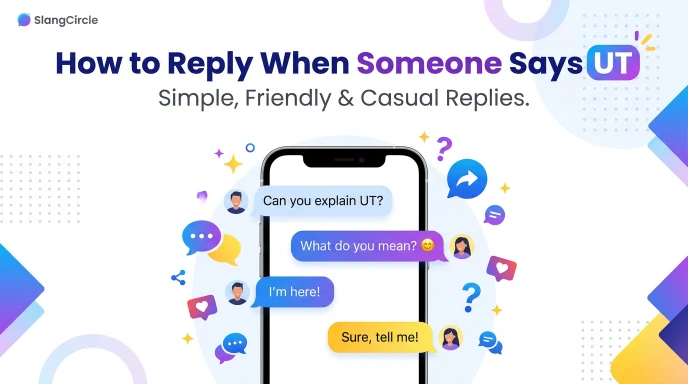
Your reply depends on what the sender means and if you are available.
If they are asking “you there?”, you can simply confirm that you are present. You do not need to write a long response.
Here are some natural ways to reply.
Casual Replies
Use these when a friend or someone you know sends UT.
- “Yeah, I’m here.”
- “Yep, what’s up?”
- “I’m online.”
- “Yes, tell me.”
- “What’s going on?”
These replies sound relaxed and friendly.
Funny Replies
If you have a playful relationship with the sender, try a funny response.
- “No, I’m on Mars!”
- “Yes, I have returned.”
- “Barely awake, but yes.”
- “I’m here. What happened?”
- “You summoned me?”
These replies add humor without making the conversation confusing.
Friendly Replies
If someone seems worried or wants to talk, use a warm response.
- “Yes, I’m here. Everything okay?”
- “Of course! What’s going on?”
- “I’m listening.”
- “Hey! Tell me what’s up.”
- “Yes, you can talk to me.”
These responses show that you are ready to listen.
Neutral Replies
Sometimes you may not know the sender very well. In that case, keep your answer simple.
- “Yes.”
- “I’m available.”
- “What’s the matter?”
- “How can I help?”
- “Yes, I received your message.”
A neutral reply works well when you want to be polite without sounding too casual.
What If You Are Busy?
You do not have to reply immediately if you cannot talk.
You can say:
- “I’m busy right now. I’ll text you later.”
- “Not at the moment. Is it urgent?”
- “I’m away from my phone.”
- “Can we talk in a little while?”
- “I’ll get back to you soon.”
A clear response helps the other person understand when you can continue the conversation.
Is UT Rude or Offensive?
No, UT is not generally a rude or offensive expression when someone uses it to ask “you there?”
It is usually a simple way to check if another person is available. It does not contain an insult, swear word, or disrespectful meaning by itself.
However, the tone can change depending on the situation.
For example:
“UT? I need help.”
This sounds like a normal request.
But sending “UT???” again and again while someone is busy may feel impatient or demanding. The problem is not the abbreviation itself. It is how the sender uses it.
Is UT Safe to Use With Friends?
Yes, you can use it in casual conversations if the other person understands what you mean.
It may work between close friends, siblings, or people who regularly use texting shortcuts.
Still, some people may not recognize it. If they seem confused, explain that you mean “you there?”
Can You Use UT at School or Work?
It is better to avoid unclear abbreviations in formal communication.
For example, if you are messaging a teacher, manager, or colleague, write:
“Are you available?”
This sounds clearer and more respectful.
You can use informal shortcuts with friends during breaks or in personal chats. However, professional messages should use complete words when clarity matters.
Who Uses UT?
There is no reliable reason to say that one age group owns this abbreviation. People of different ages use texting shortcuts, but their habits vary.
Does Gen Z Use UT?
Gen Z often uses abbreviations, short phrases, and internet expressions in online conversations.
However, UT is not as widely recognized as common forms such as LOL, BRB, or IDK. Some people may use it as personal shorthand, while others may not understand it at all.
It is better to treat UT as a context dependent abbreviation rather than a major Gen Z slang term.
Do Teenagers Use UT?
Some teenagers may use UT in private chats when they want to ask if a friend is online.
However, there is no clear evidence that it is a standard texting habit among all teenagers.
Many people prefer more familiar options, such as:
- “You there?”
- “Are you online?”
- “Hey?”
- “Still here?”
These phrases are easier for most people to understand.
Where Is It Most Likely to Appear?
If someone uses UT as “you there?”, you are most likely to encounter it in an informal message or private conversation.
It may appear in:
- One to one text messages
- Private social media chats
- Friend group conversations
- Gaming chats
- Casual online discussions
Remember that the letters can also have non slang meanings. The topic of the conversation is important.
Origin of UT
There is no clearly established origin for UT as a texting abbreviation meaning “you there?”
It may come from the general habit of shortening common phrases in digital conversations. People often remove words or use initials to make messages faster to type.
For example:
- “Are you there?” can become “You there?”
- “Be right back” becomes BRB.
- “I don’t know” becomes IDK.
- “Talk to you later” becomes TTYL.
Short forms became common as people began using SMS messages, instant messaging services, and social media chats.
However, this does not prove that UT started on a particular app or in a specific year. Without reliable evidence, it would be inaccurate to claim a definite creator, date, or platform.
The safest explanation is that UT may be used as a personal or informal abbreviation for “you there?” Its exact history and popularity remain unclear.
UT vs. IDK, IDC, IMO, and BRB
UT and other texting abbreviations may look similar because they use short letter combinations. However, they serve different purposes.
| Term | Meaning | Type | Usage | Popularity |
| UT | You there? (possible chat meaning) | Abbreviation | Checking if someone is available | Less widely recognized |
| IDK | I don’t know | Abbreviation | Showing uncertainty | Very common |
| IDC | I don’t care | Abbreviation | Showing a lack of concern | Common |
| IMO | In my opinion | Abbreviation | Sharing a personal view | Common |
| BRB | Be right back | Abbreviation | Saying you will return soon | Very common |
What Makes UT Different?
The main difference is that UT may work as a question. It can ask if someone is present or available.
Other abbreviations have different purposes:
- IDK expresses uncertainty.
- IDC expresses a lack of interest or concern.
- IMO introduces an opinion.
- BRB tells someone that you will return shortly.
These terms are more widely recognized in everyday online conversations than UT.
Real World Usage Example
Imagine that you are waiting for your friend outside a shopping mall.
You send a message asking where they are. They do not reply for several minutes. You are unsure if they have seen your message.
You then send:
“UT?”
Your friend replies:
“Yeah, I’m here. Just parking.”
In this situation, UT may mean “you there?” You are checking if your friend is available to respond.
Now imagine a different situation. You are discussing a university with someone, and they write:
“I want to study at UT.”
Here, UT may refer to a university rather than a texting phrase.
The same two letters can have different meanings. That is why you should always consider the topic, the sender, and the complete sentence.
How to Understand UT Without Confusion
Short abbreviations can be confusing when you see them for the first time. Fortunately, a few simple steps can help you understand the intended meaning.
1. Read the Full Message
Do not focus only on the two letters.
For example, “UT? Can you hear me?” suggests that the sender wants to know if you are present.
On the other hand, “I live in UT” may refer to a location.
2. Think About the Conversation Topic
Ask yourself what you and the other person were discussing.
If you were talking about meeting up, a quick availability check may make sense. If you were discussing travel or education, UT may refer to a place or institution.
3. Consider the Sender
Close friends sometimes create their own shortcuts.
A person may use an abbreviation that their friends understand but that other people rarely use. This is normal in personal chats.
4. Ask for Clarification
If the meaning is still unclear, ask a simple question.
You can reply:
- “What do you mean by UT?”
- “Do you mean you there?”
- “Can you explain?”
- “Are you asking if I’m online?”
There is no need to guess when a quick question can clear things up.
FAQ’S
1. What does UT mean in text messages?
UT may mean “you there?” in casual text messages. People can use it to check if someone is online, available, or still following a conversation. However, it is not a universally recognized abbreviation, so the full message and context matter.
2. What does UT mean on TikTok?
On TikTok, UT may be used in a private chat to ask if someone is there. However, it does not have one official meaning on the platform. It can also refer to a place, university, or another topic.
3. Is UT slang?
UT is better described as an abbreviation when someone uses it to mean “you there?” It is informal, but it is not a widely established slang term. Its meaning can change depending on the conversation.
4. Is UT rude or offensive?
No, UT is not generally offensive when it means “you there?” It is usually a simple availability check. However, sending repeated messages may seem impatient. The tone and situation matter more than the abbreviation itself.
5. How should you reply to UT?
If someone uses UT to ask if you are there, you can reply with “Yeah, I’m here,” “What’s up?” or “Yes, tell me.” If you are busy, say that you will respond later.
6. Does UT mean you too?
Some people may use UT as personal shorthand for “you too,” but this is not a standard or widely recognized meaning. Check the message before interpreting it this way. If you are unsure, ask the sender.
7. What does UT mean from a friend?
A friend may use UT to ask if you are available or still online. For example, “UT? I need to tell you something” may mean they want to check if you are there before continuing the conversation.
8. Is UT common in texting?
UT is not as widely recognized as abbreviations such as LOL, BRB, and IDK. Some people may use it in private chats, but others may not understand it. Writing “you there?” is clearer when you are unsure.
Conclusion
UT may mean “you there?” in casual text messages. People can use it to check if someone is online, available, or ready to continue a conversation.
You may see it in private messages, group chats, or social media conversations. However, UT is not a widely recognized texting abbreviation, and it can have other meanings in different situations.
If someone sends you UT, read the full message before replying. You can answer with “Yeah, I’m here” or simply ask what they mean.
Use it with friends if they understand the abbreviation. For school, work, or formal conversations, choose clear phrases such as “Are you available?” instead.
Discover More About!
What Does USB Mean in Text? Real Meaning, & Social Media Use
What Does TMB Mean in Text? Real Meaning & Social Media Use
What Does TM Mean in Text?Examples & Social Media Use