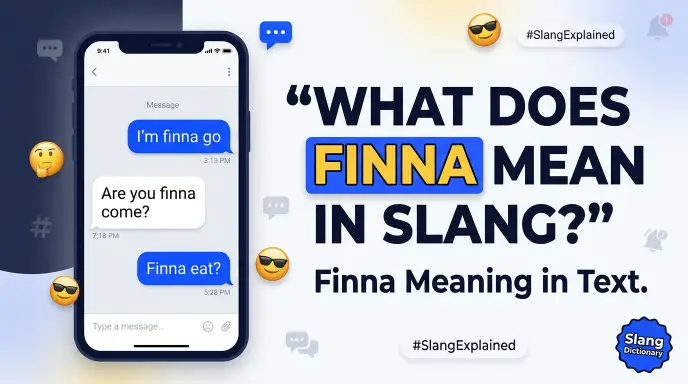
What does finna mean in slang? If you have seen someone write “I’m finna go,” “finna eat,” or “Are you finna come?” you may wonder what this unusual word means.
The term appears often in texts, social media posts, music, and casual conversations. It can look like a spelling mistake at first, but it has a clear meaning in informal English.
People use finna to talk about something they plan or intend to do soon. The word usually replaces phrases such as “going to,” “about to,” or “planning to,” depending on the sentence.
If you want to understand the finna meaning in text, this guide explains its meaning, tone, origin, common uses, examples, and similar slang terms.
Quick Answer:
- Finna means “going to” or “about to” in informal English. For example, “I’m finna eat” means “I’m going to eat” or “I’m about to eat.”
What Does Finna Mean in Text?
Finna is informal slang that people use to show an upcoming action, plan, or intention.
For example:
- “I’m finna sleep.” = “I’m going to sleep.”
- “We finna leave.” = “We are going to leave.”
- “She finna call you.” = “She is going to call you.”
- “I’m finna start my homework.” = “I’m about to start my homework.”
The exact meaning can change slightly with context. In some sentences, finna sounds closer to “about to.” In others, it sounds closer to “going to.”
The word usually carries a relaxed and conversational tone. People often use it with friends, family members, online followers, or other people in casual settings.
Finna Full Form and Definition
Many people search for the finna full form because the word looks like an abbreviation. However, finna does not work like a typical acronym with a fixed letter by letter full form.
Finna developed from the phrase “fixing to.” In African American English, the expression “fixing to” has long carried the meaning of preparing or intending to do something.
Over time, pronunciation and casual speech helped produce forms such as “finna.”
So, instead of thinking of finna as an acronym, think of it as a slang form that expresses an upcoming action or intention.
Simple Definition
Finna = going to / about to / intending to do something
The best replacement depends on the sentence.
| Finna sentence | Standard English |
| I’m finna eat. | I’m going to eat. |
| We finna leave. | We are about to leave. |
| She finna text him. | She is going to text him. |
| They finna play. | They are going to play. |
| I’m finna study. | I’m about to study. |
What Does Finna Stand For?
The question “what does finna stand for?” can cause some confusion.
Finna does not stand for a group of separate words in the same way that “LOL” stands for “laugh out loud.” Instead, it developed from the spoken phrase “fixing to.”
“Fixing to” means preparing or planning to do something.
For example:
“I’m fixing to leave.”
This idea eventually led to the shorter informal form:
“I’m finna leave.”
Both expressions communicate an upcoming action, although they belong to different varieties and styles of English.
Is Finna Rude, Offensive, or Neutral?
Finna is generally not rude or offensive. It works as informal slang.
However, the setting matters.
You can use finna in a casual text such as:
“I’m finna head home.”
A formal email would call for standard English:
“I am going to head home.”
Using slang does not automatically make a message disrespectful. Still, formal situations often require a more standard style.
Finna usually works well in:
- Text messages
- Casual conversations
- Social media posts
- Memes
- Friendly chats
- Music and lyrics
- Online communities
- Informal comments
Finna may not fit well in:
- Academic essays
- Job applications
- Formal reports
- Business emails
- Official documents
- Professional presentations
The key issue involves formality, not offensiveness.
Where Is Finna Commonly Used?
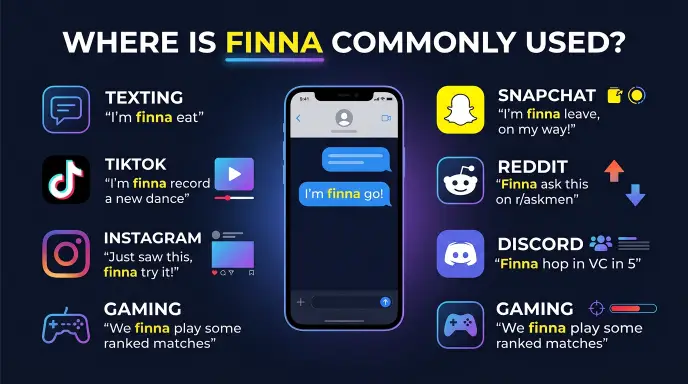
You can find finna across many forms of informal communication.
Texting
Friends may use finna when they talk about immediate plans.
“I’m finna grab some food. Want anything?”
TikTok and Instagram
Social media users often use casual slang to make captions, comments, and videos sound natural.
“Me finna quit after one difficult question.”
The phrase can also appear in memes and humorous posts.
Finna can appear in casual discussions, jokes, comments, and conversations. The exact frequency depends on the community and the speaker’s language style.
Discord and Gaming Chats
Gamers may use finna while discussing what they plan to do next.
“I’m finna join the next match.”
“We finna win this round.”
Music and Popular Culture
Finna also appears in songs, interviews, memes, and other forms of popular culture. Its presence in these spaces has helped more people recognize the word.
That does not mean every speaker uses it. Slang choices can vary by region, community, age, and personal style.
Real Life Examples of Finna
Context helps you understand this word much faster. Here are examples from different situations.
Friendly Example
Person A: “Are you coming to the party?”
Person B: “Yeah, I’m finna get ready now.”
Meaning:
“I’m going to get ready now.”
The speaker uses finna in a relaxed way.
Casual Text Example
“I’m finna order pizza. What do you want?”
Here, finna means “I’m about to” or “I’m going to.”
Social Media Example
“I’m finna delete this app 😂”
The writer may express an immediate intention, frustration, or joke.
Gaming Example
“I’m finna push the enemy team.”
Here, the speaker means:
“I’m about to attack or move toward the enemy team.”
Friendly Invitation
“We finna watch a movie tonight.”
The sentence means:
“We are going to watch a movie tonight.”
Argumentative Example
“If you keep talking, I’m finna leave.”
This sentence carries a stronger emotional tone. The speaker says they plan to leave because the other person keeps talking.
The word itself does not create the argument. The surrounding language creates the stronger tone.
Can Finna Mean “About to”?
Yes. In many contexts, finna can mean “about to.”
Consider this example:
“I’m finna eat.”
The speaker could mean:
- “I’m going to eat.”
- “I’m about to eat.”
The exact sense depends on the situation.
If someone has already ordered food and says “I’m finna eat,” “about to eat” may fit best.
If someone talks about a plan for later, “going to eat” may fit better.
Finna vs Gonna
Finna and gonna can both describe future actions, but they do not always sound the same.
| Slang | Common meaning | Example |
| Finna | Going to / about to | “I’m finna leave.” |
| Gonna | Going to | “I’m gonna leave.” |
“Gonna” comes from the spoken form of “going to.” Finna has a different history and connects to “fixing to.”
Both terms work well in casual speech, but finna carries a distinct cultural and linguistic history.
Finna vs About To
These two expressions often overlap.
“I’m finna leave.”
“I’m about to leave.”
Both sentences can communicate that the person expects to leave soon.
However, “about to” works in both informal and more neutral English. Finna has a stronger informal flavor.
Finna vs Fixing To
The connection between finna and fixing to matters because it helps explain the word’s background.
“Fixing to” can mean “getting ready to” or “planning to.”
For example:
“I’m fixing to go home.”
Over time, informal speech produced shorter forms, including finna.
The words share a similar idea, but speakers may use them differently depending on region, community, and personal speech style.
Origin and Background of Finna
The history of finna connects strongly with African American English (AAE) and Southern American English.
The phrase “fixing to” has a long history in Southern varieties of English. It expresses an intention or an action that will happen soon.
African American speech communities developed and used forms such as finna as part of their natural language patterns. The term later gained wider visibility through music, entertainment, social media, and online communication.
This history matters because finna does not simply represent random internet slang. It has roots in established speech varieties and linguistic patterns.
Today, many people outside those communities recognize and use the word. However, its broader popularity does not erase its cultural and linguistic background.
Why Do People Use Finna?
People choose finna for several reasons.
1. It sounds casual
Finna can make a sentence feel relaxed and conversational.
“I’m finna go home.”
sounds more casual than:
“I am going to go home.”
2. It is short
Slang often makes communication faster.
“I’m finna eat.”
takes less effort than a more formal sentence.
3. It expresses personality
People use language to show their identity, humor, mood, or connection with a community.
4. It fits online communication
Social media and texting encourage short, informal messages. Finna fits that style naturally.
5. It can add emphasis
In some situations, finna can make an upcoming action sound immediate.
“I’m finna lose my mind.”
The speaker may express frustration, excitement, or humor rather than describe a literal action.
Common Mistakes With Finna
New learners sometimes use finna in ways that sound unnatural.
Treating it like an acronym
Finna does not function like LOL, BRB, or IDK.
Using it in every future sentence
Finna does not replace every use of “will” or “going to.”
For example:
“Tomorrow, I finna travel.”
This sentence does not sound natural in standard informal usage.
A more natural example would be:
“I’m finna travel tomorrow.”
Even then, the exact sentence depends on the speaker’s dialect and context.
Using it in formal writing
Avoid finna when a teacher, employer, client, or official audience expects standard English.
Ignoring cultural context
Finna has roots in African American English and Southern English varieties. Understanding that background helps you use the term with greater awareness.
When Should You Avoid Using Finna?
You do not need to avoid finna in casual conversation simply because it is slang. However, consider your audience and setting.
Avoid it when you need a formal or academic tone.
For example, instead of:
“I’m finna submit my report.”
use:
“I am going to submit my report.”
For a school essay, choose standard English.
For a friendly text, the slang may fit naturally.
Polite and Standard Alternatives to Finna
Finna itself does not carry an offensive meaning, so you do not need a “polite” replacement. You may simply want a more formal alternative.
Common options include:
- Going to
- About to
- Planning to
- Intend to
- Will
- Preparing to
Examples
Informal:
“I’m finna call her.”
Neutral:
“I’m going to call her.”
More formal:
“I plan to call her.”
Choose the version that matches your audience.
Impact of Finna on Communication
Slang can make communication feel more personal and natural. It can also create confusion when someone does not know the term.
For people who understand the expression, “I’m finna go” sounds clear and casual.
For someone unfamiliar with the word, the sentence may look like a typo.
That difference shows why context matters. Good communication does not require everyone to use formal English all the time. It requires speakers and writers to choose language that fits their audience.
Is Finna Safe for Social Media?
Yes. Finna does not contain offensive or dangerous content. You can encounter it on platforms such as TikTok, Instagram, Reddit, Snapchat, Discord, and other social spaces.
Still, platform rules can change, and context always matters. The word itself does not normally create a safety concern.
If you create content for a broad audience, remember that some readers may not understand slang immediately. A standard phrase may work better when clarity matters more than casual style.
Finna in Different Tones
The word can take on different tones depending on the surrounding sentence.
| Tone | Example | Meaning |
| Friendly | “I’m finna grab food. Want some?” | Going to |
| Casual | “I’m finna watch a movie.” | About to / going to |
| Excited | “We finna have so much fun!” | We are going to |
| Frustrated | “I’m finna leave if this keeps happening.” | I am about to |
| Gaming | “We finna win this match.” | We are going to |
| Humorous | “I’m finna cry over this homework.” | Strong emotional expression |
The same word can appear in all these situations. The surrounding words and the speaker’s tone provide the extra meaning.
Is Finna the Same as “Going To”?
Not exactly, but the meanings often overlap.
“Going to” belongs to standard English and works in formal and informal settings.
Finna belongs to informal speech and has its own linguistic history.
For example:
“I’m going to the store.”
and
“I’m finna go to the store.”
both discuss a future action, but the second sentence has a much more informal tone.
FAQ’S
Q1:What does finna mean in slang?
Finna usually means “going to,” “about to,” or “planning to.” People use it in informal speech, texting, social media, and other casual settings.
Q2:What does finna stand for?
Finna does not work as an acronym. Its history connects to “fixing to,” an expression that can describe an upcoming action or intention.
Q3:Is finna a bad word?
No. Finna is generally not a bad or offensive word. It is informal slang, so you should consider the setting before using it.
Q4:Is finna the same as gonna?
They can have similar meanings, but they have different histories. Gonna comes from “going to,” while finna connects to “fixing to.”
Q5:Can I use finna in a formal essay?
It is better to avoid finna in formal academic writing unless you discuss the word itself. Use phrases such as “going to,” “planning to,” or “about to” instead.
Q6:Why do people say finna instead of going to?
People may use finna because it sounds natural within their speech community and adds a casual, conversational style. The term also has established roots in African American English and Southern English varieties.
Conclusion
So, what does finna mean in slang? Finna usually means “going to,” “about to,” or “planning to do something.” It describes an upcoming action or intention and works mainly in informal communication.
The word has roots in the expression “fixing to” and connects strongly with African American English and Southern American English. Today, people can see it across texting, social media, music, gaming chats, and other casual spaces.
Remember that context matters. A sentence such as “I’m finna eat” can sound perfectly natural in a friendly conversation, while “I’m going to eat” works better in formal English.
Understanding the finna meaning slang uses is not just about learning one internet word. It also helps you understand how language changes, how different speech communities shape English, and how people use informal language to express identity and tone.
More Slang Meanings
- What Does HMB Mean in Slang? HMB Meaning in Text
- Tomorrow in Slang: Meaning, Terms & Examples
- T Slang Meaning: What Does “T” Mean in Text?