T slang usually means “truth” or “the truth,” especially when someone asks for honest information, gossip, or the real story behind a situation. In some contexts, T can also connect to the slang word “tea,” which means gossip, inside information, or a revealing story.
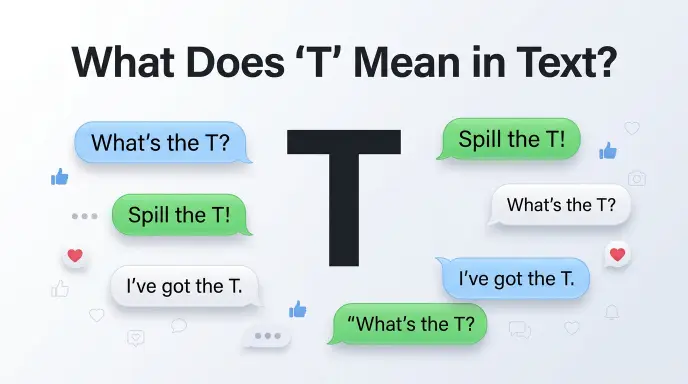
If you saw T in a text, comment, or social media post, the meaning may not seem clear at first. A person might write “What’s the T?”, “Give me the T,” or “Spill the T.” These phrases usually ask someone to share the truth or interesting details.
This guide explains T slang meaning, how people use it in texting and online chats, where it came from, and how its meaning can change with context. You will also see simple examples that show how T slang works in real conversations.
Quick Answer:
- In slang, T usually means “truth” or the real story. It can also refer to gossip or juicy information, much like “tea.” For example, “What’s the T?” means “What’s the truth?” or “What’s the real story?”
What Does T Slang Mean?
T slang means “truth,” especially the real or private details about a person or situation. People often use it when they want honest information instead of a vague answer.
For example:
“Okay, what’s the T?”
This can mean:
“Okay, what really happened?”
The meaning can shift slightly depending on the conversation. Sometimes T focuses on truth. Other times, it points to gossip, drama, or inside information.
Common meanings of T
| T Meaning | What It Means | Example |
| Truth | The real facts | “Give me the T.” |
| Real story | What actually happened | “What’s the T about them?” |
| Gossip | Interesting personal information | “She has the T.” |
| Inside information | Details that others may not know | “Do you know the T?” |
The tone often feels casual and playful. Still, the topic can become serious if the information involves someone’s private life.
Does T Stand for Truth?
Yes. In this slang sense, T is commonly explained as a short form of “truth.” The slang has roots in Black drag culture, where T referred to truth or personal information. Merriam Webster points to a documented 1994 use connected to drag performer The Lady Chablis.
Over time, the idea of T = truth developed into the wider slang use of tea for gossip or revealing information. Today, people may use either T or tea depending on the phrase and their style.
So, when someone asks:
“What’s the T?”
They usually want the real story.
Different Meanings of T Slang
The meaning of T can change with the situation. Here are the main uses worth knowing.
1. T Means Truth
This is the clearest slang meaning.
Someone may use T to ask for the facts or the honest version of a story.
Example:
“Forget the rumors. Give me the T.”
Meaning:
“Tell me what is actually true.”
This use works well when friends discuss a confusing situation.
2. T Means Gossip
T can also mean gossip or interesting information about someone.
For example:
“I have some T about the party.”
The speaker probably means:
“I have some interesting gossip or details about the party.”
The word does not always mean something negative. The information could involve exciting news, a relationship update, a funny story, or ordinary social drama.
3. T Means Inside Information
Sometimes T means information that other people do not know yet.
For example:
“Do you have the T on the new teacher?”
Here, the person asks if you know anything useful or interesting about the new teacher.
The phrase does not automatically mean the information is true. Context matters. If the information comes from rumors, treat it as unverified.
Where Is T Slang Commonly Used?
You may see T in casual texting, social media posts, comments, and group chats. The slang works best in informal settings because it has a relaxed, conversational tone.
You may find it in:
- Text messages
- Group chats
- Instagram comments
- TikTok comments
- Reddit discussions
- X posts
- Online communities
- Casual conversations
- Pop culture discussions
People often use T in short phrases such as “What’s the T?” or “Spill the T.”
The exact wording can vary by person and community. Some people prefer tea, while others use T as the shorter form.
Is T Slang Rude, Offensive, or Harmless?
T slang is usually casual and harmless, but the subject of the conversation matters. The word itself does not count as an insult or offensive term.
A friendly example might look like this:
“What’s the T on the new movie?”
The person simply wants the latest information.
However, T can involve gossip about someone’s private life. That can create problems when people share rumors, private details, or unverified claims.
A good rule is simple:
Using T is casual. Sharing harmful or private information is the real concern.
Think about the person involved before you pass along the information.
Real Life Examples of T Slang
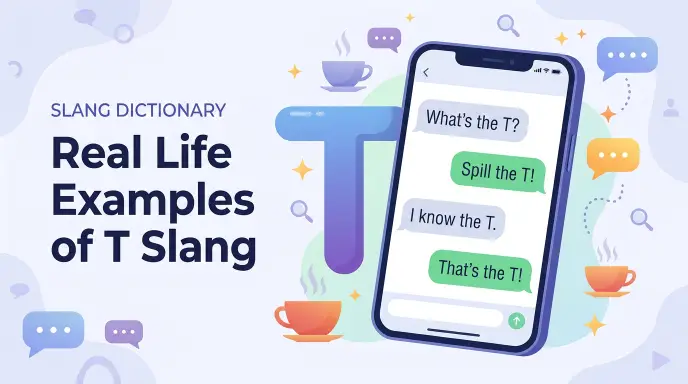
Here are some natural examples that show how people use T.
Friendly Conversation
Alex: “You were talking to Mia earlier. What’s the T?”
Sam: “She’s planning a birthday party next month.”
Here, T means the latest information.
Text Message
“Okay, give me the T. Why did they leave early?”
Meaning:
“Tell me what really happened.”
Social Media
“What’s the T with this new trend?”
Here, T means information or an explanation.
Talking About Drama
“I heard there was drama after the meeting. What’s the T?”
The speaker wants the real story.
Online Community
“Anyone have the T on the update?”
Here, T can mean useful inside information rather than personal gossip.
When Someone Has News
“Girl, I have T for you!”
This usually signals that the speaker has interesting news or details to share.
T vs. Tea: What Is the Difference?
T and tea can share the same slang meaning, but they do not always appear in the same phrases.
The slang T has a direct connection to truth. The word tea became a popular form for gossip and interesting information. Merriam Webster describes both meanings as connected to Black drag culture and the use of T for truth.
| Expression | Meaning | Tone |
| What’s the T? | What is the truth or real story? | Curious |
| Give me the T | Tell me the details | Casual |
| Spill the T | Reveal the information | Playful |
| What’s the tea? | What is the gossip or news? | Casual |
| Spill the tea | Tell me the gossip | Playful |
The phrases overlap, but “tea” now has a very familiar slang meaning for gossip and juicy information.
Origin and History of T Slang
The slang T has a deeper cultural history than many people realize. It did not begin as a random internet abbreviation.
Merriam Webster traces the slang use to Black drag culture, where T could mean truth or personal business. One notable documented example appears in John Berendt’s 1994 book Midnight in the Garden of Good and Evil, which quotes The Lady Chablis using T to describe her truth and personal life.
The slang later spread beyond its original community. Over time, T and tea became strongly linked with gossip, secrets, and interesting personal information. Mainstream media and online culture helped more people recognize the expression.
This history matters because slang terms often come from real communities and cultures. It is better to understand that background than to label every popular expression as simply “internet slang.”
Similar Slang Terms
Several slang phrases can express ideas close to T.
| Slang | Meaning |
| Tea | Gossip, truth, or interesting information |
| Spill the tea | Tell the gossip or details |
| What’s the tea? | What happened? What is the latest news? |
| The real story | What actually happened |
| Gossip | Personal or private information shared about others |
| Inside info | Information that may not be widely known |
Tea is the closest match to T in this context.
When Should You Avoid Using T Slang?
You can use T in relaxed conversations, but formal situations call for clearer language.
Avoid it when:
- You are writing a formal email.
- You are speaking to a professional audience.
- You are writing an academic assignment.
- The reader may not understand slang.
- You are discussing sensitive private information.
- You have no reliable source for a rumor.
For example, instead of writing:
“What’s the T on the project?”
in a formal workplace email, use:
“Do you have an update on the project?”
That version sounds clearer and more professional.
Polite Alternatives to T
If your audience may not know the slang, you can use simple alternatives.
Instead of “What’s the T?”, say:
- “What’s the real story?”
- “What happened?”
- “Do you know what happened?”
- “What’s the latest?”
- “Do you have any information?”
- “Can you tell me what happened?”
These phrases work well in school, work, family, and other formal settings.
Why Do People Use T Slang?
People use T because it makes a conversation feel short, casual, and expressive.
A phrase like:
“What’s the T?”
can sound more playful than:
“Can you tell me what happened?”
The slang also fits naturally into online conversations. A short expression can quickly show curiosity, excitement, or interest.
Another reason is social connection. Friends may use slang to create a relaxed tone within a group.
Still, slang works best when everyone understands the context.
Common Misunderstandings About T Slang
Does T always mean gossip?
No. T can mean truth, real information, or inside details. The context tells you which meaning fits best.
Does T always mean something negative?
No. Someone can share positive news or harmless information as “T.”
Does T always mean tea?
Not exactly. In slang, T has a direct connection to truth, while tea commonly refers to gossip or juicy information. The two overlap in many modern expressions.
Does T mean the information is true?
Not necessarily. The slang can suggest “truth,” but a person can still repeat a rumor. Do not treat every piece of “T” as verified fact.
Is T Slang Safe for Social Media?
Yes, the slang itself is generally safe for social media. The main concern comes from the information someone shares with it.
For example:
“What’s the T on the new game?”
creates no obvious issue.
A post that shares someone’s private information or spreads an unverified rumor can cause harm. The phrase T does not make that information reliable or appropriate.
Before sharing “the T,” ask:
- Is the information true?
- Is it public?
- Could it hurt someone?
- Does the person have a reasonable expectation of privacy?
That simple check can help keep casual slang from turning into harmful gossip.
FAQ’S
Q1:What does T mean in slang?
T usually means truth, the real story, gossip, or inside information. The exact meaning depends on the context.
Q2:What does “What’s the T?” mean?
“What’s the T?” means “What’s the truth?” or “What’s the real story?” It often shows curiosity about news or gossip.
Q3:Is T short for tea?
T originally connects to “truth,” while “tea” became a related slang form for gossip and interesting information. The two terms often overlap today.
Q4:What does “spill the T” mean?
“Spill the T” means to reveal the truth, details, gossip, or inside information about a situation.
Q5:Is T slang appropriate at work?
It depends on the workplace, but formal communication should avoid it. Use clear phrases such as “What is the latest update?” instead.
Q6:Is T slang offensive?
No, T itself is generally not offensive. However, the gossip or private information connected to it can create problems.
Conclusion
T slang usually means “truth,” the real story, gossip, or inside information. You may see it in phrases such as “What’s the T?”, “Give me the T,” and “Spill the T.”
The term has roots in Black drag culture, where T referred to truth or personal information. Its meaning later spread into wider slang, where T and tea became linked with gossip and revealing details.
Use T in casual chats when the people around you understand the slang. For work, school, or formal writing, choose clearer words such as truth, update, details, or real story.
Discover More About!
- Bay Slang Meaning: What Does “Bay” Mean in Slang?
- Slang for Punch: Meaning, Terms & Examples
- Quad Meaning Slang: What Does “Quad” Mean?