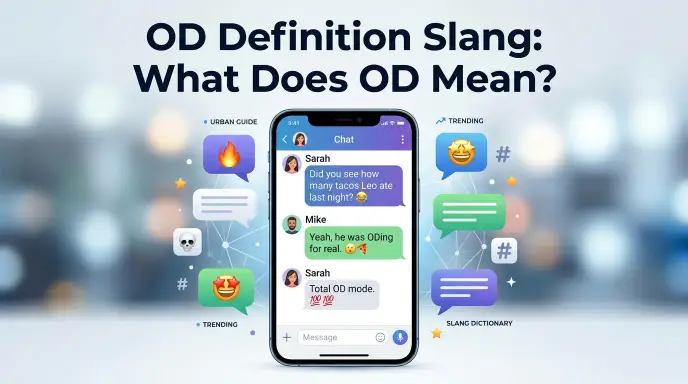
OD definition slang usually refers to “overdose,” especially when people use “OD” to talk about taking too much of a drug. In casual speech and online conversations, OD can also mean doing something to an extreme or excessive degree, such as “I’m OD tired” or “He’s OD funny.” The exact meaning depends on the sentence and context.
If you saw OD in a text, TikTok comment, Snapchat message, gaming chat, or social media post, the meaning may not be obvious at first. Some uses describe a serious situation, while others simply add emphasis to a casual statement.
This guide explains OD definition slang, its meanings, tone, common uses, examples, and situations where you should avoid it.
Quick Answer:
- In slang, OD most commonly means “overdose.” In casual online speech, it can also mean “very much,” “extremely,” or “too much,” depending on context.
What Does OD Mean in Slang?
OD is a short form that most commonly means “overdose.” It can describe taking an excessive amount of a drug, and it can also work as a verb, such as “he OD’d.”
However, casual slang has another use. People sometimes use OD to mean doing something excessively or going overboard.
For example:
- “That movie was OD funny.”
- “You’re OD dramatic.”
- “She’s OD talented.”
- “He spent OD money on that setup.”
In these examples, OD does not refer to a drug overdose. It adds strong emphasis to the word that follows it.
Context matters a lot. A sentence about drugs can make OD a serious term. A sentence about food, jokes, gaming, or fashion may use it as casual exaggeration.
OD Full Form and Definition
The most common full form of OD in slang is “overdose.” Dictionaries also list OD as a noun and verb connected with drug overdose.
Here is a simple breakdown:
| Term | Meaning | Typical context |
| OD | Overdose | Drugs or health |
| OD | Do too much / excessively | Casual slang |
| OD’d | Overdosed | Serious or slang context |
| ODing | Overdosing | Ongoing action |
| OD | Other abbreviations | Non slang contexts |
The uppercase form OD often signals the abbreviation for “overdose,” but people may write it differently in casual messages.
Different Meanings of OD
The meaning of OD changes with context. Two meanings matter most when you see it in slang.
1. OD Means “Overdose”
The first and most established slang meaning is overdose.
An overdose happens when someone takes too much of a drug. The term can refer to a serious medical emergency, and an overdose can cause severe harm or death.
Examples:
- “He was taken to the hospital after an OD.”
- “The news reported an OD in the area.”
- “They said the person died from an OD.”
In this context, OD carries a serious meaning. Do not treat it as a joke when someone discusses a real overdose.
2. OD Means “Extremely” or “Too Much”
Some slang users also use OD as an intensifier. In this style, it means something like “very,” “extremely,” “a lot,” or “too much.”
Examples:
- “That game was OD hard.”
- “You’re OD funny today.”
- “This bag costs OD money.”
- “He talks OD loud.”
This usage can express strong emphasis. It may also suggest that someone has gone too far.
The meaning often depends on the word around OD.
Is OD Rude, Offensive, or Harmless?
OD can be harmless or serious depending on how someone uses it.
When people use it to mean “extremely” or “too much,” the slang usually feels casual. Friends may use it while joking, chatting, or commenting online.
For example:
“Bro, you’re OD funny 😂”
That sentence sounds playful.
The meaning changes when OD refers to an actual overdose. In that case, the topic can involve serious health consequences and loss of life.
A simple rule helps:
- OD + casual adjective → often means “very” or “extremely”
- OD + drugs or medical context → likely means “overdose”
- OD’d after taking something → likely refers to an overdose
Where Is OD Commonly Used?
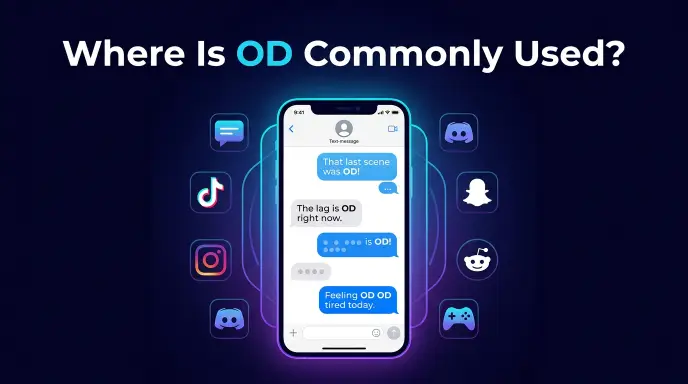
You may see OD in casual online conversations, texts, comments, and social media posts. The exact meaning depends on the community and sentence.
Texting
Friends may use OD as a quick way to add emphasis.
Example:
“That food was OD good.”
Here, OD means extremely or very.
TikTok and Instagram
Comments may use OD to exaggerate a reaction.
Example:
“She’s OD talented.”
The commenter means that the person has a very high level of talent.
Snapchat
Friends may use the term in short messages.
Example:
“You’re OD late 😂”
This means the person is very late or excessively late.
Discord and Gaming
Gaming communities often use slang for quick reactions.
Example:
“That boss is OD hard.”
The speaker means the boss is extremely difficult.
The meaning depends strongly on the discussion. A casual post may use OD as an intensifier, while a discussion about drugs may use it in the literal overdose sense.
Real Life Examples of OD Slang
Context makes OD easier to understand. Here are several examples.
Friendly Conversation
Friend 1: “Did you see Mia’s new haircut?”
Friend 2: “Yeah, it looks OD good.”
Here, OD means very or extremely.
Casual Texting
Alex: “How was the concert?”
Sam: “OD fun. I didn’t want it to end.”
The speaker uses OD to emphasize how much fun they had.
Argumentative Context
Person 1: “Why are you making such a big deal about it?”
Person 2: “Because you’re OD dramatic right now.”
Here, OD means excessively. The speaker thinks the other person has gone too far.
Gaming Context
Player 1: “How’s the new level?”
Player 2: “OD hard. I’ve tried it five times.”
The player means the level feels extremely difficult.
Social Media Context
Comment: “This outfit is OD clean 🔥”
The commenter means the outfit looks extremely good or polished.
Serious Context
Post: “The family said he died after an OD.”
Here, OD means overdose, not “very” or “too much.”
This example shows why context matters.
OD Meaning in Different Contexts
| Context | Likely meaning | Tone |
| “That song is OD good” | Extremely good | Casual |
| “He is OD funny” | Very funny | Friendly |
| “You’re OD dramatic” | Too dramatic | Critical |
| “That level is OD hard” | Extremely hard | Casual |
| “He had an OD” | Overdose | Serious |
| “She OD’d” | Overdosed | Serious |
The surrounding words usually give you the strongest clue.
Origin and Background of OD
The abbreviation OD has a long connection with the word overdose. Dictionary sources list OD as a noun for a drug overdose and as a verb meaning to take an overdose.
The broader word overdose itself dates back to the late 17th century, according to Dictionary.com.
The casual slang use of OD as an intensifier is different. It comes from shortening the idea of “overdoing” something or doing something excessively. The exact development and spread of this casual usage can vary across communities, so it makes more sense to explain the usage than to claim one exact starting date.
The key point is simple: OD can carry both a serious drug related meaning and a casual exaggeration meaning.
OD vs. Similar Slang
Several slang terms can express intensity or excess. They do not always work in the same way.
| Slang | Common meaning | Example |
| OD | Extremely / too much | “That was OD funny.” |
| Extra | Excessive or dramatic | “You’re being extra.” |
| Mad | Very / a lot | “That was mad good.” |
| Super | Very | “That was super fun.” |
| AF | Extremely | “That was funny AF.” |
OD can sound more informal than “very” or “extremely.” It also has the separate overdose meaning, so readers need to check the context.
When Should You Avoid Using OD?
You can use casual slang with friends when you know they understand it. Still, OD deserves extra care because of its overdose meaning.
Avoid the casual form in situations where people may misunderstand your message.
For example, a workplace email should not say:
“The meeting was OD long.”
Instead, write:
“The meeting was very long.”
You should also avoid joking about an actual overdose. A real overdose can involve a medical emergency, so serious situations need clear language.
Avoid OD when:
- You are writing a formal email.
- You are speaking with someone who may not know slang.
- You are discussing a real medical event.
- The context could create confusion.
- You need precise and professional wording.
Polite Alternatives to OD
If you want a clearer option, replace casual OD with a standard word.
For example:
| Instead of | Use |
| “OD funny” | “Very funny” |
| “OD expensive” | “Extremely expensive” |
| “OD difficult” | “Very difficult” |
| “OD late” | “Extremely late” |
| “OD dramatic” | “Too dramatic” |
These alternatives work better in school, work, formal writing, and professional conversations.
Why Do People Use OD Slang?
People use OD because it makes casual messages shorter and more expressive.
It can also add personality to a conversation.
For example:
“That pizza was really good.”
sounds neutral.
“That pizza was OD good.”
sounds more energetic and informal.
Slang often helps friends match each other’s communication style. On social media, short expressions can also make comments feel more natural and conversational.
However, the same short form can confuse someone who knows OD only as “overdose.” That is why context matters.
Common Misunderstandings About OD
Does OD always mean overdose?
No. OD commonly means “overdose,” but casual slang can also use it to mean extremely, very, or excessively.
Does OD always refer to drugs?
No. A sentence such as “That movie was OD funny” uses the term as an intensifier.
Is OD the same as “very”?
Not exactly. In some casual slang contexts, OD can work like “very” or “extremely,” but it sounds more informal.
Can OD mean “too much”?
Yes. Some casual uses suggest that someone has gone beyond a normal or reasonable level.
For example:
“You’re OD worried about this.”
The speaker may mean that the person is worrying too much.
FAQ’S
Q1. What does OD mean in slang?
OD commonly means “overdose.” In casual slang, it can also mean “extremely,” “very,” or “too much.” The sentence determines the intended meaning.
Q2. What does OD mean in texting?
In texting, OD can mean “very” or “extremely” when someone uses it as an intensifier. It can also mean “overdose” in a serious conversation.
Q3. Is OD a bad word?
OD is not automatically a bad word. Its tone depends on the context. The casual meaning can sound harmless, while the overdose meaning refers to a serious subject.
Q4. What does “OD funny” mean?
“OD funny” means “extremely funny” or “very funny.” It usually appears in casual conversations or online comments.
Q5. What does “OD’d” mean?
“OD’d” usually means “overdosed.” It can refer to taking too much of a drug. Context can help confirm the meaning.
Q6. Can I use OD at work?
It is better to avoid casual OD in professional writing. Use clear words such as very, extremely, or excessively instead.
Conclusion
OD definition slang has more than one meaning, so context plays an important role. The most established slang meaning is “overdose,” especially in conversations about drugs. In casual texting and social media, OD can also mean “very,” “extremely,” or “too much.”
If you see “OD funny,” “OD good,” or “OD hard,” the writer probably uses it as an intensifier. If the conversation discusses drugs or a medical emergency, OD likely refers to an overdose.
When you need clear communication, especially at school or work, standard words such as very, extremely, or excessively work better.
Discover More About!
- Goofy Meaning Slang: What Does Goofy Mean?
- Merch Meaning in Slang: What Does Merch Mean?
- You Ate Slang Meaning in Text