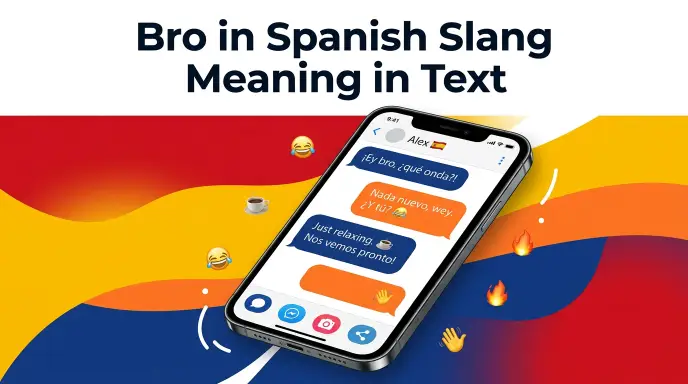
Bro in Spanish slang usually means “bro,” “dude,” “buddy,” or “close friend.” Spanish speakers often use the English word bro in casual chats, social media, gaming, and friendly conversations. The exact feeling can change with the speaker, region, and tone.
If you saw someone write “¿Qué pasa, bro?”, they most likely mean “What’s up, bro?” The person does not usually refer to a real brother. Instead, bro can show friendship, familiarity, or casual respect.
This guide explains the bro in Spanish slang meaning, where Spanish speakers use it, how it compares with Spanish words such as hermano, amigo, compa, pana, parce, and bróder, and when you should avoid it. You will also see natural examples from texting, social media, gaming, and everyday conversations.
Quick Answer
- Bro in Spanish slang means “bro,” “dude,” “buddy,” or “friend.” Spanish speakers often use it as a casual way to address someone they know or feel comfortable with. It comes from English bro, a short form of brother, and online Spanish speakers often mix it with Spanish words.
What Does Bro in Spanish Slang Mean in Text?
In text messages, bro usually means friend, dude, buddy, or bro.
The word does not always describe a close friendship. A person may use it with a friend, gaming partner, online contact, or someone they address in a relaxed way.
For example:
“Bro, ¿qué haces?”
“Bro, what are you doing?”
Here, bro adds a friendly and casual tone.
Another example:
“Gracias, bro.”
“Thanks, bro.”
The speaker uses bro to show familiarity. The word can also sound playful or humorous, especially in online conversations.
Does Bro Mean Brother in Spanish?
Sometimes, but context matters.
English speakers originally used bro as a short form of brother. Spanish speaking internet users can use the word in a similar way. However, they often use it for a friend or male companion, not only for a biological brother.
Spanish also has the word hermano, which literally means “brother.” So:
- Mi hermano = My brother
- Mi bro = My bro / My close friend
- Gracias, bro = Thanks, bro
- ¿Qué pasa, bro? = What’s up, bro?
The surrounding sentence usually makes the meaning clear.
Bro in Spanish Slang: Full Form and Definition
The English word bro comes from brother. Spanish speaking communities have adopted the short form in casual communication, especially in informal and online settings.
The Diccionario de americanismos from ASALE lists bro as a shortened form of English brother. It also records a friendly greeting, “¡eh, bro!”, in Puerto Rico and the United States.
So, the simplest definition is:
Bro = a casual way to address a male friend, buddy, or companion.
The meaning can change with tone. A friendly “bro” may show closeness. A sarcastic “bro” may show annoyance or disbelief.
Is Bro Rude, Offensive, or Neutral?
Bro usually sounds informal and neutral or friendly. It does not normally count as an offensive word.
Still, context matters.
A close friend may say:
“Bro, you have to see this!”
That sounds friendly.
Someone may also say:
“Bro, seriously?”
That sentence can show surprise, frustration, or disbelief.
The word itself does not create the negative tone. The situation and the speaker’s voice often do.
Can You Use Bro With Anyone?
Not always.
Bro works best in casual situations. It may sound too relaxed with:
- A teacher
- A boss
- A customer
- A formal client
- Someone you do not know well
- A formal school or business setting
For formal communication, use the person’s name or an appropriate title instead.
Where Is Bro Commonly Used?

Spanish speaking internet users can use bro in many informal settings. The word often appears in online communication because English internet slang mixes easily with Spanish.
You may see bro in:
- Text messages
- TikTok comments
- Instagram comments
- YouTube comments
- Discord chats
- Gaming conversations
- Group chats
- Memes
- Casual social media posts
For example:
“Bro, mira este video.”
“Bro, look at this video.”
Or:
“No puede ser, bro 😂”
“No way, bro 😂”
The exact frequency varies across Spanish speaking communities. Do not assume that every Spanish speaking country uses bro in the same way.
Bro in Spanish Texting
Texting gives bro a very casual feel.
Friends may place it at the beginning or end of a message:
“Bro, ¿ya llegaste?”
“Bro, did you arrive?”
“Nos vemos mañana, bro.”
“See you tomorrow, bro.”
People can also combine it with Spanish expressions:
“Bro, qué buena idea.”
“Bro, what a great idea.”
This type of mixed language message can appear naturally in online conversations.
Bro on TikTok, Instagram, and YouTube
On social media, bro often works as a reaction word.
For example:
“Bro really did that 😭”
A Spanish speaking user might mix English and Spanish:
“Bro, eso fue increíble.”
“Bro, that was incredible.”
Comments may also use bro to express surprise:
“Bro, ¿qué acabo de ver?”
“Bro, what did I just watch?”
The word can sound serious, funny, shocked, or sarcastic depending on the comment.
Bro in Gaming and Discord
Gaming communities often use short, casual words such as bro.
A Spanish speaking gamer might write:
“Bro, cúbreme.”
“Bro, cover me.”
Or:
“Buen juego, bro.”
“Good game, bro.”
Gamers may use the word with friends, teammates, or online players. In this setting, bro often creates a relaxed sense of teamwork.
However, you should not assume that every player wants an informal nickname. Keep the tone respectful when you meet someone new.
Spanish Alternatives to Bro
Spanish has many words that can express a similar idea. The best choice depends on the country and situation.
| Spanish term | Basic meaning | General feel |
| Bro | Bro / dude | Modern, casual |
| Hermano | Brother | Friendly or literal |
| Amigo | Friend | General and safe |
| Bróder | Bro / close friend | Informal, regional |
| Compa | Buddy / pal | Regional, very casual |
| Pana | Friend / buddy | Regional |
| Parce | Friend / buddy | Strongly associated with Colombia |
| Colega | Mate / friend | Common in some varieties of Spanish |
These words do not work as perfect substitutes everywhere. Spanish slang changes from one country and community to another.
Bro vs. Bróder
Bro and bróder share the same English source, but they do not have exactly the same distribution.
ASALE’s Diccionario de americanismos lists bróder as a form derived from English brother. It records the word for an intimate friend or inseparable companion in several countries, including Venezuela and Peru, and also records uses in other parts of Central America and the Caribbean.
So:
Bro → short, modern, internet friendly form
Bróder → Spanish shaped informal form with regional uses
What Is the Difference Between Bro and Hermano?
Hermano means “brother” in standard Spanish. It can refer to a real family member.
For example:
“Mi hermano vive en Madrid.”
“My brother lives in Madrid.”
But bro usually carries a more casual social meaning:
“Gracias, bro.”
“Thanks, bro.”
A person can use hermano with a friend too, especially in an affectionate or informal way. Context tells you which meaning fits.
Real Life Examples of Bro in Spanish Slang
Friendly Conversation
Luis: Bro, ¿quieres salir esta noche?
Marco: Sí, claro.
English:
Luis: Bro, do you want to go out tonight?
Marco: Yes, sure.
Text Message
“Bro, te mandé las fotos.”
“Bro, I sent you the photos.”
Surprise
“Bro, ¿en serio ganaste?”
“Bro, did you really win?”
Mild Frustration
“Bro, otra vez olvidaste las llaves.”
“Bro, you forgot the keys again.”
Here, bro does not make the sentence offensive. The frustration comes from the situation.
Gaming
“Bro, necesito ayuda en esta partida.”
“Bro, I need help in this match.”
Social Media
“Bro, ese video está buenísimo.”
“Bro, that video is awesome.”
Sarcastic Use
“Bro… ¿de verdad hiciste eso?”
“Bro… did you really do that?”
The pause can make the sentence sound humorous or disappointed.
Origin and Background of Bro in Spanish
The Spanish use of bro comes from English bro, which itself comes from brother.
Spanish speakers did not create the original English word. Instead, some Spanish speaking communities adopted it as an informal loanword. Online communication has made this kind of language mixing easier to notice.
The ASALE entry for bro directly identifies it as an abbreviation of English brother.
Spanish also has related forms such as bróder. ASALE traces bróder to English brother and records several regional meanings connected with close friendship and informal address.
The exact point when Spanish speakers first started using bro in every region is not clearly documented. Usage can also vary by country, age group, and online community.
Why Do Spanish Speakers Use Bro?
People use bro because it feels short, casual, and familiar.
It can help a message sound:
- Friendly
- Relaxed
- Playful
- Informal
- Familiar
- Modern
It can also fit naturally into mixed Spanish English speech.
For example:
“Bro, necesito tu ayuda.”
The Spanish sentence stays Spanish, while bro adds an informal English slang element.
When Should You Avoid Using Bro?
You should avoid bro when the situation requires formal or respectful language.
For example, avoid it in:
- Formal business emails
- Job interviews
- Official letters
- Formal presentations
- Professional complaints
- Important academic communication
- Conversations with someone who prefers formal language
Instead of:
“Bro, necesito hablar contigo.”
A formal speaker might say:
“Necesito hablar con usted.”
The second version fits a respectful situation much better.
Is Bro Safe for Social Media?
Yes, bro usually works as harmless casual slang on social media.
The word itself does not normally contain an offensive meaning. Still, the tone can change based on context.
A friendly comment such as:
“Gracias, bro!”
sounds positive.
A sarcastic comment such as:
“Bro, qué mala idea.”
can sound critical.
So, always look at the whole sentence before deciding what bro means.
Common Misunderstandings About Bro
1. Bro Always Means Biological Brother
Not necessarily. People often use bro for friends, teammates, and online contacts.
2. Bro Is Traditional Spanish Slang Everywhere
No. Bro comes from English. Spanish speaking communities have adopted it in informal communication, but it does not replace traditional regional slang.
3. Bro Has One Meaning in Every Spanish Speaking Country
No. Spanish slang varies by region. Words such as bróder, compa, pana, and parce can have different regional patterns.
4. Bro Always Sounds Friendly
Not always. Tone can make it playful, surprised, annoyed, or sarcastic.
FAQ’S
Q1. What does bro mean in Spanish slang?
Bro usually means “bro,” “dude,” “buddy,” or “friend.” Spanish speakers can use it as a casual form of address. The word comes from English bro, which comes from brother. Context determines if it sounds friendly, playful, surprised, or annoyed.
Q2. Is bro actually a Spanish word?
Spanish speakers do use bro in informal communication, but the word comes from English. ASALE lists bro as a shortened form of English brother and records a friendly greeting use in Puerto Rico and the United States.
Q3. What is the Spanish word for bro?
There is no single Spanish equivalent for every country. Amigo, hermano, bróder, compa, pana, and parce can express similar ideas in different contexts. The best choice depends on the country, relationship, and tone.
Q4. Does bro mean friend in Spanish?
Yes, bro can mean “friend” or “buddy” in informal Spanish conversations. A speaker may use it for a close friend or another person they address casually. It does not always refer to a family relationship.
Q5. Is bro rude in Spanish?
Bro is usually not rude or offensive. It sounds informal, though. Because of that, you should avoid it in formal work, school, or professional situations unless you know the setting allows casual language.
Q6. What does bróder mean in Spanish slang?
Bróder comes from English brother and can mean a close friend or inseparable companion in several Spanish speaking regions. ASALE records regional uses in countries such as Venezuela and Peru.
Conclusion
Bro in Spanish slang usually means “bro,” “dude,” “buddy,” or “friend.” Spanish speakers may use it in texting, gaming, social media, group chats, and other casual settings. The word comes from English bro, so it does not represent a traditional Spanish word for “brother.”
Context matters most. A message such as “Gracias, bro” sounds friendly, while “Bro, ¿en serio?” can show surprise or frustration. Spanish also has regional choices such as hermano, amigo, bróder, compa, pana, and parce.
If you are learning Spanish, remember that slang changes from one country and community to another. Use bro when the setting feels relaxed, but choose more standard Spanish in formal situations. When in doubt, amigo gives you a simple and widely understood option.
Learn More About!
- Bloody British Slang: What Does Bloody Mean?
- Very Muscular in Slang Crossword: Answer & Meaning
- What Does OOP Mean in Slang?