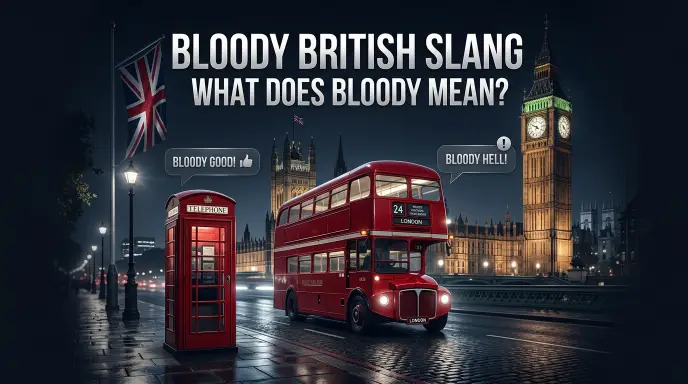
Bloody British slang usually uses the word “bloody” as an intensifier. In simple terms, it can mean “very,” “really,” or “extremely”, but it can also add anger, surprise, or strong emotion. British speakers often use it in casual speech, such as “bloody good,” “bloody cold,” or “bloody annoying.” Cambridge Dictionary labels this use as mainly UK and very informal.
You may hear bloody in British movies, TV shows, books, conversations, and online chats. The word can sound friendly in one sentence and rude in another. Your tone and the situation matter.
This guide explains the bloody British slang meaning in simple English. You will learn what the word means, how people use it, if it counts as a swear word, where it came from, and when you should avoid it. You will also see natural examples that show how the word works in real conversations.
Quick Answer
- In British slang, “bloody” works as a mild swear word and an intensifier that adds strong emphasis. It often means “very,” “really,” or “extremely.” For example, “That was a bloody good meal” means “That was a very good meal.” The word can also show anger, frustration, surprise, or excitement.
What Does Bloody Mean in British Slang?
The bloody British slang meaning depends on the sentence, but the most common slang use adds emphasis to another word.
Think of it as turning up the strength of a statement.
For example:
- “It is bloody cold.” = It is very cold.
- “That was bloody brilliant.” = That was really brilliant.
- “This is bloody annoying.” = This is extremely annoying.
- “He is a bloody fool.” = He is a very foolish person.
The word can work with both positive and negative ideas. It does not always show anger.
A speaker might say “bloody fantastic” to show excitement. Another person might say “bloody useless” to show frustration.
So, the emotion comes from the whole sentence.
Collins Dictionary also lists bloody as a mainly British slang intensifier and gives examples such as “a bloody fool” and “bloody fine food.”
Is Bloody a Swear Word in British English?
Yes, bloody can count as a mild swear word in British English. However, its strength can vary from person to person.
Oxford Learner’s Dictionaries describes this use as a British English swear word that people use to emphasize a comment or an angry statement. Cambridge calls it slightly rude and very informal.
That means the word usually does not carry the same force as stronger English profanity.
Still, you should not treat it as completely neutral.
For example:
“That was a bloody good movie.”
This sounds informal and mildly rude to some listeners.
“Please submit the bloody report today.”
This sounds more annoyed and less polite.
The speaker’s tone matters. A friendly tone can make the word sound playful. An angry tone can make it sound much harsher.
What Does “Bloody” Mean in Different Contexts?
The word has more than one meaning. These meanings should stay separate because they can change the whole sentence.
1. Bloody as an Intensifier
This is the main British slang use.
Here, bloody adds extra force to the next word.
Examples:
- bloody good
- bloody awful
- bloody hard
- bloody funny
- bloody expensive
- bloody annoying
In these examples, the word does not refer to blood.
For instance, “That exam was bloody hard” means the exam was very hard.
2. Bloody as a Literal Word
The normal English meaning relates to blood.
For example:
- “He had a bloody nose.”
- “The shirt had a bloody stain.”
- “The scene showed a bloody injury.”
Here, the word describes something connected with blood.
This meaning has nothing to do with British slang.
3. Bloody as a Description of Violence
The word can also describe an event that involves bloodshed or serious violence.
For example:
- “It was a bloody battle.”
- “The country went through a bloody conflict.”
In this use, bloody does not simply mean “very.”
The context tells you which meaning the speaker intends.
How Do British People Use “Bloody” in Conversation?
British speakers often place bloody before an adjective, noun, or another word they want to emphasize.
Common patterns include:
| Expression | Simple meaning |
| bloody good | very good |
| bloody awful | very bad |
| bloody brilliant | extremely good |
| bloody annoying | very annoying |
| bloody cold | extremely cold |
| bloody difficult | very difficult |
| bloody fool | very foolish person |
| bloody hell | strong surprise, anger, or frustration |
The expression “bloody hell” deserves special attention. People use it as an exclamation when something surprises, shocks, or annoys them.
For example:
“Bloody hell! That was close.”
The speaker may feel surprised or relieved.
The phrase can sound stronger than simple bloody because the speaker uses it as a direct emotional reaction.
Where Is Bloody British Slang Used?

You can find this expression in many forms of British communication, but the tone changes with the setting.
Text Messages
Friends may use bloody in casual texts.
“That was a bloody long day.”
The message sounds informal and emotional.
Social Media
British users may use it in comments, posts, or replies.
“That is bloody brilliant 😂”
The word can add excitement without making the comment highly offensive.
Movies and TV Shows
You may hear bloody often in British dialogue. Writers can use it to show a character’s personality, frustration, humor, or strong reaction.
Reddit and Online Communities
British users may use the word naturally in casual discussions.
However, not every use online comes from a British speaker. People from other countries also use bloody when they imitate or recognize British English.
Gaming
Players may use it when they feel annoyed or excited.
“That bloody boss got me again!”
This sentence shows frustration.
Workplace Chat
This area needs more care.
A close group of coworkers may use the word casually. Still, bloody remains informal and mildly rude. A professional email, formal meeting, customer message, or job interview usually calls for cleaner language.
Cambridge specifically marks this usage as very informal and slightly rude.
Is Bloody Rude or Offensive?
Bloody can sound rude, but most people view it as mild profanity rather than severe profanity.
The level of offense depends on the listener, setting, and tone.
| Situation | How it may sound |
| Close friends | Casual or playful |
| Family | Depends on family habits |
| Online chat | Informal |
| Gaming | Emotional or frustrated |
| School | Usually better to avoid |
| Workplace | Too informal for formal communication |
| Job interview | Avoid it |
| Customer service | Avoid it |
| Formal writing | Avoid it |
The word does not automatically insult someone.
For example:
“That was a bloody good idea.”
This can sound like strong praise.
But:
“You bloody idiot.”
This directly insults someone.
So, the phrase matters as much as the word itself.
Real Life Examples of Bloody British Slang
Here are natural examples that show different emotions and situations.
Talking About the Weather
Sam: “Are you going outside?”
Jack: “No way. It is bloody freezing.”
Here, bloody freezing means extremely cold.
Praising Food
Mia: “How was the new restaurant?”
Tom: “The food was bloody good.”
Here, bloody good means very good.
Showing Frustration
Alex: “Why are you still working?”
Ben: “This bloody computer keeps crashing.”
Here, the speaker uses bloody to show annoyance.
Showing Surprise
Ella: “Did you see that goal?”
Ryan: “Bloody hell! That was amazing.”
The phrase shows surprise and excitement.
Gaming
Player 1: “We almost won.”
Player 2: “That bloody boss ruined it again.”
Here, bloody adds frustration to the sentence.
Social Media
Comment: “That sunset is bloody beautiful.”
The commenter uses bloody to add strong praise.
Workplace
Coworker: “How did the meeting go?”
Employee: “It was a bloody nightmare.”
This may work in a casual conversation between coworkers who know each other well. A formal email would need a more professional phrase.
Where Did the Word “Bloody” Come From?
The word bloody has a long history in English. Its literal meaning relates to blood, and English records show the word in forms that go back to Old English. Collins gives its word origin as Old English “blōdig.”
The emphatic or swear word use has a more complicated history.
Oxford Learner’s Dictionaries dates this use to around the mid 17th century. It also says that the exact reason for the intensifier remains uncertain. One theory connects the use with the word “bloods,” which referred to rowdy young aristocrats in the late 17th and early 18th centuries.
Older sources show that people once treated the word as much more offensive than many speakers do today. Its social meaning changed over time.
Because historical explanations differ, it is better to avoid claims that say one exact event created the slang. The evidence does not support such certainty.
Similar British Slang Words
Several words can add emphasis in informal British English.
| Word or phrase | General effect |
| bloody | Mild emphasis or profanity |
| damn | Mild emphasis or annoyance |
| really | Strong emphasis without profanity |
| very | Simple emphasis |
| proper | Strong informal emphasis in some British speech |
| bloody hell | Strong surprise, anger, or frustration |
The best choice depends on the situation.
If you want to sound polite, really or very usually works better than bloody.
Polite Alternatives to Bloody
You can replace bloody with a neutral word when you want a cleaner tone.
Instead of:
“That was bloody amazing.”
Try:
“That was really amazing.”
Instead of:
“It is bloody cold.”
Try:
“It is extremely cold.”
Instead of:
“This is bloody difficult.”
Try:
“This is very difficult.”
These alternatives keep the meaning while removing the mild profanity.
When Should You Avoid Using Bloody?
You should avoid bloody when the situation requires formal or careful language.
For example, avoid it in:
- Job interviews
- Formal emails
- Academic assignments
- School presentations
- Customer service messages
- Official documents
- Professional introductions
- Formal meetings with people you do not know well
You should also avoid it when you do not know how the listener feels about swear words.
With friends, the word may sound natural. With a teacher, employer, client, or stranger, a neutral alternative gives you less risk.
Is Bloody Still Common?
Bloody remains a recognizable part of British informal English, but its strength varies by speaker and setting.
Some British speakers use it casually. Others rarely use it because they prefer cleaner language.
You may also hear it in older British films, television shows, books, and comedy. Younger speakers can understand the word even when they do not use it often.
Popularity status: Common and recognizable in British informal English.
This does not mean every British person uses it. Regional, personal, and generational differences affect slang use.
Common Misunderstandings About Bloody
“Bloody” Always Means Blood
Not in British slang.
In “a bloody nose,” the word relates to blood.
In “a bloody good film,” it adds emphasis.
The surrounding words reveal the meaning.
Bloody Always Means Something Negative
Not true.
People can use it with positive words.
“That was bloody brilliant.”
Here, the speaker praises something.
Bloody Means the Same Thing Everywhere
No.
British English uses the word as an informal intensifier much more clearly than American English. American speakers may understand the British use, but they may associate the word more strongly with its literal meaning or with British speech. Collins lists the intensifier as British slang.
Bloody Is Extremely Offensive
Usually, no.
It can sound rude or offensive to some people, but dictionaries generally place it in the mild to moderate range of informal profanity rather than among the strongest swear words.
FAQ’S
Q1: What does bloody mean in British slang?
In British slang, bloody usually acts as an intensifier. It can mean “very,” “really,” or “extremely,” while also adding emotion. For example, “bloody good” means “very good.” The word can show praise, anger, frustration, surprise, or annoyance. The exact feeling depends on the sentence and the speaker’s tone.
Q2:Is bloody a British swear word?
Yes. British dictionaries describe this use as informal profanity or a swear word. However, many speakers consider it relatively mild. Cambridge describes the word as slightly rude, while Oxford lists it as a British English swear word.
Q3:What does “bloody hell” mean?
“Bloody hell” works as an emotional exclamation. People may say it when they feel surprised, shocked, annoyed, or impressed. For example, “Bloody hell! That was close!” shows a strong reaction to something unexpected.
Q4:Can bloody mean very?
Yes. In British informal English, bloody can work like “very” or “extremely.” For example, “It is bloody cold” means “It is extremely cold.” This use focuses on emphasis rather than the literal meaning of blood.
Q5:Is bloody rude in British English?
It can sound rude because it functions as a mild swear word. Friends may use it without taking offense, but formal situations need more care. Your relationship with the listener and the tone of the conversation can change how the word feels.
Q6:Can I use bloody at work?
You can hear it in casual workplace conversations, but it does not suit formal communication. Avoid it in professional emails, interviews, customer messages, and official documents. Words such as really, very, or extremely provide safer choices.
Q7:Does bloody always refer to blood?
No. British slang often uses bloody as an intensifier. In “bloody good,” it has no literal connection to blood. In “bloody hands,” the word may describe actual blood. Context tells you which meaning applies.
Q8:Is bloody still used in British English?
Yes. Many people still recognize and use bloody as an informal intensifier. However, not every British speaker uses it, and personal preferences can differ. The word remains strongly associated with informal British speech.
Conclusion
The bloody British slang meaning usually involves strong emphasis. In many casual sentences, bloody means something like “very,” “really,” or “extremely.” It can add excitement, praise, frustration, anger, or surprise.
The word has several meanings, so context matters. “Bloody good” means very good, while “a bloody nose” refers to actual blood. The famous phrase “bloody hell” works as an emotional exclamation.
British speakers often use the slang form in casual speech, texting, online conversations, gaming, and entertainment. Still, bloody can sound rude because it functions as mild profanity. Formal settings call for safer choices such as really, very, or extremely.
The easiest rule is simple: use “bloody” when you understand the informal tone, and choose a neutral word when you need to sound professional or polite.
Read More About!
- Very Muscular in Slang Crossword: Answer & Meaning
- What Does OOP Mean in Slang?
- 2013 Slang: Popular Words and Their Meanings