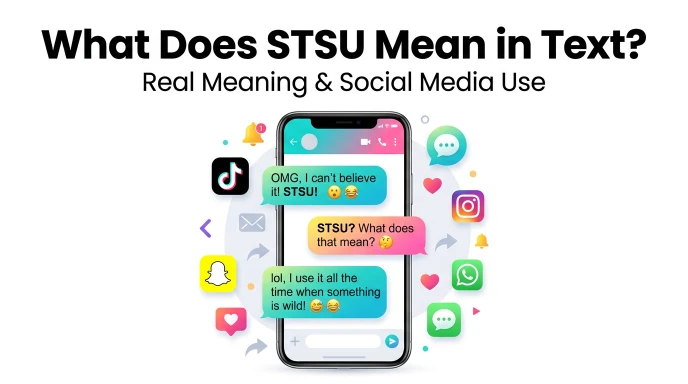
STSU usually works as an informal “shut up” expression in text, often used to show surprise, disbelief, teasing, or annoyance. You may see it in texts, TikTok comments, Snapchat, Instagram DMs, WhatsApp chats, and group conversations.
If someone sends you “STSU”, do not assume they want you to stop talking right away. Friends can use it as a dramatic reaction to surprising or funny news.
The tricky part comes from the fact that STSU does not have one fixed, widely accepted expansion. Online references commonly connect it with a “shut up” phrase, but different users may interpret the letters in slightly different ways.
That makes context very important. The same four letters can sound playful in one chat and rude in another. This guide explains what STSU means, how people use it, how to reply, and when you should avoid it.
What Does STSU Mean in Text?
STSU is an informal texting abbreviation connected with a “shut up” expression. Many online slang references interpret it as a shortened form of “Shut The Sh*t Up” or a softer variation such as “Shut The Stuff Up.”
The exact expansion can vary because STSU does not have the same level of standardization as common abbreviations such as LOL, IDK, or BRB.
In simple words, STSU can communicate:
- “Shut up.”
- “Stop it.”
- “No way!”
- “You’re kidding!”
- “I can’t believe you.”
- “Seriously?”
- “That is unbelievable.”
The intended meaning depends on the conversation.
For example:
A: I just met my favorite singer.
B: STSU 😭
A: I’m serious!
Here, B probably does not want A to stop talking. B reacts with surprise and disbelief.
Now look at a different example:
A: You keep interrupting me.
B: STSU and let me finish.
This version sounds much more direct. The sender likely wants the other person to stop talking.
That difference shows why you should read the whole conversation before deciding what STSU means.
Is STSU Slang, an Acronym, or an Abbreviation?
STSU works as informal internet slang and an abbreviation.
People form many texting shortcuts by taking the first letters of several words. STSU follows that general pattern, although its exact expansion varies among users.
Unlike a formal abbreviation, STSU does not have one universally accepted definition.
That point matters for beginners. If you search several websites, you may find slightly different explanations. Current online references consistently describe STSU as context dependent and often connect it with a “shut up” expression.
What Does STSU Mean in Everyday Chat?
In everyday chat, STSU often acts as an emotional reaction.
Someone may type it after hearing something surprising, funny, embarrassing, or hard to believe.
For example:
“I got front row tickets.”
“STSU 😭”
The second person may mean:
“No way!”
They use a stronger phrase because the news surprised them.
STSU can also sound playful between close friends.
“I ate the whole cake.”
“STSU 😂”
The sender may simply be joking about the person’s comment.
Still, STSU can sound rude if the relationship does not support that type of humor.
Where Do People Use STSU?
STSU can appear in casual digital conversations across different platforms. However, it does not have one official meaning on each platform.
The same general context rule applies everywhere: look at the message around STSU before deciding what the sender means.
STSU on TikTok
TikTok comments often use short slang expressions because users want to react quickly.
Someone may write:
“STSU 😭 I can’t believe she did that.”
The comment probably expresses surprise or disbelief.
Another user might write:
“STSU this is too funny.”
Here, the phrase can act like a dramatic reaction rather than a serious command.
TikTok also spreads slang between different communities. A term that starts in one online group can reach users who interpret it differently.
For that reason, you should not assume that every TikTok user uses STSU in exactly the same way.
STSU on Snapchat
Snapchat encourages quick, informal conversations, so abbreviations can fit naturally into chats.
A friend might send:
“STSU you actually went there?”
The sender may simply express surprise.
Another message could say:
“STSU 😂 that’s crazy.”
The laughing emoji gives the message a lighter tone.
Without context, however, the same abbreviation may feel confusing.
STSU on Instagram
Instagram users may use STSU in:
- Direct messages
- Comments
- Story replies
- Group chats
- Casual captions
For example:
“STSU, you look amazing in that picture.”
Between close friends, this may sound like exaggerated praise.
However, you should be careful when using the term with someone you do not know well. The “shut up” idea can make the message sound dismissive.
STSU on WhatsApp
WhatsApp conversations often involve friends, family, classmates, and work groups.
A friend might say:
“STSU, I just saw your old photo.”
That could sound like playful teasing.
A family member may not understand the abbreviation at all. Someone may also interpret it literally because they do not know the slang.
STSU in SMS
People can use STSU in normal text messages too.
For example:
“STSU, you’re telling me this now?”
The sender may express surprise or frustration.
SMS has fewer visual clues than some social platforms. Without emojis or reaction stickers, the reader may find it harder to tell if the sender is joking.
That makes the relationship and previous conversation even more important.
Real Chat Examples of STSU
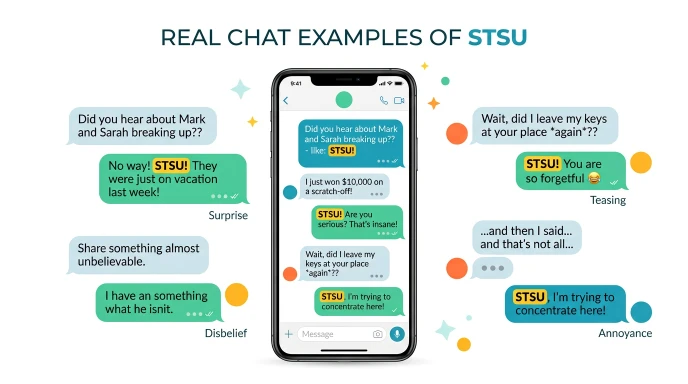
These examples show how STSU can work in different situations.
1. Surprise
A: Guess who I saw at the mall?
B: Who?
A: My old teacher.
B: STSU 😭
A: I swear!
Here, STSU shows surprise.
2. Funny Reaction
A: I tried cooking pasta and burned the pot.
B: STSU 😂
A: Don’t laugh at me.
B: I’m sorry, but that’s impressive.
The phrase works as playful teasing.
3. Exciting News
A: I got tickets for the concert!
B: STSU!
A: Yes! We are going together.
The sender reacts with excitement.
4. Disbelief
A: He finished the entire project in one night.
B: STSU, seriously?
A: Yep. I watched him do it.
Here, STSU signals disbelief.
5. Embarrassing Story
A: I waved at someone who wasn’t waving at me.
B: STSU 😭
A: I wanted to disappear.
B: I would have done the same.
The expression adds humor to the conversation.
6. Gaming Chat
A: I won the match with one health point left.
B: STSU 😂
A: Look at the replay.
B: That’s actually crazy.
Here, the phrase expresses surprise.
7. Friendly Teasing
A: I forgot my own birthday plans.
B: STSU, you’re unbelievable.
A: I know 😭
B: At least you remembered eventually.
This example shows playful annoyance.
8. Serious Argument
A: You keep talking over me.
B: STSU and listen.
A: That’s not helping.
Here, STSU sounds rude and aggressive.
The context changes the meaning completely.
9. Instagram DM
A: Did you see my new haircut?
B: STSU 😭 You actually did it?
A: Yep.
B: It looks good though.
The phrase shows surprise rather than anger.
10. Group Chat
A: I’m moving to another city next month.
B: STSU WHAT?
C: Wait, you’re serious?
A: Completely serious.
The group uses STSU as an emotional reaction to unexpected news.
How to Reply When Someone Says “STSU”
Your reply should depend on the tone.
If the person sounds playful, you can respond casually. If the message feels aggressive, you can stay calm and ask what they mean.
Funny Replies
If a close friend uses STSU jokingly, you might reply:
“Make me 😂”
Or:
“You heard me!”
Another playful response:
“Why are you so shocked?”
These replies work best when both people already joke in that way.
Casual Replies
You can keep things simple:
“Lol, I’m serious.”
Or:
“Yep, that actually happened.”
You can also say:
“I know, right?”
Friendly Replies
If the sender seems surprised but friendly, try:
“I promise I’m not joking.”
Or:
“Haha, I knew you’d react like that.”
Neutral Replies
If you do not understand the tone, use a neutral response:
“What do you mean?”
Or:
“Are you joking or serious?”
You can also ask:
“What does STSU mean here?”
That last option makes sense when the abbreviation appears without enough context.
Is STSU Rude or Offensive?
STSU can sound rude or offensive, depending on the context.
The biggest issue comes from its connection with a “shut up” expression. Telling someone to stop talking can sound disrespectful, especially during an argument.
Among close friends, people sometimes use the expression playfully.
For example:
“STSU 😂 You did not actually say that.”
The laughing emoji and friendly context can make the phrase feel less serious.
Now compare it with:
“STSU. I’m done listening to you.”
This message sounds much harsher.
The relationship also matters.
A close friend may understand your joke. A stranger may not.
Is STSU Safe to Use?
STSU is generally safer in casual conversations where everyone understands the slang.
Still, it carries some risk because not everyone knows what it means or how the sender intends it.
Avoid it when:
- You are speaking with a stranger.
- You are in a serious argument.
- You are talking to a teacher.
- You are messaging a customer.
- You are writing to an employer.
- You are sending a formal email.
- You are communicating with someone who may not understand slang.
When clarity matters, write the full message instead.
Is STSU Appropriate at School?
STSU may appear in private chats between students, but it does not fit formal school writing.
Avoid it in:
- Essays
- Assignments
- School applications
- Presentations
- Messages to teachers
- Official school communication
If a teacher asks a question, do not respond with STSU simply because you use it with friends.
The audience changes the appropriate language.
Is STSU Appropriate at Work?
STSU usually does not belong in professional communication.
Even if coworkers joke with each other, the phrase can create confusion or sound disrespectful.
Instead of:
“STSU, I already sent it.”
A professional message could say:
“I already sent the file. Please check your inbox.”
The second version gives the same basic information without the slang.
Who Uses STSU?
STSU appears mainly in informal digital communication.
You may see it among people who regularly use texting slang, social media abbreviations, memes, and online humor.
You should not assume that every young person knows STSU.
Unlike very common abbreviations such as LOL, IDK, and BRB, STSU has a less stable meaning. Current references describe it as relatively uncommon and context dependent.
Do Gen Z Users Use STSU?
Some younger internet users may recognize or use STSU, especially in casual chats and social media spaces.
However, calling it exclusively “Gen Z slang” would be too broad.
Online language spreads between age groups. A person may learn an abbreviation from TikTok, a friend, Discord, Reddit, or another online community.
The important point is that STSU belongs to informal internet language rather than a specific age group.
Where Does STSU Appear Most?
You may encounter it in:
- Text messages
- TikTok
- Snapchat
- Discord
- Group chats
- Online communities
- Gaming conversations
The frequency can vary widely.
Some people use STSU often. Others may never use it.
Where Did STSU Come From?
The exact origin of STSU remains unclear.
There does not appear to be a reliable source that identifies one person, website, or social media platform as the creator of the abbreviation.
Current online references generally describe STSU as informal and less standardized than common texting abbreviations. They often connect it with a shortened “shut up” expression.
The formation itself follows a familiar internet pattern.
People often shorten longer phrases into their first letters. This saves time and makes quick conversations easier.
The exact letters can also vary because users create their own versions.
Some references interpret STSU as:
“Shut The Sh*t Up”
Others describe it as:
“Shut The Stuff Up”
Some sources simply describe it as a general “shut up” expression without assigning one exact expansion.
That variation is one reason you should avoid presenting one expansion as an official definition.
Did TikTok Create STSU?
There is no strong evidence that TikTok created STSU.
TikTok may help slang spread, but that does not prove that the platform invented a term.
The same principle applies to Instagram, Snapchat, and other social networks.
Internet slang often develops across many communities at once.
STSU Compared With IDK, IDC, IMO, and BRB
STSU belongs to the same broad world of online abbreviations, but each term has a different function.
| Term | Meaning | Type | Usage | Popularity |
| STSU | Informal “shut up” expression; exact expansion can vary | Slang abbreviation | Surprise, teasing, disbelief, annoyance | Less common |
| IDK | I don’t know | Initialism | Shows uncertainty | Very common |
| IDC | I don’t care | Initialism | Shows indifference | Very common |
| IMO | In my opinion | Initialism | Introduces an opinion | Very common |
| BRB | Be right back | Initialism | Says the person will return soon | Very common |
The difference becomes clear in examples.
“IDK what happened.”
The writer does not know.
“IDC what happened.”
The writer does not care.
“IMO this one is better.”
The writer gives an opinion.
“BRB, someone is calling me.”
The writer temporarily leaves the conversation.
“STSU 😭 You actually won?”
The writer reacts strongly to surprising news.
STSU therefore works more like an emotional reaction than a simple information shortcut.
Real World Usage Example
Imagine two classmates chatting after school.
One student says:
“Guess what? I got tickets to the concert.”
The other student replies:
“STSU! You’re actually going?”
The first student answers:
“Yes! My cousin bought the tickets yesterday.”
The second student might then say:
“No way. I thought they were sold out.”
In this situation, STSU most likely expresses surprise.
Now imagine a different situation.
Two people are arguing about a project.
One person says:
“You never listen to anything I say.”
The other responds:
“STSU and let me explain.”
Here, the abbreviation sounds much more hostile.
The letters have not changed. The context has changed.
That is one of the most important things to remember about internet slang.
Can STSU Have Other Meanings?
Yes.
Because STSU lacks a single standardized definition, people may use the same letters for different purposes.
A private group could create STSU as an abbreviation for:
- A group name
- A project
- An event
- A gaming term
- An inside joke
- A username
- A specific phrase
For example:
“Meet me in the STSU channel.”
If STSU refers to a Discord channel, it clearly does not function as a “shut up” reaction.
STSU can also appear as a typo.
Fast typing creates mistakes all the time. If the surrounding sentence does not support any known meaning, the sender may have typed the letters accidentally.
When the meaning remains unclear, simply ask:
“What does STSU mean here?”
That question is better than making a confident guess.
How Context Changes the Meaning of STSU
Context gives you clues about the intended tone.
Emojis
An emoji can make a big difference.
“STSU 😂”
This may sound playful.
“STSU 😭”
This may show disbelief or humorous shock.
Without an emoji:
“STSU.”
The message may feel more direct.
Punctuation
Punctuation can also change the feeling.
“STSU!”
This may show excitement or shock.
“STSU?”
This could show confusion.
“STSU…”
This may suggest disbelief or hesitation.
These clues do not guarantee the meaning, but they can help.
Relationship
A close friend may use STSU as a joke.
A stranger may make the same phrase sound insulting.
Think about how the person normally talks to you.
That background can help you understand the intended tone.
Common Mistakes People Make With STSU
Assuming STSU Has One Official Expansion
It does not have the same level of standardization as common terms such as IDK or BRB.
Several current references describe different interpretations.
Assuming It Always Means “Be Quiet”
Sometimes STSU works as a playful reaction.
For example:
“STSU 😭 That’s unbelievable.”
The sender may mean “No way!” rather than giving a serious command.
Using It With Everyone
Slang depends on relationships.
A close friend may understand your joke. A stranger may not.
Ignoring the Tone
Read the whole conversation.
Look at the words before and after STSU.
Check emojis and punctuation too.
Treating Social Media Usage as a Universal Definition
One TikTok comment does not define how every person uses STSU.
Internet communities often create their own meanings.
When Should You Avoid Using STSU?
Avoid STSU when you need to sound respectful, clear, or professional.
That includes:
- Job interviews
- Formal emails
- Workplace reports
- Customer service
- School assignments
- Academic writing
- Professional presentations
- Serious complaints
- Conversations with strangers
You should also avoid it if you are unsure if the other person understands the slang.
A simple sentence often works better.
Instead of:
“STSU, that’s not true.”
You could say:
“I don’t think that’s true.”
Instead of:
“STSU, you’re serious?”
You could say:
“Wait, are you serious?”
The second versions remove the risk of sounding rude.
Why Do People Use STSU?
People use short slang because digital conversations move quickly.
Typing four letters takes less effort than writing a longer reaction.
STSU can also make a message feel more dramatic.
Compare:
“You actually did that?”
with:
“STSU 😭 You actually did that?”
The second message feels more emotional and expressive.
Friends may also use strong phrases as part of their shared humor.
That does not mean the phrase works with everyone.
Internet slang depends on social context. A phrase can feel funny inside one friendship and offensive outside it.
Is STSU Still Common?
STSU exists in current online slang, but it does not have the same broad recognition as very common abbreviations such as IDK, LOL, or BRB.
Several recent references describe STSU as relatively uncommon or less standardized.
That explains why many people search for its meaning after seeing it for the first time.
You may know dozens of common texting abbreviations but still find STSU confusing.
If someone sends it to you, do not worry about missing some universal rule. The sender may use a personal or community specific version.
When the meaning feels unclear, ask.
FAQ’s
Q1:What does STSU mean in text messages?
STSU usually works as an informal “shut up” expression. People may use it to show surprise, disbelief, teasing, or annoyance. The exact expansion can vary, so context matters.
Q2:What does STSU mean on TikTok?
On TikTok, STSU can work as a dramatic reaction to surprising, funny, or unbelievable content. It may express something like “No way!” rather than literally telling someone to stop talking.
Q3:Is STSU slang?
Yes. STSU functions as informal internet slang or a texting abbreviation. Unlike very common abbreviations, it does not have one universally accepted meaning.
Q4:Is STSU rude or offensive?
It can be. STSU connects with a “shut up” expression, so it may sound disrespectful in a serious conversation. Close friends may use it jokingly, but strangers may interpret it differently.
Q5:How should you reply to STSU?
Check the tone first. If the sender sounds playful, you can respond with humor. If you feel unsure, ask “What do you mean by STSU?” A neutral question can prevent a misunderstanding.
Conclusion
STSU is an informal texting expression that usually connects with “shut up.” People may use it to show surprise, disbelief, teasing, excitement, or genuine annoyance.
The important detail is that STSU does not have one fully standardized expansion. Current online references give slightly different interpretations, which means the surrounding conversation matters.
You may see STSU in texts, TikTok comments, Snapchat, Instagram, WhatsApp, Discord, and other casual online spaces. Friends may use it playfully, while the same expression can sound rude during an argument.
If you are unsure about the sender’s intention, look at the words around STSU, emojis, punctuation, and your relationship with that person.
For school, work, formal writing, or conversations with strangers, choose clearer language. That simple choice can help you avoid confusion and keep your message respectful.
Dig More About!
What Does STG Mean in Text? Real Meaning,Social Media Use
CB Slang Meaning: What Does CB Mean in Text?
JS Meaning Slang: What Does JS Mean in Text?