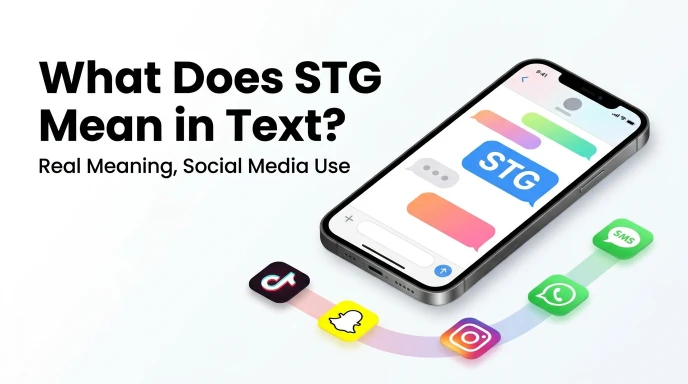
STG usually means “swear to God” in text messages and online slang. People use it to strongly emphasize that they are telling the truth, making a serious promise, or expressing a strong feeling. You may see it in texts, TikTok comments, Snapchat messages, Instagram posts, and other casual chats.
If someone writes “STG I didn’t do it,” they usually mean, “I swear to God, I didn’t do it.” The phrase can sound serious, frustrated, funny, or dramatic depending on the conversation.
People often search for STG meaning in text because these three letters can look confusing when you first see them. Once you know the meaning, the abbreviation becomes easy to understand.
What Does STG Mean in Text?
In everyday texting, STG means “swear to God.” It works as an abbreviation or initialism because each letter comes from a word in the full phrase:
- S = Swear
- T = To
- G = God
Collins Dictionary lists STG as a messaging and social media abbreviation for “swear to God.” Wiktionary also lists STG as an internet slang initialism with the same meaning.
People normally use STG to add extra force to a statement.
For example:
“STG I saw him at the mall.”
The person wants you to believe that they really saw him.
Another example:
“STG this homework never ends.”
Here, the writer uses STG to show strong frustration. They do not necessarily mean that they are making a formal religious oath.
That difference matters. Online slang often borrows phrases from normal speech and turns them into quick expressions of emotion.
Is STG Slang, an Acronym, or an Abbreviation?
STG works as an initialism and internet abbreviation.
An initialism uses the first letters of several words. People normally read each letter separately rather than pronounce STG as one word.
For example:
- STG = “swear to God”
- IDK = “I don’t know”
- IDC = “I don’t care”
- IMO = “in my opinion”
- BRB = “be right back”
In casual internet conversations, people often type these short forms because they save time and fit naturally into quick messages.
What Does STG Mean in Everyday Chat?
STG usually adds emphasis.
A person might use it when they want to:
- Confirm that something is true
- Defend themselves
- Make a strong promise
- Show frustration
- Emphasize an opinion
- React dramatically
- Show that they are not joking
Consider these two messages:
“That movie was so good.”
“STG that movie was so good.”
The second message carries more emotion. The writer wants to make the reaction feel stronger.
The exact tone depends on the rest of the message.
Where Do People Use STG?
STG fits casual digital communication. People may type it in private messages, group chats, comments, and social media conversations.
The basic meaning usually stays the same across platforms. The surrounding conversation changes the tone.
STG on TikTok
TikTok comments often use short slang terms and abbreviations. STG can appear when someone strongly reacts to a video.
For example:
“STG this is the funniest video today.”
The commenter uses STG to make the reaction stronger.
Another example:
“STG I watched this five times.”
The writer emphasizes how much they enjoyed the video.
STG on Snapchat
Snapchat conversations move quickly, so short forms fit naturally there.
Someone might write:
“STG I didn’t screenshot anything.”
The sender uses STG to strongly deny the action.
Another message could say:
“STG you’re making me laugh too hard.”
Here, the phrase sounds playful rather than angry.
STG on Instagram
Instagram users may use STG in comments, DMs, captions, or replies.
For example:
“STG this outfit looks amazing.”
The abbreviation adds enthusiasm.
A friend might also reply:
“STG you always find the best places to eat.”
The tone feels friendly and casual.
STG on WhatsApp
WhatsApp chats can include STG when friends or family members want to emphasize something.
For example:
“STG I sent the file yesterday.”
The sender strongly insists that they already sent it.
People may also use lowercase:
“stg that was crazy.”
Lowercase does not change the meaning. It simply reflects the writer’s normal texting style.
STG in SMS
Traditional text messages can also include STG.
For example:
“STG I’ll be there at 8.”
The sender uses the abbreviation to strengthen a promise.
However, STG belongs to informal communication. A formal email or professional message usually needs clearer and more neutral language.
Real Chat Examples of STG
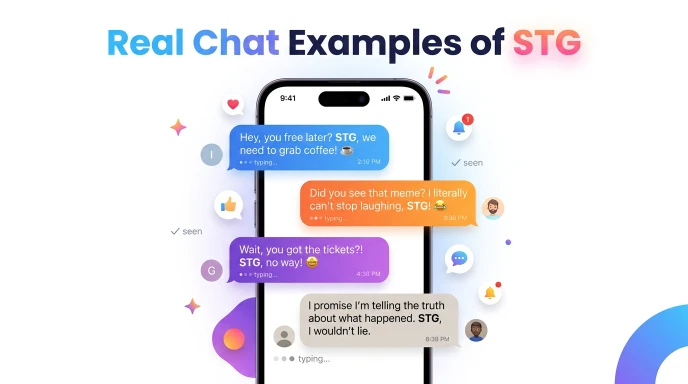
These examples show how STG can change tone depending on the situation.
Defending Yourself
A: Did you take my charger?
B: No, STG I didn’t touch it.
A: Okay, I’ll check my room again.
Here, STG makes B’s denial stronger.
Making a Promise
A: Are you really coming tomorrow?
B: Yes, STG I’ll be there.
A: Okay, don’t disappear this time.
The abbreviation adds extra emphasis to the promise.
Showing Frustration
A: How’s the internet?
B: Terrible. STG it keeps disconnecting.
A: Mine is doing the same thing.
Here, STG highlights B’s frustration.
Talking About Food
A: Was the new burger place good?
B: STG it was amazing.
A: Now I want one too.
The tone feels excited and friendly.
Talking About a Movie
A: Did you watch the ending?
B: STG I did not expect that twist.
A: Same! I was shocked.
STG emphasizes surprise.
School Conversation
A: Did you finish the science project?
B: STG I finished it at midnight.
A: That sounds painful.
The writer uses STG to stress the truth of the statement.
Gaming Chat
A: Did you really get that rare item?
B: STG, look at my inventory.
A: No way!
Here, the abbreviation helps the player emphasize their claim.
Funny Conversation
A: You ate the whole pizza?
B: STG it was only three slices.
A: The box says otherwise.
The serious looking abbreviation can create a funny effect when the situation feels obviously exaggerated.
Instagram Comment
A: This picture is so good.
B: STG the lighting is perfect.
A: Right? I almost didn’t post it.
The abbreviation adds emphasis to the compliment.
Making a Strong Statement
A: Are you going to watch the game tonight?
B: STG I’m not missing it.
A: Then I’ll message you before it starts.
The speaker uses STG to show strong intention.
How to Reply When Someone Says “STG”
You do not need a special response every time someone uses STG. Read the sentence first. Then respond to the actual point.
Funny Replies
If a friend uses STG in a playful way, you can answer with humor.
“Okay, your honor 😂”
Or:
“I need evidence.”
You can also say:
“That’s a serious promise!”
These replies work best with friends who understand your humor.
Casual Replies
For normal conversations, keep your reply simple.
“Okay, I believe you.”
Or:
“Got you.”
You can also say:
“Fair enough.”
Friendly Replies
If someone uses STG to reassure you, you can respond warmly.
“Okay, I trust you.”
Or:
“No worries, I believe you.”
Neutral Replies
If you do not want to match the slang, answer normally.
“Thanks for explaining.”
Or:
“Okay, understood.”
You do not need to use STG just because the other person used it.
Is STG Rude or Offensive?
STG is not automatically rude or offensive. People often use it casually with friends and online communities.
However, the phrase contains a reference to God. Because of that, some people may not feel comfortable using it or hearing it. Religious beliefs and personal preferences can affect how someone reacts to the expression.
Tone also matters.
For example:
“STG this cake is amazing!”
This sounds playful and excited.
Compare that with:
“STG if you do that again, I’m done with you.”
This version can sound angry or threatening.
The abbreviation itself does not create the entire tone. The words around it matter.
Is STG Safe to Use at School?
It depends on the school, audience, and conversation.
Among friends, a student may use STG in a casual chat. However, school assignments, presentations, and formal messages need standard language.
For example, instead of:
“STG I finished the project.”
A student can write:
“I finished the project.”
The second version sounds clearer and more appropriate for formal school communication.
Is STG Appropriate at Work?
STG usually fits better in casual personal conversations than professional communication.
Avoid it in:
- Formal emails
- Job applications
- Reports
- Client messages
- Official documents
- Professional presentations
A casual coworker chat may have a different tone, but you should still consider your workplace culture.
When you need to sound professional, simply state the message without the abbreviation.
Who Uses STG?
STG appears most naturally in informal online communication. Younger internet users may recognize it from texting, social media, and online communities.
However, you should not assume that only Gen Z uses the term. Internet abbreviations can spread across different age groups when people communicate online.
You may see STG in:
- Group chats
- Text messages
- TikTok comments
- Snapchat
- Discord
- Gaming chats
- Online forums
The term also appears in different forms. Some people type STG, while others use stg.
Both forms normally carry the same slang meaning.
There is also a closely related form:
ISTG = I swear to God
For example:
“ISTG this always happens.”
STG and ISTG often perform almost the same job in a conversation.
Where Did STG Come From?
The slang form STG comes directly from the phrase “swear to God.” Internet users shortened the phrase into its initial letters for quick digital communication. Dictionaries and slang references now record this messaging use.
The exact moment when people first started using STG as internet slang is not clearly established by the major dictionary sources reviewed here.
That uncertainty matters.
You may find websites that give specific dates or claim that one platform created the term. Such claims need strong historical evidence. The safer explanation is that STG developed as a shortened form of an already familiar spoken phrase and gained use in digital communication.
A related form, S2G, also means “swear to God.” Wiktionary lists s2g as an internet slang abbreviation and gives stg as an alternative form.
STG vs. IDK, IDC, IMO, and BRB
These abbreviations all appear in online communication, but they serve different purposes.
| Term | Meaning | Type | Usage | Popularity |
| STG | Swear to God | Initialism | Emphasis, promises, strong reactions | Common in casual slang |
| IDK | I don’t know | Initialism | Uncertainty or lack of information | Very common |
| IDC | I don’t care | Initialism | Indifference | Very common |
| IMO | In my opinion | Initialism | Giving an opinion | Very common |
| BRB | Be right back | Initialism | Temporarily leaving a chat | Well known |
These abbreviations do not replace one another.
For example:
“IDK what happened.”
shows uncertainty.
“IDC what happened.”
shows that the speaker does not care.
“IMO it was the best option.”
introduces an opinion.
“BRB, someone is calling me.”
tells the other person that the speaker will return.
“STG I saw it happen.”
strongly emphasizes the speaker’s claim.
The context makes each abbreviation easy to understand once you know the basic meaning.
Real World Usage Example
Imagine two friends meet after school.
One friend says:
A: “Did you really see Mia at the new café?”
The other friend answers:
B: “STG, I saw her there with her sister.”
Here, STG adds force to the answer. The speaker wants their friend to know that the statement is genuine.
The conversation could continue:
A: “Seriously?”
B: “Yes! I was sitting at the table next to them.”
In this situation, STG sounds natural because the friends already have a casual relationship.
Now imagine the same phrase in a formal email:
“STG I sent the report yesterday.”
That sentence would sound out of place.
A better professional version would say:
“I can confirm that I sent the report yesterday.”
The meaning stays similar, but the second version fits the setting better.
Can STG Have Other Meanings?
Yes. Context can give STG other meanings outside internet slang.
For example, Collins lists stg as an abbreviation for sterling, while other references list specialized meanings in different fields.
CyberDefinitions also lists another gaming related meaning, “shoot ’em up,” for STG.
That means you should not automatically translate every instance of STG as “swear to God.”
Look at the sentence around it.
If someone writes:
“STG I can’t believe that happened.”
the slang meaning clearly fits.
If you see:
“£500 STG”
the context points toward sterling rather than internet slang.
Context solves the confusion.
Why Do People Use STG?
People use STG because it gives a message extra emotional weight without requiring a long phrase.
Instead of typing:
“I swear to God that I am telling you the truth.”
someone can simply write:
“STG I’m telling you the truth.”
The shorter version fits the speed of texting.
People also use STG for emotional emphasis. It can make a message sound more serious, excited, frustrated, surprised, or dramatic.
That flexibility helps explain why the abbreviation works across many casual conversations.
Still, people do not always use it literally. Someone might write:
“STG this pizza is incredible.”
They probably are not making a formal oath. They are simply showing strong enthusiasm.
Common Mistakes With STG
Thinking STG has one tone
STG does not always sound angry or serious.
The surrounding words determine the mood.
Assuming it always means “I swear to God”
Most casual messages use that meaning, but specialized contexts can give STG another meaning.
Using it in every conversation
STG works best in casual communication. Repeating it too often can make your messages feel forced.
Ignoring the audience
A friend may understand STG immediately. A teacher, customer, or employer may prefer standard language.
Treating slang as formal English
STG belongs to informal digital communication. Use complete phrases when clarity and professionalism matter.
FAQ’S
Q1:What does STG mean in text messages?
STG usually means “swear to God.” People use it to emphasize that they are telling the truth, making a strong promise, or expressing a strong feeling.
Q2:What does STG mean on TikTok?
On TikTok, STG usually means “swear to God.” People may use it in comments or captions to emphasize a reaction, opinion, promise, or statement.
Q3:Is STG slang?
Yes. In texting and social media, STG works as an internet slang abbreviation or initialism for “swear to God.”
Q4:Is STG rude or offensive?
STG is not automatically rude. However, some people may dislike the phrase because it refers to God. The tone can also become harsh when someone uses it during an argument.
Q5:How should you reply to STG?
Reply according to the conversation. You can say “I believe you,” “Okay, got you,” or make a joke if you are talking with a close friend. You do not need to use STG yourself.
Conclusion
STG means “swear to God” in most casual text messages and online conversations. People use it to add emphasis to a statement, promise, reaction, or strong feeling. You may see it in texting, TikTok, Snapchat, Instagram, WhatsApp, Discord, and other informal online spaces.
The tone can change with the situation. STG may sound serious, excited, frustrated, funny, or dramatic. The words around it usually tell you how the sender intends it.
STG works best in casual conversations. For school assignments, professional emails, formal documents, or workplace communication, standard phrases usually make a clearer choice.
Also remember that STG can have other meanings in specialized contexts, so always check the surrounding words before deciding what it means.
Learn More About!
CB Slang Meaning: What Does CB Mean in Text?
JS Meaning Slang: What Does JS Mean in Text?
Pontiac Meaning Slang: What Does Pontiac Mean?