TB usually means “throwback” in text and social media. People use it when they talk about an old photo, memory, video, or past event. You may see TB on TikTok, Instagram, Snapchat, WhatsApp, and in regular text messages.
The meaning can change with context. In some conversations, TB can mean “to be,” “text back,” or another phrase. However, “throwback” remains a common meaning in social media and casual online posts.
People often search for “TB meaning in text” because short acronyms can look confusing. A message with only two letters may have several possible meanings.
This guide explains what TB means, where people use it, how to reply, and how to tell which meaning someone intends.
TB Meaning in Text
In casual texting and social media, TB often means “throwback.” People use it when they refer to something from the past.
For example:
A: TB to our beach trip last summer.
B: That was such a good day!
Here, TB means “throwback.” The person wants to bring up an old memory.
You may also see TB with a date, photo, video, or memory.
TB to 2019 😂
This means the person is looking back at something from 2019.
On social media, people may use TB when they share an older picture or remember a past event.
What Does TB Stand For?
When TB means throwback, the letters stand for:
- T = Throw
- B = Back
The phrase “throwback” refers to something from the past.
People often shorten it to TB because short forms make casual communication faster.
Is TB Slang or an Abbreviation?
TB can work as an internet abbreviation or casual shorthand.
It does not have only one meaning. The conversation determines what the sender intends.
For example:
“TB to our old school days.”
Here, TB means “throwback.”
But:
“TB when you get home.”
The meaning may differ depending on the conversation and the people involved.
That is why you should read the words around an acronym before deciding what it means.
What Does TB Mean in Simple English?
When TB means “throwback,” it simply means:
- Looking back at something
- Remembering an old time
- Sharing an old photo
- Talking about a past event
- Bringing up an old memory
It often has a nostalgic feeling.
For example:
TB to my first concert.
This means:
“Throwback to my first concert.”
The person wants to remember or share something from the past.
Other Meanings of TB in Text
Although “throwback” is a common social media meaning, TB can have other meanings.
Context matters.
TB Meaning “Text Back”
In some casual conversations, TB may refer to “text back.”
For example:
A: TB when you’re free.
B: Sure, I’ll message you later.
However, people more often write “text back” or “text me back” when they want to make the meaning clear.
If someone sends only “TB,” do not immediately assume that it means “throwback.” Look at the rest of the conversation.
TB Meaning “To Be”
In some informal writing, people may use TB as shorthand for “to be.”
For example:
“TB honest, I didn’t like it.”
However, TBH is much more common for “to be honest.” Because of that, readers may not understand TB as “to be” without more context.
TB as a Non Slang Term
TB can also mean things outside internet slang.
For example, TB can refer to tuberculosis in medical contexts. It can also appear as an abbreviation for other terms in different fields.
That does not mean those meanings apply to a casual text message.
If a friend writes:
“TB to our vacation!”
they almost certainly refer to a throwback rather than a medical term.
The setting gives you the clue.
Where People Use TB
People can use TB in many online spaces. The meaning may stay similar, but the style can change from one platform to another.
TB on TikTok
TikTok users may use TB when sharing an older video, memory, or moment.
For example:
Caption: TB to my first dance competition 🥹
The creator looks back at an earlier experience.
You may also see TB in comments.
Comment: TB when your videos were different 😂
Here, the commenter refers to the creator’s older content.
The term can add a nostalgic feeling without requiring a long explanation.
TB on Snapchat
Snapchat users may use TB in messages or captions when talking about old memories.
For example:
A: TB to our summer trip.
B: I miss that place 😭
Friends may use the abbreviation when they share old pictures.
Snapchat also encourages users to share memories, so short expressions such as TB can fit naturally into casual conversations.
TB on Instagram
Instagram is another common place to see “throwback” language.
Someone may post an old picture with a caption such as:
TB to graduation day 🎓
The person wants to revisit a past memory.
Friends may also use TB in comments:
“TB to this day! We need another trip.”
In this case, the abbreviation helps create a short, casual caption.
TB on WhatsApp
WhatsApp users may use TB in private chats and group conversations.
For example:
Sara: TB to our school trip 😂
Maya: I still have those pictures!
The friends understand that TB refers to a past memory.
You may also see the term when someone sends an old photo.
“TB 😭 Look what I found.”
The sender may expect the other person to understand that the image comes from the past.
TB in SMS and Text Messages
TB can also appear in ordinary text messages.
For example:
Noah: TB to our first road trip.
Liam: We should do that again.
The abbreviation works because both people already understand the context.
However, if the recipient does not know the abbreviation, writing “throwback” may be clearer.
Real Chat Examples of TB
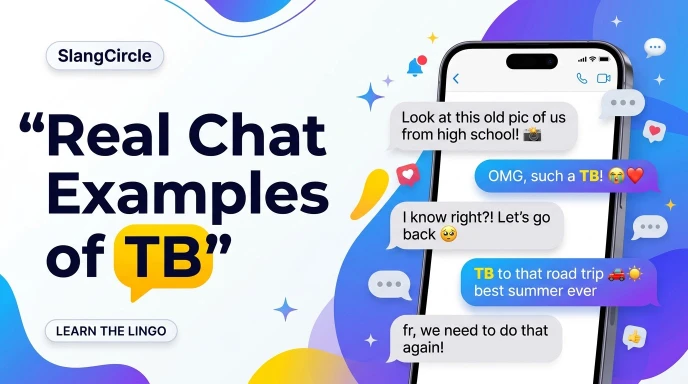
Here are ten realistic examples that show how people may use TB in everyday conversations.
1. Old photo
A: TB to this picture 😂
B: Why did we dress like that?
A: I honestly don’t know.
Here, TB means “throwback.”
2. Vacation memory
A: TB to our beach trip last year.
B: I want to go back!
A: Same 😭
The friends remember a past vacation.
3. School memory
A: TB to freshman year.
B: We looked so young.
A: Seriously 😂
The speaker refers to an earlier school year.
4. Instagram post
A: TB to graduation day 🎓
B: Best day ever!
A: Absolutely.
The post looks back at graduation.
5. Snapchat message
A: TB to that concert.
B: My ears were ringing for two days 😂
A: Worth it though.
The friends remember an old concert.
6. Group chat
A: TB to our old group chat name.
B: Don’t remind me 😭
C: That name was terrible.
The group remembers something from the past.
7. Childhood picture
A: TB when we were kids.
B: We were so tiny!
A: Look at us now.
The message refers to childhood.
8. Gaming memory
A: TB to when we actually won every game.
B: Those days are gone 😂
A: Sadly.
The friends remember an earlier period of gaming.
9. Old friendship
A: TB to our first selfie together.
B: I still have it!
A: Send it to me 😂
The speakers remember an old picture.
10. Throwback video
A: TB to this video.
B: You really posted that? 😭
A: I was younger!
The abbreviation introduces an old video.
How to Reply When Someone Says “TB”
Your response depends on what the person means.
If TB refers to a memory, you can respond by joining the nostalgic conversation.
Funny Replies
Try:
- “Why did you bring this back? 😂”
- “We looked terrible.”
- “I forgot about this!”
- “Delete this immediately 😭”
- “Those were the days.”
- “I can’t believe we did that.”
These replies work well with friends.
Casual Replies
You can keep your response simple:
- “I remember!”
- “That was fun.”
- “Good times.”
- “I miss those days.”
- “Wow, that’s old.”
- “We need to do that again.”
Friendly Replies
If someone shares a happy memory, you can say:
- “That was such a great day.”
- “I remember this so clearly.”
- “We should make new memories.”
- “I miss everyone!”
- “That trip was amazing.”
Neutral Replies
If you are not sure what TB means, you can simply ask:
- “What do you mean by TB?”
- “Do you mean throwback?”
- “Are you talking about the old photo?”
- “What does TB mean here?”
Asking for clarification can prevent confusion.
Is TB Rude or Offensive?
TB is usually not rude or offensive when it means “throwback.”
It normally has a neutral or positive tone. People use it to remember old events, share memories, or bring attention to older pictures.
For example:
“TB to our graduation day!”
This does not contain an insult or offensive language.
However, the tone can change based on the message.
Someone could use an old embarrassing photo to tease a friend:
“TB to your worst haircut 😂”
That may feel embarrassing, but the abbreviation itself remains neutral.
Is TB Safe to Use?
Yes, when you use TB to mean “throwback,” it is generally safe in casual conversations.
You can use it with:
- Friends
- Family
- Classmates
- Social media followers
- Online friends
Still, not everyone knows every internet abbreviation.
If you are writing for a broad audience, “throwback” may be clearer than TB.
Is TB Appropriate at School?
TB can work in casual school conversations when it means “throwback.”
For example:
“TB to our school trip!”
However, formal school writing should use complete words.
In an assignment, essay, or formal email, write “throwback” instead of relying on TB.
Is TB Appropriate at Work?
It depends on the context.
A coworker might write:
“TB to our first office event.”
That can work in a casual workplace chat.
However, formal emails and professional documents should use clear language.
For example:
“Looking back at our first company event…”
This sounds more professional.
Who Uses This Term?
TB can appear among many age groups because “throwback” has existed as an everyday word for a long time.
Younger internet users may shorten it to TB in social media captions and chats. Older users may also understand the term even if they prefer to write “throwback” in full.
Gen Z users often encounter short forms through TikTok, Instagram, Snapchat, and messaging apps. However, TB does not belong only to Gen Z.
Its meaning also depends on the platform.
A social media user may write:
“TB to 2018.”
A person in a formal setting may write:
“Looking back at 2018.”
Both expressions refer to the past, but the first one feels more casual.
How Often Does TB Appear Online?
TB appears regularly in casual social media content, especially when people share old photos, videos, memories, or events.
However, its use can vary widely.
You may see “throwback” written in full more often than TB because the full word is already short and easy to understand.
That means you should not assume that every message containing TB means “throwback.”
Always check the context.
Origin of the Term
The word throwback existed long before social media and texting.
People have used “throwback” to describe something that reminds them of an earlier time. The term later became common in social media captions and online conversations.
As texting culture grew, users began shortening familiar expressions. TB became one possible shorthand for “throwback.”
Social media helped this style grow because captions often favor short phrases.
You may see expressions such as:
TB to summer 2020.
or:
TB to the good old days.
The exact point when people first started using TB as a texting abbreviation is not completely clear. Unlike some modern slang terms, it does not have one confirmed creator or launch date.
That makes it better to describe TB as a natural abbreviation that developed through casual online communication rather than claim that one person invented it.
Why Do People Use TB?
People use TB because it saves space and feels casual.
Instead of typing:
“Throwback to our vacation last summer.”
someone can write:
“TB to our vacation last summer.”
The shorter version works especially well in captions, comments, and quick messages.
It can also make a post feel more relaxed and social media friendly.
TB vs IDK vs IDC vs IMO vs BRB
These abbreviations serve very different purposes.
| Term | Meaning | Type | Usage | Popularity |
| TB | Throwback | Casual abbreviation | Referring to something from the past | Common in social media |
| IDK | I don’t know | Text abbreviation | Showing uncertainty | Very common |
| IDC | I don’t care | Text abbreviation | Showing a lack of concern | Very common |
| IMO | In my opinion | Text abbreviation | Sharing an opinion | Very common |
| BRB | Be right back | Text abbreviation | Saying you will return soon | Common |
Each one has a different role.
For example:
TB to our old photos.
This refers to the past.
IDK what happened.
This shows uncertainty.
IDC which movie we watch.
This shows a lack of concern.
IMO, the first movie was better.
This introduces an opinion.
BRB, I need some water.
This tells someone that the sender will return soon.
Real World Usage Example
Imagine two friends are looking through old pictures on their phones.
One friend finds a picture from a school trip five years ago.
They send it to the other friend and write:
“TB to our school trip 😂.”
The other friend immediately remembers the day.
“I forgot about this! We need to go back.”
In this situation, TB works naturally because the conversation centers on an old memory.
Now imagine someone receives only this message:
“TB.”
They may not know what the sender means.
The safest response is:
“Do you mean throwback?”
This shows why context matters with short abbreviations.
How to Tell Which Meaning of TB Someone Intended
Look at the words around TB.
If the message mentions:
- An old photo
- A past event
- Childhood
- A vacation
- School memories
- An earlier year
- An old video
then “throwback” is likely.
For example:
“TB to 2015.”
Clearly points to the past.
If the message does not involve memories, the sender may mean something else.
For example:
“TB when you get home.”
You should ask for clarification because “throwback” does not fit naturally.
The safest rule is simple: do not guess when the context does not make the meaning clear.
Common Mistakes When Understanding TB
People who are new to texting abbreviations can make a few common mistakes.
- Assuming TB always means “throwback”: The acronym has other meanings.
- Ignoring the context: The surrounding words usually reveal the intended meaning.
- Using TB in formal writing: Complete words work better in professional and academic communication.
- Thinking TB is always slang: TB can also represent non slang terms in other fields.
- Using the abbreviation with people who may not know it: Some readers may find the meaning unclear.
- Confusing TB with similar abbreviations: Short forms can look alike but have different meanings.
A little context can prevent most misunderstandings.
When Should You Use TB?
TB works well when you want to refer to something from the past.
Good examples include:
TB to our first trip.
TB to middle school 😂.
TB to this amazing day.
TB to my first concert.
You can also use it when replying to an old photo or video.
However, use the full word “throwback” when clarity matters more than brevity.
For example, a public article or formal message should usually avoid unexplained abbreviations.
When Should You Avoid Using TB?
Avoid TB when the audience may not understand it.
This includes:
- Formal essays
- Job applications
- Professional reports
- Official emails
- Academic assignments
- Business documents
Instead of:
“TB to our first meeting.”
a professional document might say:
“Looking back at our first meeting…”
The full phrase makes the meaning clear to everyone.
FAQ’s
Q1. What does TB mean in text messages?
TB often means “throwback” in casual text messages. People use it when they talk about an old photo, memory, video, trip, or event. However, TB can have other meanings, so the surrounding conversation can help you identify the intended meaning.
Q2. What does TB mean on TikTok?
On TikTok, TB often means “throwback.” Users may place it in captions or comments when they share older videos, memories, or past moments. For example, “TB to 2020” means “throwback to 2020.”
Q3. Is TB slang?
TB can work as casual internet shorthand for “throwback.” It is better described as an abbreviation than a slang word. The term can also have other meanings in different contexts, so you should always check the conversation.
Q4. Is TB rude or offensive?
No. When TB means “throwback,” it is normally neutral and harmless. People use it to talk about old memories or past events. Other meanings of TB may have different contexts, so the surrounding message still matters.
Q5. How should you reply to TB?
If someone uses TB to share a memory, you can respond with something like “I remember!” or “Good times!” If you do not understand the abbreviation, ask, “Do you mean throwback?” That simple question can clear up the meaning.
Conclusion
TB usually means “throwback” in text and social media. People use the abbreviation when they want to look back at an old photo, video, memory, trip, or event. You may see it in TikTok captions, Instagram posts, Snapchat messages, WhatsApp chats, and regular text messages.
The term usually has a friendly or nostalgic tone. For example, “TB to our school trip” simply means “throwback to our school trip.” It does not normally carry a rude or offensive meaning.
Still, TB can have other meanings. That is why context matters. If someone talks about an old photo or past event, “throwback” makes sense. If the message does not fit that meaning, ask the sender what they mean.
For casual online conversations, TB can save time and keep a message short. For school assignments, professional emails, and formal writing, spelling out “throwback” usually gives readers more clarity.
Dig More About!
What Does SYBAU Mean in Text? Examples & Social Media Use
What Does SU Mean in Text?Meaning & Social Media Use
What Does STTM Mean in Text? Real Meaning,& Social Media Use