STTM usually means “Stop Talking To Me” in text and online slang. People use it when they want someone to stop a conversation, give them space, or sometimes stop teasing them. You may see it in texts, TikTok comments, Snapchat chats, Instagram DMs, WhatsApp, and other casual conversations.
If someone sends “STTM”, the message can feel serious or playful. A close friend may use it as a joke after a silly comment. Another person may use it because they genuinely want the conversation to end.
That difference makes STTM a little harder to understand than common terms such as IDK or BRB. The letters alone do not always tell you the speaker’s mood.
This guide explains STTM meaning in text in simple English. You will learn what it means, where people use it, how to reply, when it sounds rude, and how context can change its meaning.
What Does STTM Mean in Text?
In most casual texting contexts, STTM means “Stop Talking To Me.” It works as a short form of the full phrase.
People use it when they want another person to stop talking, texting, teasing, or continuing a conversation.
For example:
A: You still owe me pizza 😂
B: STTM 😭
Here, B may not actually want A to stop talking. B could use STTM as playful drama.
Now consider a different example:
A: Can we talk about what happened?
B: STTM. I need some space.
This message sounds serious. B clearly wants the conversation to stop.
So, STTM can express a boundary or playful annoyance. The surrounding messages help you decide which meaning fits.
CyberDefinitions lists “Stop Talking to Me” as the main meaning of STTM in texting and social media. It also describes the abbreviation as a direct way to end a conversation, although people can use it playfully with friends.
Is STTM Slang or an Abbreviation?
STTM works as an initialism and texting abbreviation.
Each letter comes from the first letter of a word:
- S = Stop
- T = Talking
- T = To
- M = Me
People normally read the letters separately:
S T T M
It does not work like a normal word that people pronounce as one sound.
You can compare it with other texting short forms:
- STTM = Stop Talking To Me
- IDK = I Don’t Know
- IDC = I Don’t Care
- IMO = In My Opinion
- BRB = Be Right Back
These short forms help people type faster during casual conversations.
What Does STTM Mean in Everyday Chat?
STTM usually tells someone to stop the conversation or give the sender some space.
However, friends sometimes use it without serious anger.
For example:
“You showed my embarrassing picture to everyone. STTM 😭”
The sender may feel embarrassed but still joke about the situation.
The same four letters can become much more serious without a laughing emoji or playful context:
“STTM. I don’t want to talk right now.”
That message gives a clear boundary.
Because of this, do not treat every STTM message as a joke.
Where Do People Use STTM?
STTM belongs mainly to casual digital communication. People may use it in private messages, group chats, comments, and online communities.
The exact tone can change from one conversation to another.
STTM on TikTok
TikTok comments often contain short slang terms because users want to react quickly.
Someone may use STTM as a funny response to a video or comment.
For example:
“STTM 😭 this is literally me.”
In this case, the writer may not want the creator to stop talking. The comment can express embarrassment, amusement, or playful frustration.
Another example:
“STTM, you just exposed me.”
Here, the phrase can mean something like “Stop, you are exposing me.”
That does not always match the literal meaning perfectly. Online slang often develops playful uses around the original phrase.
CyberDefinitions specifically lists TikTok among the social platforms where people may use STTM.
STTM on Snapchat
Snapchat conversations often move quickly between friends.
A person may type:
“STTM 😂”
after a friend sends an embarrassing picture or keeps teasing them.
The emoji can make the message feel playful.
However, you should not assume that every Snapchat use has a joking meaning. If someone sends STTM after an argument, they may genuinely want the conversation to stop.
STTM on Instagram
You may see STTM in Instagram DMs, comments, or replies.
For example:
A: I’m sending that old picture to the group.
B: STTM 😭
Here, B may jokingly ask A to stop.
Instagram comments can also use slang in exaggerated ways. A short message such as “STTM 💀” may express strong embarrassment or amusement rather than a serious request.
STTM on WhatsApp
WhatsApp can contain both casual and serious conversations.
Friends may use STTM as a joke:
“STTM 😂 you’re making this worse.”
But a person may also use it seriously:
“STTM. I don’t want to discuss this anymore.”
The second message deserves a different response. If someone clearly asks you to stop, respect that request.
STTM in SMS
People can also use STTM in regular text messages.
For example:
“STTM. I’m busy right now.”
This message sounds direct.
Because SMS often lacks extra context, do not rely only on the letters. Look at the conversation before the message.
Real Chat Examples of STTM
The following examples show how people might use STTM in different situations.
Playful Teasing
A: I’m telling everyone about your karaoke video.
B: STTM 😭
A: Too late 😂
Here, B probably uses STTM as playful embarrassment.
Asking for Space
A: Can we keep talking about this?
B: STTM. I need time to think.
A: Okay, I’ll give you some space.
This use sounds serious.
Funny Reaction
A: You actually wore that shirt to the party?
B: STTM 💀
A: I’m just asking!
B may use STTM as a funny reaction to teasing.
After an Embarrassing Story
A: I just told your crush what you said.
B: STTM 😭😭
A: Sorry!
The sender may feel embarrassed rather than truly angry.
During an Argument
A: You keep changing the subject.
B: STTM. I’m done arguing.
A: Fine. We can talk later.
Here, STTM clearly signals frustration.
Gaming Chat
A: You lost the match again 😂
B: STTM, I’m trying!
A: Okay, okay. One more round.
The phrase may sound playful between gaming friends.
Group Chat
A: I’m posting your old school photo.
B: STTM 😭
C: Please post it 😂
This example shows playful group chat use.
TikTok Comment
A: This video describes my whole life.
B: STTM 😭
A: You know it’s true.
Here, STTM can act like an exaggerated reaction.
Serious Conversation
A: Why aren’t you answering me?
B: STTM. I don’t want to talk right now.
A: Understood.
This message sets a clear boundary.
10. Casual Friendship
A: You forgot my birthday again.
B: STTM 😂 I already apologized.
A: Fine, you’re forgiven.
This example uses STTM in a light and playful way.
How to Reply When Someone Says “STTM”
Your response should depend on the tone.
If the sender sounds serious, stop pushing the conversation.
If the sender sounds playful, you can respond with humor.
Funny Replies
When a close friend clearly jokes with you, you might say:
“Okay, okay 😂”
Or:
“Fine, I’ll disappear.”
Another playful option:
“You can’t get rid of me that easily.”
Use these only when you know the person wants to joke.
Casual Replies
For a normal conversation, keep your answer simple:
“Alright.”
Or:
“Okay, I got you.”
You can also say:
“No problem.”
Friendly Replies
If someone seems upset, show that you respect their feelings:
“Okay, I’ll give you some space.”
Or:
“No worries. We can talk later.”
This response works better than continuing to send messages.
Neutral Replies
If you cannot tell whether the person is joking, ask:
“Do you mean that seriously?”
Or:
“Do you want some space?”
A short question can prevent a misunderstanding.
Is STTM Rude or Offensive?
STTM can sound rude or blunt because it directly tells someone to stop talking.
The abbreviation itself does not always signal anger. Friends may use it as a joke. Still, the literal meaning creates a stronger tone than many harmless texting abbreviations.
Compare:
“BRB.”
This simply tells someone that you will return.
Now compare:
“STTM.”
This tells another person to stop talking to you.
That difference makes STTM more sensitive.
When STTM Sounds Playful
It may sound playful when:
- Friends already joke with each other
- The message includes 😂 or 😭
- The conversation has a silly tone
- The sender uses it after a joke
- Both people often use dramatic slang
For example:
“You ate my fries again. STTM 😂”
This probably does not mean the friendship needs to end.
When STTM Sounds Serious
It may sound serious when:
- The conversation involves an argument
- The sender says they need space
- The sender uses a period
- The sender repeats the request
- The person stops responding afterward
- The conversation involves a sensitive issue
For example:
“STTM. I don’t want to discuss this anymore.”
You should respect that message.
Is STTM Safe at School?
STTM may appear in casual student conversations, but it does not belong in formal school writing.
Avoid using it in:
- Essays
- Assignments
- Presentations
- Formal emails
- Messages to teachers
Instead, use clear language such as:
“Can we talk about this later?”
or
“I need some time before we continue this conversation.”
Is STTM Appropriate at Work?
STTM usually does not fit professional communication.
If you send “STTM” to a manager, client, or coworker during a disagreement, they may read it as disrespectful.
A professional alternative could be:
“Could we pause this conversation for now?”
Or:
“I would prefer to continue this discussion later.”
These phrases communicate the same basic need without sounding harsh.
Who Uses STTM?
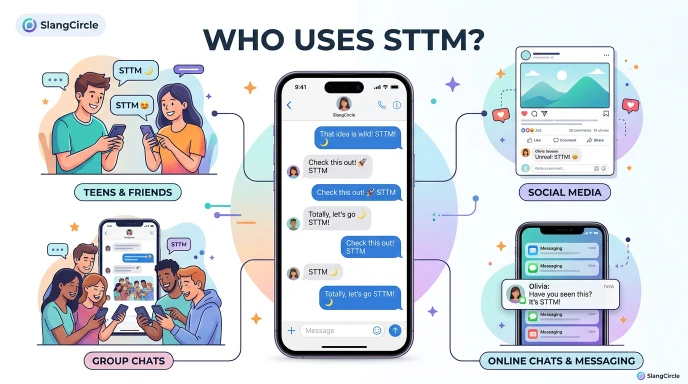
STTM appears mainly in informal online communication.
Teenagers and young adults may recognize it from texting, social media, gaming chats, and group conversations. Adults who spend time in online communities may recognize it too.
Still, STTM does not have the same universal recognition as very common abbreviations such as IDK, LOL, or BRB.
That matters when you communicate with people from different age groups.
A friend may understand STTM immediately.
Someone unfamiliar with internet slang may need the full phrase explained.
Does Gen Z Use STTM?
Some Gen Z users may use STTM in casual conversations, especially when they communicate through social media or messaging apps.
However, it would be too broad to say that every Gen Z user uses the term regularly.
Internet slang changes quickly. Some expressions become popular in one online group while other groups rarely use them.
Does STTM Appear in Gaming?
Gaming chats can contain STTM because players often use short messages during fast conversations.
A player might write:
“STTM 😂 I know I missed the shot.”
Friends can use it as playful banter.
Still, if someone says:
“STTM. I’m done arguing.”
take the message seriously.
The gaming setting does not automatically make the term playful.
Where Did STTM Come From?
STTM comes from shortening the phrase “Stop Talking To Me” into its first letters.
This follows a common pattern in internet language. People often shorten familiar phrases to make texting faster.
Examples include:
- LOL
- IDK
- BRB
- IMO
- IDC
- STTM
The exact date when STTM first became popular as internet slang is not clear from reliable sources. That means you should be careful with claims that give one exact year or say that one social platform invented it.
CyberDefinitions classifies STTM as an initialism used in text messaging and social media.
Some recent slang websites also list additional meanings for STTM, including “Send This To Me” and other less common phrases. However, these sources disagree with one another about which meaning appears most often.
Because of that disagreement, the safest approach is to use the conversation itself as your main clue.
Can STTM Have Other Meanings?
Yes.
Online abbreviations can develop several meanings. STTM appears in some online sources with alternatives such as:
- Stop Talking To Me
- Send This To Me
- Spill The Tea To Me
- Other community specific meanings
Recent slang references do not agree on the exact ranking or popularity of these alternatives.
For example, imagine someone posts a funny picture and another person replies:
“STTM!”
If the surrounding conversation involves sharing a picture, “Send This To Me” could make sense in that community.
Now imagine someone writes:
“STTM. I already told you no.”
Here, “Stop Talking To Me” clearly fits.
Context matters more than the letters alone.
How Can You Tell Which Meaning Fits?
Look at three things:
1. The previous message
What did the other person just say?
2. The tone
Does the conversation feel funny, angry, serious, or casual?
3. The relationship
Are these close friends, strangers, classmates, coworkers, or people arguing?
These clues can help you understand the intended meaning.
STTM Compared With IDK, IDC, IMO, and BRB
STTM has a very different purpose from several common texting abbreviations.
| Abbreviation | Meaning | Type | Usage | Popularity |
| STTM | Stop Talking To Me | Initialism | Ending or pausing a conversation | Less universal |
| IDK | I Don’t Know | Initialism | Showing uncertainty | Very common |
| IDC | I Don’t Care | Initialism | Showing indifference | Very common |
| IMO | In My Opinion | Initialism | Introducing an opinion | Very common |
| BRB | Be Right Back | Initialism | Temporarily leaving a chat | Very common |
The biggest difference involves tone.
IDK usually shows uncertainty.
“IDK what happened.”
IDC usually shows that someone does not care.
“IDC what they think.”
IMO introduces an opinion.
“IMO, the first movie was better.”
BRB tells someone that the sender will return soon.
“BRB, my phone is dying.”
STTM can ask someone to stop talking or give the sender space.
“STTM, I need a break.”
That makes STTM more sensitive than many common texting abbreviations.
Real World Usage Example
Imagine two classmates talking after school.
One student keeps teasing the other about a funny mistake from class.
Student A: “You really answered ‘Paris’ when the teacher asked for London.”
Student B: “STTM 😂”
The first STTM may sound playful.
The final sentence makes the real feeling clearer. Student B now wants the teasing to stop.
This example shows why context matters.
If someone says STTM once with a laughing emoji, they may joke around.
If they repeat the phrase and explain that they need space, take it seriously.
Why Do People Use STTM?
People use STTM because short messages make online conversations faster.
Typing four letters takes less time than typing the entire phrase.
The abbreviation can also make a message feel more casual.
For example:
“STTM 😂”
looks more like quick internet conversation than:
“Please stop talking to me because I am annoyed.”
Friends may also use STTM for dramatic humor.
A person might say:
“STTM, you’re embarrassing me.”
without actually wanting the other person to leave them alone.
The short form gives the speaker room to exaggerate.
However, that style only works when both people understand the joke.
When Should You Avoid Using STTM?
STTM can cause misunderstandings, so choose it carefully.
Avoid it when:
- You are speaking with a teacher.
- You are messaging an employer.
- You are talking to a customer.
- You are writing a formal email.
- You are discussing a serious problem.
- You are speaking with someone who may not understand slang.
- You genuinely need to set an important boundary and want absolute clarity.
If you genuinely want someone to stop contacting you, direct language can work better.
For example:
“Please stop messaging me.”
That sentence leaves little room for confusion.
If you simply need a break, try:
“I need some time. We can talk later.”
These alternatives make your intention clearer.
Common Mistakes When Reading STTM
Assuming It Always Means a Joke
A friend may joke with STTM, but another person may use it seriously.
Always check the conversation.
Ignoring the Message Before It
The previous message often gives you the strongest clue.
A funny joke and an angry argument can create very different meanings.
Sending More Messages
If someone clearly uses STTM to ask for space, continuing to message them can make the situation worse.
Give them time.
Using STTM at Work
Professional communication usually needs clearer language.
STTM can sound abrupt or disrespectful in a workplace.
Assuming Every Website Gives the Same Definition
Online slang sources can disagree about less common meanings. Current web references list several possible expansions for STTM, so context remains important.
FAQ’s
Q1:What does STTM mean in text messages?
STTM usually means “Stop Talking To Me.” People use it to ask someone to stop a conversation, give them space, or sometimes stop teasing them.
Q2:What does STTM mean on TikTok?
On TikTok, STTM can mean “Stop Talking To Me.” People may use it seriously or as playful slang in comments. The surrounding video and comment thread can help explain the tone.
Q3:Is STTM slang?
Yes. STTM works as an internet abbreviation or initialism. It commonly represents “Stop Talking To Me” in casual texting and social media conversations.
Q4:Is STTM rude or offensive?
STTM can sound rude because it directly tells someone to stop talking. Friends may use it as a joke, but you should take it seriously when someone uses it to ask for space.
Q5:How should you reply to STTM?
If the sender sounds serious, give them space. You can reply with “Okay, I understand” or “Sure, we can talk later.” If a close friend clearly jokes, a light reply may work.
Conclusion
STTM usually means “Stop Talking To Me” in text and online slang. People use it to end a conversation, ask for space, or react dramatically to teasing. The phrase can sound serious or playful, so the surrounding conversation matters.
You may see STTM on TikTok, Snapchat, Instagram, WhatsApp, SMS, Discord, and other casual platforms. Friends may use it jokingly, while someone in a tense conversation may use it as a real boundary.
The term also has less common meanings in some online communities. Recent sources list alternatives such as “Send This To Me,” which shows why you should not interpret every STTM message without checking the context.
If you want to use STTM yourself, save it for casual conversations where the other person understands internet slang. Avoid it in formal school or workplace communication.
Most importantly, if someone uses STTM seriously and asks you to stop, respect the message. Sometimes four letters can communicate a very clear request for space.
Learn More About!
What Does STSU Mean in Text? Real Meaning & Social Media Use
What Does STG Mean in Text? Real Meaning,Social Media Use
CB Slang Meaning: What Does CB Mean in Text?