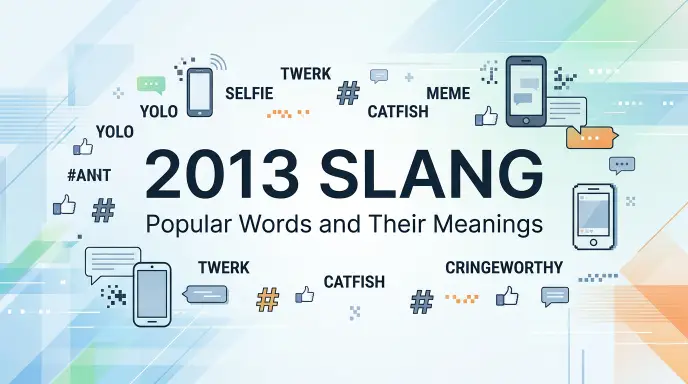
2013 slang includes popular internet words and expressions such as selfie, YOLO, twerk, ratchet, catfish, and cringeworthy. Many of these terms became highly visible online during 2013, although some started years earlier.
People search for 2013 slang to understand old social media posts, text messages, memes, songs, videos, and conversations from the early 2010s. The year also marked a major shift toward smartphone photos, viral content, and fast moving online culture.
In this guide, you will learn what 2013 slang meant, where people used it, and which terms still sound natural today. You will also see why some words feel dated now. Most importantly, this list does not claim that every word began in 2013. Instead, it focuses on words that gained strong attention or cultural importance around that year.
Quick Answer
- 2013 slang refers to informal words, phrases, and internet expressions that people widely used or talked about around 2013. Popular examples include selfie, YOLO, twerk, ratchet, catfish, cringeworthy, hype train, pleb, spoopy, and neckbeard.
- These terms appeared across social media, forums, texting, music, gaming, memes, and everyday conversations. Some remain common, while others now sound strongly tied to early 2010s internet culture.
What Does 2013 Slang Mean?
2013 slang does not describe one single word. It describes a group of expressions that stood out in online and popular culture during 2013.
A useful way to understand the term is to divide these expressions into a few groups:
- Social media language: selfie, catfish
- Lifestyle expressions: YOLO
- Pop culture slang: twerk, ratchet
- Internet humor: spoopy, cringeworthy
- Gaming and forum language: hype train, pleb
- Online identity terms: neckbeard
This distinction matters because slang often spreads before people agree on a fixed definition. A word may also carry different meanings in different communities.
Popular 2013 Slang Words and Their Meanings
Here are some of the most notable terms linked with 2013 internet culture:
| Slang | Simple meaning | Main context |
| Selfie | A photo of yourself | Social media |
| YOLO | You only live once | Risky or carefree choices |
| Twerk | A provocative dance involving hip movement | Music and pop culture |
| Ratchet | Wild, messy, or low class; sometimes playful | Informal slang |
| Catfish | Someone who creates a fake online identity | Dating and social media |
| Cringeworthy | Embarrassing or awkward to watch | Internet humor |
| Hype train | Excitement around something expected | Gaming and online communities |
| Pleb | An unsophisticated or uncultured person | Forums and gaming |
| Spoopy | A funny or intentionally misspelled form of “spooky” | Memes and Tumblr |
| Neckbeard | A derogatory label for a poorly groomed geek stereotype | Internet forums |
Know Your Meme published a 2013 roundup that included many of these expressions. Its list shows how strongly internet forums, memes, gaming communities, and social platforms shaped slang during that period.
Selfie
Selfie means a photograph that someone takes of themselves, usually with a smartphone or webcam.
The word became one of the clearest symbols of 2013 internet culture. Oxford named selfie its 2013 Word of the Year after tracking a huge rise in usage. Oxford’s research traced an early known use to an Australian online forum in 2002, so 2013 did not create the word. Instead, 2013 pushed it into mainstream use.
Example:
“Wait, let’s take a selfie before we leave.”
Today, selfie feels completely normal rather than dated slang.
YOLO
YOLO stands for “you only live once.”
People often say YOLO when they want to justify a fun, risky, expensive, or unusual choice. Merriam Webster explains the expression as a reason for doing something carefree that someone might normally avoid.
Example:
“I booked the concert tickets. YOLO!”
YOLO became strongly associated with early 2010s youth culture. However, the idea behind the phrase has a much older history, and the initialism itself predates 2013.
Twerk
Twerk refers to a dance that involves repeated hip movements and a low stance. The term received major attention in 2013 through pop culture, music, and Miley Cyrus’s widely discussed MTV performance that year.
The word itself did not begin in 2013. Merriam Webster records a first known use from 2001.
Example:
“The music video caused a huge debate about twerking.”
Because the term connects with sexually suggestive dancing, avoid it in formal or professional writing unless the topic requires it.
Ratchet
Ratchet can describe something wild, messy, disorderly, or low class. Some speakers also use it playfully to describe letting loose or acting boldly.
This word needs extra care. Merriam Webster connects ratchet with Black slang and popular Black culture. In some contexts, the term can carry racist, sexist, or classist meaning, especially when someone uses it to stereotype Black women. Some Black women and LGBTQ+ people have also reclaimed the term in humorous or positive ways.
Example:
“The party got a little ratchet after midnight.”
Use this word carefully because the speaker, audience, and context strongly affect its meaning.
Catfish
Catfish describes someone who creates a fake online identity, often to deceive people in romantic or personal relationships.
The term gained major online attention after the 2010 documentary Catfish. By 2013, the expression had become a familiar part of internet culture. Know Your Meme included it among its notable slang terms of that year.
Example:
“She discovered that the person she met online had created a fake profile.”
Today, catfish remains common on social media and dating platforms.
Cringeworthy
Cringeworthy describes something that causes embarrassment, awkwardness, or discomfort.
People often used the term when discussing embarrassing internet posts, awkward behavior, or content that made viewers feel secondhand embarrassment. Know Your Meme listed cringeworthy as its top slang term in its 2013 roundup.
Example:
“That old video feels so cringeworthy now.”
The word still works in modern English, although its strong connection with early internet culture can make some old examples feel dated.
Where Was 2013 Slang Commonly Used?
2013 slang spread through several parts of online culture.
| Platform or setting | Common type of language |
| Personal updates, memes, jokes | |
| Short expressions and trending phrases | |
| Tumblr | Meme language and playful spelling |
| Community slang and jokes | |
| YouTube | Pop culture and video related language |
| Gaming forums | Terms such as hype train and pleb |
| Text messages | Short expressions such as YOLO |
| Selfie and photo related language |
The online world looked different in 2013. Instagram and Twitter helped selfie move from a niche social media term toward mainstream language.
Gaming and forum communities also created their own vocabulary. Know Your Meme’s 2013 list included hype train, top lel, pleb, and other terms linked with online communities.
Was 2013 Slang Rude or Offensive?
Some 2013 slang sounds harmless, while other terms need more care.
For example:
- Selfie :harmless in normal conversation.
- YOLO :casual and usually harmless.
- Cringeworthy :usually harmless, but it can insult someone’s behavior.
- Twerk :casual and connected with sexualized dancing.
- Ratchet :context sensitive and potentially offensive.
- Pleb :insulting when someone uses it to look down on another person.
- Neckbeard :usually insulting and stereotypical.
- Catfish :negative because it describes deception.
Do not judge a slang word only by its dictionary meaning. The speaker, target, relationship, and situation all affect the tone.
Real Life Examples of 2013 Slang
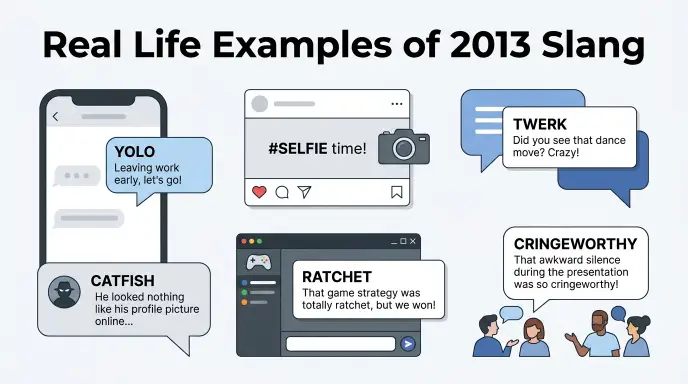
Here are natural examples that show how people might have used these expressions:
Text message:
“We are going out tonight. YOLO!”
Social media:
“New outfit, new selfie.”
Gaming chat:
“Everyone is excited about the new update. Hype train!”
Online discussion:
“That comment section became so ratchet.”
Dating conversation:
“Be careful. That profile might belong to a catfish.”
Internet humor:
“That old video is seriously cringeworthy.”
These examples show why context matters. The same word can sound funny among friends but inappropriate in a school, workplace, or formal conversation.
Origin and History of 2013 Slang
The biggest mistake people make with 2013 slang involves assuming that every popular word started in 2013.
That idea does not match the evidence.
For example, selfie has an early known use from 2002, yet Oxford named it the 2013 Word of the Year because its use grew sharply and reached mainstream culture.
Likewise, Merriam Webster records twerk from 2001, while 2013 gave the term a major pop culture boost.
YOLO also predates 2013. Merriam Webster traces the phrase “you only live once” much further back and notes that the initialism dates to the 1990s in some historical accounts.
Ratchet also predates 2013. Merriam Webster notes that the slang spread in the late 2000s and early 2010s and reached mainstream attention around 2012.
So, 2013 often marks popularity rather than invention.
How 2013 Slang Differs From Modern Slang
Many expressions from 2013 still work today, but their cultural feel has changed.
Still common:
- Selfie
- Catfish
- Cringeworthy
- YOLO, although less trendy
More dated or strongly tied to the era:
- Ratchet
- Spoopy
- Hype train
- Top lel
- Neckbeard
- Pleb in some casual internet contexts
Internet slang has a short life cycle. A term can move from niche community language to mainstream speech and then become old fashioned or ironic.
That does not make the word incorrect. It simply changes the feeling it creates.
When Should You Avoid 2013 Slang?
Avoid older slang when the setting requires clear, neutral, or professional language.
You should usually avoid these terms in:
- Job applications
- Formal emails
- Academic assignments
- Business reports
- Professional presentations
- Official documents
- Communication with people who may not understand internet slang
You can use casual slang with friends when everyone understands the expression.
Also take extra care with words such as ratchet, pleb, and neckbeard. Their insulting or stereotypical meanings can create unnecessary conflict.
Similar Slang and Related Terms
If you enjoy researching 2013 slang, these related terms can help you explore early 2010s internet culture:
- FOMO :fear of missing out
- Swag :stylish confidence or attitude
- Turnt :highly excited or energetic
- Bae :a term of affection
- Hashtag :a word or phrase marked with the # symbol
- Binge watch :watch many episodes in a short period
- Showrooming :inspect a product in a store before buying it online
Not every term on this related list started in 2013. The goal here involves the language people commonly encountered around the same period.
Common Misunderstandings About 2013 Slang
Did all 2013 slang start in 2013?
No. Many expressions became popular in 2013 without starting that year. Selfie, twerk, YOLO, and ratchet all provide good examples.
Did people only use 2013 slang online?
No. People also used many expressions in text messages, music, television, school conversations, parties, and everyday speech.
Does old slang always sound wrong today?
No. Some words remain completely normal. Selfie and catfish, for example, still have clear modern meanings.
Why does some 2013 slang sound embarrassing now?
Internet trends change quickly. A word can become overused, lose its novelty, or become strongly linked with one period of online culture.
Did social media help spread 2013 slang?
Yes. Social platforms gave short expressions, memes, photos, and jokes a fast path into mainstream culture. The rise of selfie offers a clear example.
FAQ’S
Q1:What is the most famous 2013 slang word?
Selfie stands out as one of the strongest examples. Oxford named it the 2013 Word of the Year after its usage grew sharply and moved into mainstream language.
Q2:What did YOLO mean in 2013?
YOLO meant “you only live once.” People often said it before taking a risk or making a carefree choice.
Q3:What did ratchet mean in 2013?
Ratchet could describe something wild, messy, disorderly, or low class. Some speakers also used it playfully. However, the word can carry racist, sexist, and classist meanings, so context matters.
Q4:What did twerk mean in 2013?
Twerk referred to a provocative dance involving repeated hip movements. Pop culture gave the word major attention during 2013.
Q5:Is 2013 slang still popular?
Some terms remain common, while others now feel dated. Selfie and catfish remain familiar, while terms such as spoopy and top lel feel more connected with older internet culture.
Q6:Can I use 2013 slang at work?
You can use harmless terms in casual workplace conversations when your audience understands them. However, formal writing should favor clear standard English.
Conclusion
2013 slang captures an important period in internet and pop culture. Words such as selfie, YOLO, twerk, ratchet, catfish, and cringeworthy appeared frequently in conversations, memes, music, social media, and online communities.
The key point involves timing. A word can become famous in 2013 without actually starting in 2013. Selfie and twerk show this clearly: both existed before 2013, yet that year brought them much wider attention.
When you read old posts or messages, always consider the context. Slang can change meaning, tone, and popularity over time. Understanding that history makes 2013 slang much easier to recognize and use correctly.
Discover More About!
- Military Slang Insults: Meanings, Terms & Examples
- Area Between Anus and Scrotum Slang: Meaning & Terms
- Slang From 90s: Popular 90s Words & Phrases