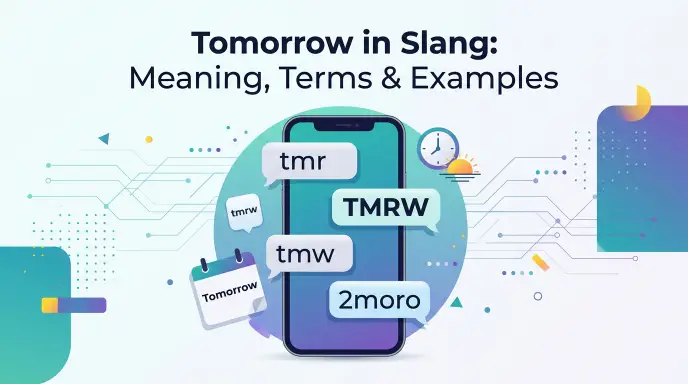
Tomorrow in slang usually appears in short forms such as tmr, tmrw, 2moro, and tmw. People use these forms in texts, chats, social media posts, and casual online messages to save time and keep conversations relaxed.
If you search for tomorrow in slang, you may wonder which short form sounds natural and which one people actually use. You may also see different spellings because texting slang has no single official rule.
This guide explains the most common ways to say tomorrow in text. You will learn what each form means, where people use it, how the tone changes, and when you should choose the full word instead. You will also see real examples that show how these terms work in everyday conversations.
Quick Answer:
- The most common slang forms for tomorrow include tmr, tmrw, tmw, and 2moro. Among these, tmr and tmrw often appear in casual texting and online chats.
- Tomorrow in slang means a shorter or more casual way to write the word tomorrow in texts, chats, and social media. Common forms include tmr, tmrw, tmw, and 2moro.
- These forms usually have the same basic meaning:
- Tomorrow = the day after today.
- The difference comes from style and personal preference. Some people like tmr because it looks short and simple. Others use tmrw because it keeps more of the original word.
- There is no single official slang spelling. Texting users may choose different forms based on habit, platform, or personal style.
What Does Tomorrow in Slang Mean?
Tomorrow in slang means the next day, just like the standard word “tomorrow.” The main difference lies in the spelling.
Here are common forms:
| Slang form | Meaning | Common use |
| tmr | Tomorrow | Texting and casual chats |
| tmrw | Tomorrow | Texting and social media |
| tmw | Tomorrow | Short online messages |
| 2moro | Tomorrow | Informal texting |
| 2mrw | Tomorrow | Very casual messages |
For example:
- “See you tmr!”
- “Are you free tmrw?”
- “Let’s talk tmw.”
- “I’ll finish it 2moro.”
All four examples refer to the next day.
Full Form of TMR, TMRW, and TMW
The full form of these common texting terms is simple:
- TMR = Tomorrow
- TMRW = Tomorrow
- TMW = Tomorrow
- 2MORO = Tomorrow
- 2MRW = Tomorrow
These forms work as texting shortcuts rather than formal abbreviations.
People often remove vowels or replace parts of a word with numbers. This style helps users type faster, especially during quick conversations.
TMR
TMR stands for tomorrow.
Example:
“Can we meet tmr?”
This form feels short and casual.
TMRW
TMRW also means tomorrow.
Example:
“I’ll call you tmrw.”
This version stays closer to the original spelling.
TMW
TMW can mean tomorrow in casual texting.
Example:
“I have a test tmw.”
Context matters because short forms can sometimes have other meanings. When someone talks about the next day, tmw usually means tomorrow.
2MORO
2MORO uses the number 2 to create a shorter spelling of “tomorrow.”
Example:
“See you 2moro!”
This style feels more playful and informal than standard English.
Different Ways to Say Tomorrow in Slang
People use several forms when they want a shorter version of “tomorrow.” The most useful options include tmr, tmrw, tmw, and 2moro.
1. TMR
TMR is a compact form that works well in quick messages.
Example:
“What time are we meeting tmr?”
It saves space without making the meaning hard to understand.
2. TMRW
TMRW gives readers a strong visual connection to the word “tomorrow.”
Example:
“I’ll send the photos tmrw.”
This form can feel slightly clearer than some shorter versions.
3. TMW
TMW offers another short option.
Example:
“Are you coming tmw?”
The reader can usually understand the meaning from the sentence.
4. 2MORO
2MORO uses a number in place of part of the word.
Example:
“I’ll see you 2moro.”
This spelling has a playful texting style.
Where Is Tomorrow Slang Commonly Used?
People mainly use these short forms in informal digital communication. The exact form can vary from person to person.
You may see them in:
- Text messages
- Group chats
- Direct messages
- Casual social media comments
- Online communities
- Gaming chats
- Friendly conversations
- Personal messages
A person might type “tmr” in a quick message because the other person already understands the context.
However, casual texting slang does not fit every situation.
Texting
Text messages often use short forms because people want to type quickly.
“Can u come tmr?”
Social Media
Users may use shortened forms in comments, captions, or direct messages.
“New post tmr 👀”
Gaming Chats
Gamers may use short forms during quick conversations.
“We play again tmr?”
Discord and Online Chats
Casual communities may use tmr or tmrw when discussing plans.
“Same time tmr?”
Workplace Chats
Some teams may use casual abbreviations in internal chats. Still, the full word tomorrow gives a cleaner tone, especially when you talk to clients, managers, or people you do not know well.
Is Tomorrow Slang Rude or Offensive?
No. Tomorrow slang is generally harmless and informal. Forms such as tmr and tmrw do not carry an offensive meaning by themselves.
The main issue involves formality, not politeness.
For example:
“See you tmr!”
This sounds casual and friendly.
A more formal version would say:
“I’ll see you tomorrow.”
You should consider your audience before using texting shortcuts. A friend may understand tmr instantly, while a teacher, client, or employer may prefer standard English.
Real Life Examples of Tomorrow Slang
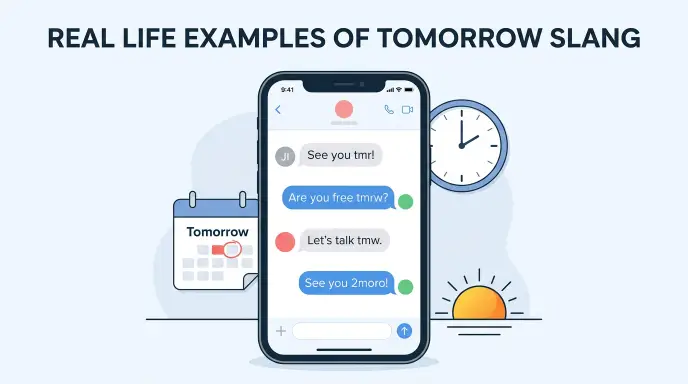
The best way to understand texting slang involves seeing it in normal conversations.
Friendly Conversation
Alex: “Wanna grab coffee tmr?”
Sam: “Sure! Around 5?”
Here, tmr simply means tomorrow.
Making Plans
“Are we still going shopping tmr?”
The speaker asks about plans for the next day.
School Chat
“Did you finish the project? We need to submit it tmr.”
The person uses tmr to keep the message short.
Social Media
“Big announcement tmr 👀”
The writer uses tmr in a casual online style.
Gaming
“Can we play again tmr?”
The word refers to the next gaming session.
Family Text
“I’ll visit grandma tmr.”
The short form works in an informal family message.
Casual Workplace Chat
“I can send the draft tmr morning.”
This may work in a relaxed team chat. Still, tomorrow morning looks more professional in formal communication.
Tomorrow Slang: Formal vs. Informal
The best choice depends on your audience and the type of message.
| Situation | Better choice |
| Texting a friend | tmr / tmrw |
| Gaming chat | tmr / tmw |
| Casual group chat | tmr / tmrw |
| Social media comment | tmr / tmw |
| School assignment | tomorrow |
| Formal email | tomorrow |
| Job application | tomorrow |
| Client message | tomorrow |
| Official document | tomorrow |
The short forms fit casual communication. The full word works better when clarity and professionalism matter.
Origin and Background of Tomorrow Texting Slang
Forms such as tmr, tmrw, and 2moro grew from the broader culture of shortened digital communication. People have long used abbreviations and creative spellings to make messages quicker to type.
Texting encouraged this habit because early mobile phones made typing slower than modern smartphone keyboards. Short forms helped people communicate with fewer characters and less effort.
However, you should not treat every spelling as a fixed historical abbreviation with one confirmed creator or starting date. Informal texting language develops through repeated everyday use, so different forms can appear and spread without a clear origin point.
Today, smartphones make typing easier, but many short forms remain popular because they feel quick and casual.
Similar Slang for Tomorrow
Several terms can express a similar idea.
| Term | Meaning | Tone |
| TMR | Tomorrow | Casual |
| TMRW | Tomorrow | Casual |
| TMW | Tomorrow | Casual |
| 2MORO | Tomorrow | Playful/casual |
| Next day | The following day | Neutral |
| Tomorrow | The day after today | Standard |
These terms do not always fit the same situations. Tomorrow remains the safest choice when you want clear, standard English.
When Should You Avoid Tomorrow Slang?
You should avoid forms such as tmr and 2moro when the message needs a formal or polished tone.
Avoid them in:
- Formal emails
- School essays
- Academic work
- Job applications
- Business proposals
- Official documents
- Formal letters
- Professional messages to clients
For example, avoid:
“I’ll send the report tmr.”
Use:
“I’ll send the report tomorrow.”
The second version looks clearer and more professional.
Polite Alternatives to Tomorrow Slang
If you want a more polished message, simply use tomorrow.
You can also use phrases such as:
- Tomorrow morning
- Tomorrow afternoon
- Tomorrow evening
- The following day
- The next day
For example:
Casual:
“Can we talk tmr?”
Polished:
“Can we talk tomorrow?”
Both sentences communicate the same basic idea.
Why Do People Use TMR and TMRW?
People use short forms for several simple reasons.
1. They Save Time
Typing tmr takes less effort than typing the full word.
2. They Fit Casual Chats
Short forms match the relaxed style of texting.
3. They Keep Messages Short
People often shorten words when they send quick messages.
4. They Match Online Habits
Many users already understand common texting shortcuts, so they can read them without much effort.
5. They Add a Casual Tone
A message such as:
“See you tmr!”
can feel more relaxed than:
“See you tomorrow!”
The meaning stays the same, but the style changes.
Common Misunderstandings About Tomorrow Slang
Does TMR Mean Tomorrow?
Yes. In a clear texting context, tmr commonly means tomorrow.
Does TMRW Mean Tomorrow?
Yes. Tmrw is another informal spelling of tomorrow.
Does TMW Mean Tomorrow?
Yes, tmw can mean tomorrow in casual messages. Context helps confirm the meaning.
Does 2MORO Mean Tomorrow?
Yes. 2moro uses the number 2 as part of a playful shortened spelling.
Is TMR Proper English?
No. TMR works as an informal texting shortcut. Use tomorrow in standard formal writing.
Can I Use TMR at Work?
You can use it in a relaxed workplace chat if your team commonly uses texting shortcuts. For formal emails, client communication, and official documents, choose tomorrow.
FAQ’S
Q1:What is the slang word for tomorrow?
Common texting forms include tmr, tmrw, tmw, and 2moro. They all refer to the day after today.
Q2:What does TMR mean in text?
TMR usually means tomorrow in casual text messages and online chats.
Q3:What does TMRW mean in texting?
TMRW means tomorrow. People use it as an informal texting shortcut.
Q4:What does TMW mean in slang?
TMW can mean tomorrow in casual texting. The surrounding words help confirm its meaning.
Q5:Is TMR formal English?
No. TMR works as a casual texting abbreviation. Use tomorrow for formal writing.
Q6:Can I use tomorrow slang on social media?
Yes. Forms such as tmr and tmrw can work well in casual social media posts, comments, and direct messages.
Conclusion
Tomorrow in slang usually appears as tmr, tmrw, tmw, or 2moro. These forms carry the same basic meaning as tomorrow, but they create a more casual texting style.
The best choice depends on your audience. Use tmr or tmrw with friends, in casual chats, and in relaxed online conversations. For schoolwork, formal emails, business messages, and official writing, choose the full word tomorrow.
The key takeaway is simple: texting slang changes the style, not the meaning. When you understand the context, you can choose the form that fits the conversation.
Discover More About!
- T Slang Meaning: What Does “T” Mean in Text?
- Slang for Punch: Meaning, Terms & Examples
- Quad Meaning Slang: What Does “Quad” Mean?