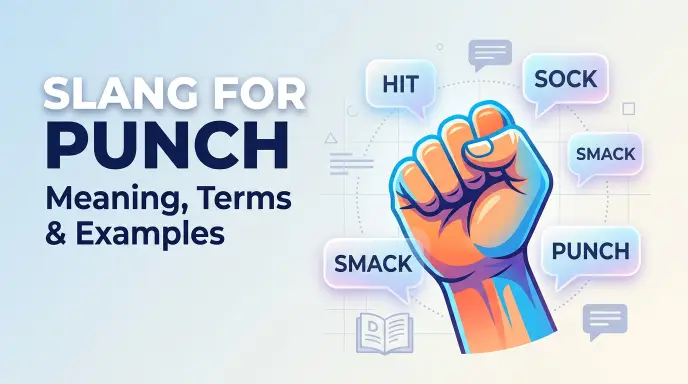
Slang for punch can include words such as hit, smack, slug, wallop, sock, deck, clock, and bop. The best choice depends on the situation, the force of the punch, and the speaker’s tone.
People often search for slang for punch when they read a phrase in a movie, text, song, game, or social media post. A word like deck may mean “knock someone down,” while haymaker often describes a very powerful punch. Some terms also carry a special meaning, such as sucker punch, which describes a surprise attack.
This guide explains common slang terms for a punch in simple English. You will learn what each term means, how people use it, what tone it carries, and which expressions work best in casual speech. You will also see realistic examples so you can understand these words in context.
Quick Answer
- Common slang for punch includes hit, smack, slug, sock, wallop, deck, clock, bop, and haymaker. These words do not always mean the same thing. Some describe a normal hit, while others suggest a hard, sudden, or powerful punch.
For example:
- Hit :a general and common term
- Smack :a sharp hit
- Slug :a hard punch
- Sock :to hit someone hard
- Wallop :a strong hit
- Deck :to knock someone down
- Clock :to hit someone, often in the face
- Bop :a light or playful hit in some contexts
- Haymaker :a very powerful punch
What Does “Slang for Punch” Mean?
“Slang for punch” refers to informal words or phrases that people use instead of the standard word punch.
The exact meaning can change with the word. For example, slug usually suggests a strong punch, while bop can sound much lighter. Deck focuses more on the result of the hit because it often means knocking someone down.
Here is a simple comparison:
| Slang term | Basic meaning | Tone |
| Hit | Strike someone | Neutral |
| Smack | Hit sharply | Casual |
| Slug | Hit hard | Informal |
| Sock | Hit hard | Casual |
| Wallop | Hit with force | Informal |
| Deck | Knock someone down | Strong |
| Clock | Hit someone | Casual |
| Bop | Hit lightly or casually | Playful in some contexts |
| Haymaker | Powerful punch | Informal |
Context matters. A person may use these words seriously, jokingly, or as part of a story.
Common Slang Terms for a Punch
1. Hit
Hit remains the simplest informal word for a punch.
People use it in everyday speech because it works in many situations. It can describe a light hit, a hard punch, or a general physical strike.
Example:
“He hit the bag for an hour at the gym.”
The word does not always mean a punch. The surrounding sentence tells you what kind of hit the speaker means.
2. Smack
Smack means to hit someone or something with a sharp motion.
The word often sounds more vivid than hit. It can describe a punch, slap, or another sharp strike, so context matters.
Example:
“He smacked the punching bag.”
In casual speech, smack can sound stronger and more expressive than hit.
3. Slug
Slug can mean to hit someone with a hard punch.
This word often suggests force. You may hear it in stories, sports talk, movies, or casual conversation.
Example:
“The boxer landed a heavy slug.”
People also use slug as a noun for a hard punch.
4. Sock
Sock means to hit someone hard.
It has a strong informal feel and often appears in older expressions, comics, movies, and playful descriptions.
Example:
“The hero socked the villain in the jaw.”
The word can sound dramatic, so it may not fit normal everyday conversation.
5. Wallop
Wallop means a strong or forceful hit.
It can describe a punch, but people also use it for other powerful impacts. The word often adds a dramatic or humorous tone.
Example:
“That punch had a real wallop.”
A speaker may use wallop when they want to highlight the force behind the punch.
6. Deck
Deck means to knock someone down with a punch or another strong hit.
This term focuses on the result. If someone says, “He decked him,” the sentence suggests that the person fell or went down after the hit.
Example:
“The fighter decked his opponent with one punch.”
The expression can sound aggressive, so avoid it in formal situations.
7. Clock
Clock can mean to hit someone, especially in the face.
The term often appears in casual American English and entertainment dialogue. The exact meaning depends on context.
Example:
“He clocked him during the fight scene.”
Here, clocked means hit.
8. Bop
Bop can mean a light hit or a quick strike in some informal contexts.
The word often sounds less serious than slug or wallop. However, its meaning can change across communities and situations.
Example:
“He gave the bag a quick bop.”
Do not assume that bop always means punch. Modern slang gives the word other meanings too.
9. Haymaker
A haymaker means a very powerful punch, often one that a person swings with a lot of force.
The word often appears in boxing talk, sports writing, movies, and casual descriptions of fights.
Example:
“He threw a huge haymaker.”
A haymaker does not simply mean any punch. The word suggests a big, forceful swing.
Different Meanings and Types of Punch Slang
Not every slang term describes the same kind of punch. Some words focus on power, while others focus on surprise or the result.
Slang for a Powerful Punch
Words such as these can suggest force:
- Slug
- Wallop
- Haymaker
- Sock
For example:
“That haymaker looked brutal.”
Slang for Knocking Someone Down
Deck often highlights the result of the punch.
“He decked him with a single hit.”
The key idea here involves knocking someone down, not simply making contact.
Slang for a Surprise Punch
Sucker punch describes a punch that catches someone off guard.
It usually carries a negative meaning because the other person does not expect the attack.
Example:
“The character threw a sucker punch when nobody expected it.”
This phrase has a more specific meaning than general punch slang.
Where Is Punch Slang Commonly Used?
People use different punch terms in different settings.
In Everyday Conversation
Words such as hit, smack, slug, and deck can appear in casual speech.
Example:
“Did you see that scene where he got decked?”
In Movies and TV Shows
Action movies often use dramatic terms such as haymaker, sucker punch, and wallop.
Writers use these words to make fight scenes sound more vivid.
In Sports and Boxing
Boxing and combat sports use specific terms for punches and combinations. Haymaker can describe a big swinging punch, while other boxing terms describe specific techniques.
In Gaming
Games may use words such as hit, smack, punch, or clock in dialogue or player chat.
The exact slang depends on the game’s community.
On Social Media
People may use punch slang when they describe a movie scene, joke about a fictional fight, or discuss a sports moment.
A word like haymaker can also work in a figurative way.
For example:
“That comeback was a verbal haymaker.”
Here, haymaker describes a powerful statement rather than a physical punch.
Is Punch Slang Rude or Offensive?
Most punch slang does not count as a swear word. However, some terms describe violence, so the situation matters.
Words such as hit, smack, slug, and wallop can sound casual when someone discusses a movie or sport. In a real conflict, the same words can describe aggressive behavior.
Use extra care when discussing real violence involving people.
A simple guide
- Hit :generally neutral
- Smack :informal
- Slug :informal and forceful
- Wallop :informal and dramatic
- Deck :informal and aggressive
- Clock :casual
- Haymaker :informal and often linked to fighting
- Sucker punch :negative because it suggests an unexpected attack
Real Life Examples of Slang for Punch
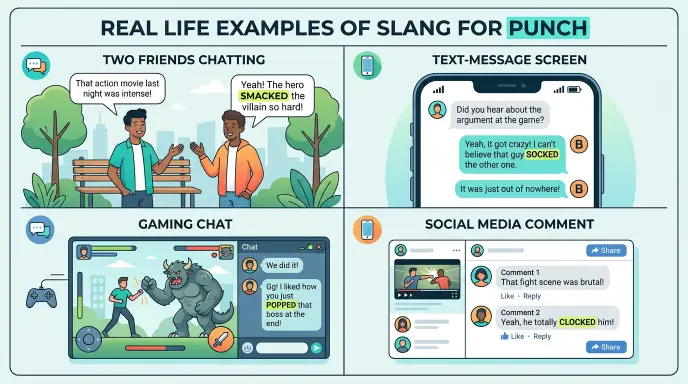
Here are natural examples from different situations.
Friendly Conversation
“That boxer can really wallop the heavy bag.”
The speaker talks about punching strength in a casual way.
Text Message
“Did you see that guy get decked in the movie?”
Here, decked means knocked down.
Boxing Context
“He threw a haymaker in the final round.”
The speaker describes a powerful punch.
Gaming Context
“My character landed a huge hit.”
The word hit works well in a game because it does not always refer to real world violence.
Movie Discussion
“That scene had a serious sucker punch.”
The speaker refers to an unexpected punch.
Casual Story
“He got clocked during the fight scene.”
Here, clocked means hit.
Origin and Background of Punch Slang
Punch slang does not come from one single source. Different terms developed through different forms of informal English, sports language, entertainment, and everyday speech.
Some expressions have long histories in English. Others gained wider attention through boxing, movies, television, and popular culture.
The exact history of individual words can also vary. For that reason, it helps to separate known usage from uncertain origin claims.
For example, haymaker has a strong connection with the image of a person swinging a tool used for hay. English speakers later used the word for a large, swinging punch. The term now appears often in boxing and informal descriptions of powerful hits.
Other terms, such as deck and clock, have their own histories and meanings outside punch slang.
Slang for Punch vs Similar Terms
Some expressions look similar but carry different meanings.
| Term | Meaning | Key difference |
| Punch | A strike with a closed hand | Standard term |
| Hit | A general strike | Broad meaning |
| Slug | A hard punch | Suggests force |
| Smack | A sharp hit | Can describe other strikes |
| Deck | Knock someone down | Focuses on the result |
| Haymaker | Very powerful punch | Focuses on force |
| Sucker punch | Unexpected punch | Focuses on surprise |
| Jab | Quick punch | Common in boxing |
| Hook | Curved punch | Specific boxing technique |
This difference matters when you choose a word. Jab and hook describe specific boxing punches, while hit has a much wider meaning.
When Should You Avoid Punch Slang?
Avoid punch slang when the situation requires clear, formal language.
For example, a school report, news report, workplace email, or formal document may work better with punch, strike, or another precise term.
You should also avoid violent slang when it could make a serious situation sound like a joke.
Instead of:
“He got clocked.”
A formal report could say:
“He received a punch to the face.”
Clear language works better when accuracy matters.
Polite or Neutral Alternatives
If you want to avoid slang, choose a simple standard word.
Good alternatives include:
- Punch
- Hit
- Strike
- Blow
- Physical strike
- Punching motion
The best choice depends on your sentence.
For formal writing, punch or strike usually gives the reader a clearer idea than colorful slang.
Why Do People Use Slang for Punch?
People use punch slang for several reasons.
It adds emotion.
“Wallop” sounds more forceful than “hit.”
It creates a clear image.
“Haymaker” can make readers imagine a large swinging punch.
It fits casual speech.
Words such as “decked” and “clocked” often sound natural in informal conversations.
It matches the setting.
Boxing fans may choose terms that describe specific punches, while movie viewers may use dramatic slang.
It can add humor.
Some older or dramatic expressions can make a story sound playful rather than serious.
Common Misunderstandings About Punch Slang
Does “hit” always mean punch?
No. Hit has a broad meaning. It can describe contact with a person, object, or surface.
Does “deck” mean any punch?
Not exactly. Deck usually highlights the result of a hit, especially when someone knocks another person down.
Does “haymaker” mean every punch?
No. A haymaker usually refers to a large, powerful punch.
Does “sucker punch” mean a strong punch?
Not mainly. The key idea involves surprise or catching someone off guard.
Can “bop” mean punch?
It can describe a light hit in some informal contexts, but bop has other slang meanings too. Context tells you which meaning applies.
FAQ’S
Q1:What is a slang word for punch?
Common slang words include slug, smack, sock, wallop, deck, clock, and hit. Each term has a slightly different tone or meaning.
Q2:What is slang for a hard punch?
Slug, wallop, sock, and haymaker can describe a hard or powerful punch. Haymaker often suggests a large swinging punch.
Q3:What does “deck” mean in slang?
Deck can mean to knock someone down with a punch or another strong hit.
Q4:What does “clock” mean in slang?
Clock can mean to hit someone, often in the face. Context determines if the word carries a literal or figurative meaning.
Q5:What does “sucker punch” mean?
A sucker punch means an unexpected punch that catches someone off guard. The phrase often carries a negative tone.
Q6:Is punch slang appropriate at work?
Most punch slang sounds informal. Use standard words such as punch, hit, or strike when you need clear and professional language.
Conclusion
The best slang for punch depends on what you want to describe. Hit gives you the simplest option, while slug and wallop suggest force. Deck focuses on knocking someone down, and haymaker describes a powerful swinging punch. Sucker punch adds the idea of surprise.
Context matters more than the slang word alone. A term that sounds funny in a movie discussion may sound harsh when someone describes real violence. For formal writing, choose clear words such as punch, hit, or strike.
Dicover More About!
- Melt UK Slang Meaning in Text
- Quad Meaning Slang: What Does “Quad” Mean?
- Bay Slang Meaning: What Does “Bay” Mean in Slang?