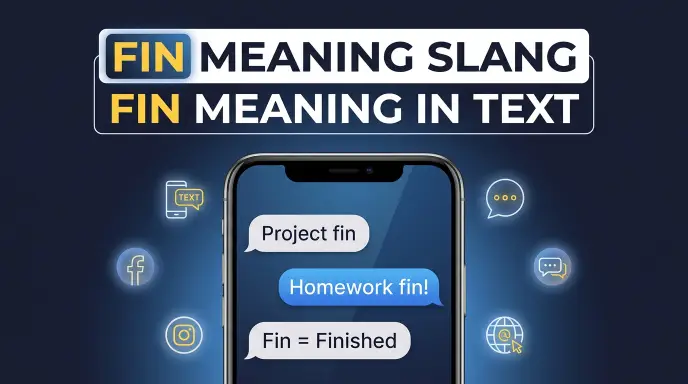
Fin meaning slang can confuse you because this short word can point to different ideas. If you see “fin” in a text, comment, or online conversation, you need the surrounding words to understand the writer’s intent. In casual texting, FIN can mean “finished,” although this use remains fairly uncommon.
The word also has older slang meanings. In American slang, fin can mean a five dollar bill. In other contexts, “fin” can simply refer to the French word for “end,” a finance abbreviation, or the body part that helps a fish swim.
Quick Answer:
- In texting slang, fin usually means “finished” or “finish.” However, context matters because “fin” also has established meanings such as a five dollar bill or “the end.”
What Does Fin Mean in Text?
When someone writes “fin” in a text, they may mean “finished” or “finish.” This short form can tell someone that an activity, task, conversation, or situation has reached its end. CyberDefinitions lists “finished” as the main texting meaning but also notes that people use the term rarely.
For example:
“Homework fin. Time to relax.”
Here, the writer means:
“Homework finished. Time to relax.”
You may also see “fin” at the end of a humorous story or comment:
“And that was the end of my terrible Monday. Fin.”
In that example, the word creates a dramatic sense of closure.
However, you should not assume that every “fin” means “finished.” The word has several dictionary meanings, so the surrounding conversation gives you the strongest clue.
Fin Full Form and Definition
People sometimes search for the fin full form because they think “fin” works like an acronym. In most casual texting contexts, it does not work like abbreviations such as “LOL” or “BRB.”
When a person uses fin as a texting abbreviation, the intended word usually comes from finish or finished. Some online slang references describe it as a shortened form of “finish.”
Here are the most useful meanings to remember:
| Meaning | Context | Example |
| Finished | Texting | “Project fin.” |
| Finish | Casual shorthand | “I need to fin my work.” |
| The end | Dramatic or humorous writing | “And that’s the story. Fin.” |
| Five dollar bill | Older U.S. slang | “I only have a fin.” |
| Finance/financial | Business abbreviation | “Fin. report due Friday.” |
The first three meanings relate to informal communication. The fourth represents older American slang, while the fifth works as an abbreviation rather than internet slang. Merriam Webster lists fin as U.S. slang for a five dollar bill and also lists “finance,” “financial,” and “finish” among its abbreviation meanings.
Does Fin Mean “Finished”?
Yes. In texting, fin can mean “finished.”
For example:
“My assignment is fin.”
The writer intends:
“My assignment is finished.”
However, this form does not have the same everyday popularity as common texting words such as “done” or “finished.” CyberDefinitions describes FIN as a rare texting term.
That point matters when you write about slang. You should not treat every slang abbreviation as a common expression. Some terms appear in certain online communities but rarely appear in everyday conversation.
Can Fin Mean “The End”?
Yes. Fin can also signal “the end” or “finish.”
This meaning comes from French fin, which means “end” or “finish.” English language films and stories have also used “Fin” as a stylized way to show that a story has ended. Wiktionary records this historical use and notes its association with film and television title cards.
For example:
“They finally solved the mystery. Fin.”
The writer creates a dramatic ending.
You might see this style in:
- Memes
- Storytelling posts
- Funny captions
- Movie discussions
- Dramatic comments
- Creative writing
- Social media jokes
In these cases, “fin” may feel more playful than ordinary texting slang.
Is Fin Rude, Offensive, or Neutral?
Fin does not normally carry a rude or offensive meaning.
When someone uses it to mean “finished” or “the end,” the word simply communicates completion.
The tone can change because of the surrounding sentence.
For example:
“Dinner fin! That was amazing.”
This sounds playful.
Compare that with:
“Conversation fin. I’m done arguing.”
This sounds firm or frustrated.
The word itself does not create the negative tone. The rest of the message does.
The five dollar bill meaning also has no inherently offensive meaning. Merriam Webster and Collins both recognize fin as U.S. slang for a five dollar bill.
Where Is Fin Commonly Used?
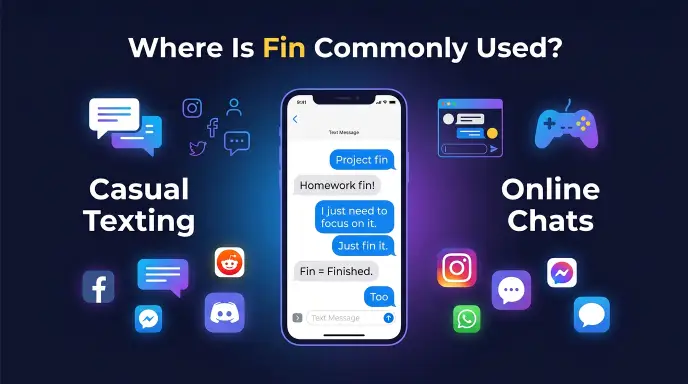
The texting meaning of fin appears mainly in informal digital communication. However, you should not assume that every social platform uses it heavily.
You may encounter it in:
Text Messages
A person may shorten “finished” when they want to keep a message brief.
“Work fin. I’m heading home.”
Social Media
A user may add “fin” to a caption or comment to create a sense of finality.
“That was my last attempt. Fin.”
Memes
Meme creators may use “fin” for dramatic or humorous effect.
“Opened my bank account after shopping. Fin.”
Online Communities
Forums and group chats can contain short forms like this, especially when members share an informal writing style.
Creative Posts
Writers sometimes use “fin” as a playful ending.
“He searched everywhere for his keys. They were in his hand. Fin.”
Because the texting sense remains uncommon, context matters more than the platform name.
Real Life Examples of Fin in Text
The following examples show how the meaning can change with tone.
Friendly Example
“Fin with my homework! Want to play?”
Meaning:
“I finished my homework! Want to play?”
The writer sounds relaxed and friendly.
Casual Example
“Movie fin. That ending was wild.”
Meaning:
“The movie finished. That ending was wild.”
The writer uses the word as a short, casual marker.
Argumentative Example
“I already explained my side. Fin.”
Here, “fin” means something like:
“That’s the end of the discussion.”
The short ending gives the message a firm tone.
Gaming Example
“Boss fight fin! Finally!”
The writer means:
“The boss fight is finished!”
The context makes the intended meaning clear.
Social Media Example
“Spent my last dollar on snacks. Fin.”
Here, “fin” adds humorous finality to the post.
Dramatic Example
“He opened the door, saw the mess, and walked away. Fin.”
This use resembles the traditional “the end” style rather than ordinary texting slang.
Fin as Slang for Five Dollars
There is another important meaning that you should know.
In U.S. slang, a fin can mean a five dollar bill. Merriam Webster lists this meaning as U.S. slang, while Collins also identifies it as American slang.
For example:
“I only have a fin in my wallet.”
This means:
“I only have five dollars in my wallet.”
This meaning has a different history from the texting abbreviation for “finished.” Collins traces the money sense to Yiddish words related to “five.”
So, if someone says:
“Can you lend me a fin?”
Do not automatically interpret it as “finished.” The money context clearly points to five dollars.
Fin vs Finished
The biggest difference between fin and finished involves clarity.
| Term | Meaning | Style |
| Fin | Finished / finish | Very informal |
| Finished | Completed | Standard English |
| Done | Completed | Casual and standard |
| Complete | Fully done | Neutral/formal |
| Over | Reached the end | Neutral |
For example:
“I’m finished with my work.”
sounds clear to almost everyone.
“Work fin.”
requires more context because many readers may not recognize the shorthand.
Fin vs Done
Done provides a much more common casual alternative.
Compare:
“I’m done with my homework.”
and:
“Homework fin.”
Both can communicate completion, but “done” sounds much more natural in everyday English.
If your audience may not know the slang, choose done or finished.
Fin vs Finally
Do not automatically treat fin as a short form of finally.
For example:
“I fin got the tickets.”
Some online posts may use unusual shorthand, but this pattern does not represent the clearest or most established meaning of fin. The better known texting sense connects to finished, while other uses depend heavily on context.
If someone writes:
“I finally got the tickets.”
the word “finally” clearly expresses that the person waited or struggled before getting the tickets.
That meaning differs from:
“The project is fin.”
which expresses completion.
Origin and Background of Fin
The history of fin depends on which meaning you mean.
The English word finish traces back to Latin roots connected with limits and boundaries. Modern references also connect “fin” with the French word fin, meaning “end.”
The money slang has a separate history. Collins traces the U.S. slang fin for five dollars to Yiddish words meaning “five.”
The texting abbreviation represents a much more recent informal shortening. People often shorten words in digital communication to save time and create a casual tone. Online slang references identify “fin” as a short form related to “finish.”
Because these meanings have different histories, you should not treat every use of “fin” as one single slang term.
Why Do People Use Fin?
People often shorten words online because quick communication favors simple forms.
Someone may choose fin because:
- It takes fewer characters.
- It creates a casual tone.
- It can add humor.
- It can create dramatic finality.
- Friends may already understand the shorthand.
- It can make a caption feel short and punchy.
Still, fin does not have the same broad recognition as common texting abbreviations. That makes context especially important.
When Should You Avoid Using Fin?
You should avoid the texting abbreviation when your audience needs maximum clarity.
For example, avoid it in:
- School assignments
- Academic papers
- Job applications
- Formal business emails
- Legal documents
- Official reports
- Professional presentations
Instead of:
“The project is fin.”
write:
“The project is finished.”
Standard wording removes doubt and helps every reader understand your message.
Polite and Clear Alternatives to Fin
Because “fin” does not normally carry an offensive meaning, you do not need a polite replacement. You may simply need a clearer word.
Good alternatives include:
- Finished
- Finish
- Done
- Complete
- Over
- Ended
- The end
- Completed
Example
Slang:
“Homework fin.”
Clear casual English:
“Homework done.”
Standard English:
“I finished my homework.”
More formal:
“I have completed my homework.”
Choose the option that matches your audience.
Impact of Fin on Communication
Short slang terms can make online communication faster and more expressive. However, they can also create confusion when readers do not recognize them.
That issue matters with fin because several established meanings exist.
For example:
“I need a fin.”
could mean something very different from:
“My work is fin.”
The first sentence may refer to five dollars. The second sentence may refer to completion.
This example shows why context matters more than the word alone.
Good communication does not require formal English in every conversation. Instead, you should choose words that your audience can understand quickly.
Is Fin Safe for Social Media?
Yes. Fin does not normally contain offensive or harmful content.
You can use the word in casual posts, captions, comments, or chats when the intended meaning remains clear.
Still, slang can confuse people who do not know the term. If you create content for a wide audience, consider using “finished,” “done,” or “the end” when you want immediate clarity.
Also remember that social media platforms can have their own rules. The word fin itself does not normally create a safety concern.
Common Misunderstandings About Fin
“Fin always means finished.”
Not necessarily. Context can point to the five dollar slang meaning, the French “end” meaning, or an abbreviation such as finance or financial.
“Fin is an acronym.”
Usually no. In texting, it functions more like a shortened form than a letter by letter acronym.
“Fin always means five dollars.”
No. The five dollar meaning represents older U.S. slang. A text about finishing homework likely points to “finished,” not money.
“Fin is a bad word.”
No. The word does not normally carry an offensive meaning.
FAQ’S
Q1:What does fin mean in slang?
In texting, fin usually means “finished” or “finish.” However, the word has other meanings, so you should check the context before deciding what the writer means.
Q2:What does fin stand for in text?
In informal texting, fin can work as a shortened form of finish or finished. It does not normally work like an acronym such as LOL.
Q3:Is fin a bad word?
No. Fin does not normally carry a rude, vulgar, or offensive meaning. The tone depends on the sentence and context.
Q4:Does fin mean five dollars?
Yes. In U.S. slang, a fin means a five dollar bill. This older slang meaning differs from the texting meaning related to “finished.”
Q5:Does fin mean the end?
Yes. French fin means “end,” and English language films and creative writing have used “Fin” to signal the conclusion of a story.
Q6:Should I use fin in formal writing?
No. If you mean “finished,” choose finished, done, or completed in formal writing. These choices give readers a clearer message.
Conclusion
The fin meaning slang question has more than one answer because the word carries several meanings.
In informal texting, fin can mean “finished” or “finish.” People may also use it to create a dramatic “the end” effect. Outside modern texting, fin has established meanings that include a five dollar bill in U.S. slang and abbreviations for words such as finance, financial, and finish.
The best way to understand fin meaning in text involves looking at the complete message. If someone writes “Project fin,” they likely mean “project finished.” If someone says “I only have a fin,” the money context points to five dollars.
So, remember the simple rule: context decides the meaning. Use “fin” casually when your audience understands it, but choose “finished,” “done,” or “completed” when clarity matters most.
Dig Deeper About!
- What Does HMB Mean in Slang? HMB Meaning in Text
- What Does Finna Mean in Slang? Finna Meaning in Text
- Tomorrow in Slang: Meaning, Terms & Examples