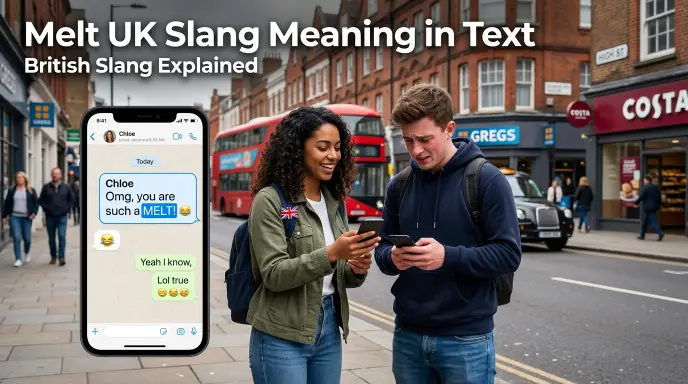
Melt UK slang describes a person who seems weak, overly emotional, soft, foolish, or unable to handle a situation well. In British English, people often call someone “a melt” when that person acts in a silly, timid, or overly sensitive way. The exact tone can range from friendly teasing to a mild insult.
People search for melt UK slang after hearing the word in British conversations, reality TV, social media, or online chats. The meaning can feel confusing because melt also has its normal English meaning of turning from solid to liquid.
This guide explains the melt meaning in text, its British slang meaning, tone, examples, background, and common situations. You will also learn when the word sounds playful and when it may sound rude.
Quick Answer:
- In UK slang, “melt” means a person who acts weak, timid, overly emotional, soft, or foolish. For example, “Don’t be such a melt” means “Don’t act so weak or silly.”
What Does Melt Mean in Text?
In text messages, melt usually means a person who acts soft, foolish, weak, or overly emotional.
The word works as a noun when someone says:
“You’re such a melt.”
The speaker does not mean that the person literally melts. Instead, the speaker criticizes the person’s behavior.
For example:
“He backed out at the last minute. What a melt.”
Here, melt suggests that the person acted weak or lacked confidence.
The meaning can change with the situation. A friend might say it as a joke, while someone in an argument might use it as a direct insult.
Melt UK Slang: Full Meaning and Definition
Melt has several related ideas in British slang:
- A weak person
- A timid person
- Someone who lacks confidence
- Someone who acts foolishly
- Someone who becomes overly emotional
- Someone who seems soft or too sensitive
- A person who backs down under pressure
Collins Dictionary lists melt as British slang for a meek, submissive, or timid person. Wiktionary also records a UK slang sense for a soft, soppy, or overly emotional person.
So, melt UK slang does not simply mean “idiot.” In some situations, it can carry that idea, but the word often focuses more on weakness, softness, foolish behavior, or excessive emotion.
Does Melt Stand for Anything?
No. Melt does not normally stand for a longer phrase.
It works as an ordinary slang noun. Some slang websites may list “idiot” as a simple meaning, but that description misses some of the word’s wider British usage.
Different Meanings of Melt UK Slang

The word can carry slightly different meanings depending on the situation.
1. Melt Means a Weak or Timid Person
Someone may call another person a melt when they think that person lacks courage.
Example:
“You said you would talk to him, then you backed out. Don’t be a melt.”
The speaker criticizes the person’s lack of confidence.
2. Melt Means Someone Who Acts Too Emotional
A person may also use melt for someone who reacts with too much emotion.
Example:
“He started crying over a tiny argument. He’s such a melt.”
The speaker thinks the reaction seems too emotional for the situation.
3. Melt Means a Foolish Person
Some speakers use melt for someone who does something silly or embarrassing.
Example:
“I locked my keys inside the car again. I’m such a melt.”
Here, the speaker may use the word about themselves in a humorous way.
4. Melt Means Someone Who Goes Soft Over Romance
British slang can also use melt for someone who becomes overly sentimental or soft because of romantic feelings.
Example:
“He keeps talking about her. He’s turned into a proper melt.”
The speaker jokes that the person’s romantic feelings have made them softer or more emotional.
Is “Melt” Rude, Offensive, or Neutral?
Melt is informal and usually carries a negative meaning, but it is not normally a highly offensive swear word.
The tone matters a lot.
| Situation | Likely tone |
| Close friends joking | Playful |
| Light teasing | Mildly insulting |
| Argument | Clearly insulting |
| Talking about a stranger | Dismissive |
| Workplace conversation | Too informal |
| Formal writing | Usually inappropriate |
A friend might laugh after saying:
“You absolute melt!”
The same words can sound harsher during a serious argument.
Because melt describes someone negatively, you should not assume that everyone will take it as a joke.
Where Is Melt UK Slang Commonly Used?
You can find melt in casual British speech and online conversations. It may appear in:
- Text messages
- Group chats
- Social media comments
- British reality TV discussions
- Online forums
- Sports conversations
- Friendly banter
- Casual conversations
The word has also gained wider attention through British reality television and online culture. Some sources connect its wider modern visibility with shows such as Love Island and The Only Way Is Essex, although that does not prove that either show created the slang. The word appears in British slang records outside those shows.
A recent online discussion also shows people outside the UK encountering melt through Love Island and learning its meaning from context.
Melt on TikTok, Instagram, Snapchat, and Reddit
On social media, melt usually keeps its British slang meaning.
TikTok
A British creator might call someone a melt after a silly or embarrassing moment.
“Bro forgot his own password. Absolute melt.”
A comment might use melt as friendly teasing.
“You’re a melt 😂”
The emoji can make the comment feel more playful.
Snapchat
Friends may use the word in quick messages:
“Don’t be a melt. Come out with us.”
British users may explain or debate the word’s meaning when non British readers ask about it. The meaning can vary slightly by region and context.
The key point remains simple: context and tone decide how harsh the word feels.
Real Life Examples of Melt UK Slang
Here are natural examples that show different tones.
Friendly Example
Tom: “I forgot your birthday again.”
Jack: “You absolute melt 😂”
Here, Jack probably uses melt as playful teasing.
Casual Text Example
“Stop being a melt and just ask her out.”
The sender thinks the person feels too nervous to act.
Argument Example
“You promised you would help, then you disappeared. You’re a melt.”
Here, the word sounds more insulting because the speaker feels annoyed.
Gaming Example
“You quit after one bad round? What a melt.”
The player criticizes someone for giving up too quickly.
Social Media Example
“He posted five stories about the same problem. Proper melt.”
The writer criticizes someone for reacting too emotionally or dramatically.
Self Joking Example
“I walked into the wrong classroom. I’m such a melt.”
This example sounds lighter because the speaker uses the word about themselves.
Origin and Background of Melt UK Slang
The exact origin of melt as British slang remains unclear.
That matters because many online explanations claim a specific origin without strong evidence. We should not treat those claims as proven fact.
The figurative idea may connect naturally with the normal verb melt, which can describe something becoming soft or losing its solid form. That image fits the slang idea of someone becoming weak, soft, or unable to stay firm. However, this connection does not give us a confirmed historical origin.
Historical research also shows examples of melt as a noun meaning “idiot” in British regional material. A Swansea University thesis records such an example and notes a lack of supporting records for that particular usage. This suggests that the slang has a longer and more complex history than modern reality TV alone.
So the safest explanation is:
Melt has a long established British slang life, while modern TV and social media helped more people recognize the term.
Melt vs Similar British Slang
Several British slang words can describe someone who acts foolish, weak, or annoying. However, they do not carry exactly the same meaning.
| Slang | General meaning | Tone |
| Melt | Soft, weak, timid, foolish, or overly emotional person | Mild to negative |
| Mug | Foolish or easily fooled person | Negative |
| Wally | Silly or foolish person | Often mild |
| Plonker | Foolish or stupid person | Usually humorous |
| Wimp | Person who lacks courage | Negative |
| Idiot | Very foolish person | More direct |
Melt stands out because it can suggest softness or emotional weakness, not just a lack of intelligence.
When Should You Avoid Using “Melt”?
You can use melt in casual conversations when you know the audience understands British slang. Still, avoid it when the situation calls for respect or formal language.
Avoid using it:
- In formal emails
- In job interviews
- When speaking to a customer
- When talking to a teacher or professor
- With someone you barely know
- During a serious disagreement
- When you do not know how the other person takes jokes
For example, telling your close friend:
“You’re such a melt.”
may sound funny.
Telling your manager:
“You’re a melt.”
could sound disrespectful and unprofessional.
Polite Alternatives to “Melt”
If you want to express the same general idea without insulting someone, choose softer language.
Depending on the situation, you could say:
- You’re being a bit silly.
- You seem nervous.
- Don’t overthink it.
- You’re taking this too seriously.
- Try not to worry so much.
- You gave up too quickly.
These phrases explain the behavior without directly labeling the person.
Why Do People Use Melt?
People often use melt because it delivers a strong opinion in one short word.
Instead of saying:
“You are acting overly emotional and nervous about this.”
someone can simply say:
“You’re being a melt.”
The slang also fits British banter. Friends may use it to tease each other after an awkward, silly, or overly emotional moment.
Tone makes the difference. A smile or laughing emoji can soften the message, while an angry voice can turn the same word into an insult.
The Impact of Using Melt in Communication
Slang can make communication feel more relaxed and personal. Melt can work well among friends who understand the joke.
However, slang can also create confusion when people come from different regions.
For example, an American reader may understand the normal verb melt but not understand why someone calls another person “a melt.” British slang often needs context for international audiences.
If your audience may not know the term, use a clearer phrase or explain it once.
Is Melt Safe for Social Media?
Yes, melt generally presents no special safety concern on social media. It describes a person in a negative way, so the main issue involves tone rather than safety.
A casual comment such as:
“You’re such a melt 😂”
may work as friendly teasing.
A repeated insult aimed at someone can contribute to an unpleasant interaction. Use the word carefully when you do not know the person.
Common Misunderstandings About Melt
Does melt mean idiot?
Sometimes, but that definition does not cover every use. British speakers can use melt for someone who acts weak, timid, overly emotional, soft, or foolish.
Does melt mean coward?
It can suggest cowardice or a lack of courage, especially when someone backs down from a difficult situation.
Does melt mean someone is crying?
Not always. The word can describe someone who acts overly emotional, but it does not literally mean “crying.”
Is melt a swear word?
No. Melt is not normally a swear word. It is an informal insult.
Can I call my friend a melt?
Yes, if your friendship supports that kind of teasing. Still, consider your friend’s feelings and the situation.
FAQ’S
Q1:What does melt mean in UK slang?
Melt means a person who seems weak, timid, soft, foolish, or overly emotional. The exact meaning depends on the situation and tone.
Q2:What does melt mean in text?
In texting, melt usually describes someone who acts foolish, weak, nervous, soft, or too emotional. Friends may use it as playful teasing.
Q3:Is melt an insult in Britain?
Yes. Melt usually carries a negative meaning, although friends can use it jokingly. The relationship and tone affect how harsh it sounds.
Q4:What does “don’t be a melt” mean?
“Don’t be a melt” usually means “don’t act weak, silly, nervous, or overly emotional.”
Q5:Is melt offensive?
It can offend someone because it labels their behavior negatively. However, it generally ranks as a mild insult rather than a strong swear word.
Q6:Where does British slang melt come from?
The exact origin remains uncertain. The slang has a longer history than its recent popularity through British reality TV and social media, so claims about one specific show creating the term lack solid support.
Conclusion
Melt UK slang describes someone who acts weak, timid, soft, foolish, or overly emotional. In text messages, people often use “melt” as a quick way to tease or criticize someone’s behavior.
The word can sound funny between close friends, especially with a laughing emoji or playful tone. However, it can also sound insulting during an argument or when you use it toward someone you do not know well.
The best way to understand melt meaning in text involves looking at the whole conversation. If someone says, “You’re such a melt 😂,” they may simply tease a friend. If someone says, “You’re a complete melt,” during an argument, the speaker likely intends a stronger insult.
Discver More About!
- Savage Definition Slang: Meaning, Uses & Examples
- Quad Meaning Slang: What Does “Quad” Mean?
- Bay Slang Meaning: What Does “Bay” Mean in Slang?