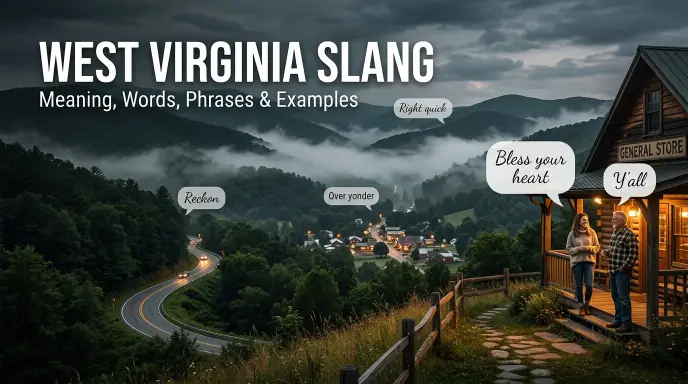
West Virginia slang refers to informal words, phrases, and speech patterns that people use in parts of West Virginia and the wider Appalachian region. Words such as holler, crick, poke, yonder, purdy, winder, and right smart can sound unusual to people from other parts of the United States.
West Virginia does not have one single set of slang words that everyone uses. Speech changes across the state, and different communities use different words and pronunciations. The southern and rural parts of the state often show stronger Appalachian English features, while northern areas can share speech patterns with nearby regions.
People often search for West Virginia slang because they hear a word in a conversation, movie, social media post, or visit to the Mountain State. This guide explains common terms, their meanings, their tone, and the context where they fit best.
Quick Answer
- West Virginia slang means informal regional words and expressions used by some West Virginians. Many of these terms connect with Appalachian English and local culture. However, not every West Virginian uses the same words, and some expressions also appear in nearby Appalachian states.
What Does West Virginia Slang Mean?
West Virginia slang usually describes regional vocabulary and expressions, not a separate language. Some terms describe places, people, feelings, objects, or everyday activities.
For example,
a person might say “crick” instead of “creek.” Another speaker might use “holler” for a small valley. Someone might describe a crooked object as “si gogglin.”
The West Virginia Dialect Project at West Virginia University documented many examples of Appalachian speech. Its educational material also stresses that Appalachia has many English varieties, not one single Appalachian dialect.
That point matters because people sometimes use “West Virginia slang” as a broad label for many different speech features.
Common West Virginia Slang Words
Here are several regional terms that can help you understand West Virginia speech.
| Word or phrase | Meaning | Example |
| Crick | Creek or small stream | “We went fishing down at the crick.” |
| Holler | Small valley or hollow | “They live back in the holler.” |
| Poke | Bag | “Put the apples in that poke.” |
| Yonder | Over there or at some distance | “The store is over yonder.” |
| Winder | Window | “Open the winder.” |
| Purdy | Pretty | “That flower sure is purdy.” |
| Si gogglin | Crooked or uneven | “That shelf looks si gogglin.” |
| Right smart | A good amount or quite a lot | “That took a right smart of time.” |
| Ripshin | Thorny or entangling plant | “Watch out for that ripshin.” |
| Gaumy | Smeared or dirty | “Your boots are getting gaumy.” |
| They uns | They, them, or their in some Appalachian usage | “They uns are coming later.” |
| Everwhere | Wherever in some Appalachian speech | “Go everwhere you need to go.” |
West Virginia University gives examples such as poke, si gogglin, ripshin, gaumy, and they uns in its Appalachian language materials. The university also notes that these forms occur among some Appalachian speakers in some areas, so readers should not assume that every West Virginian uses them.
West Virginia Slang for Places
Some of the most recognizable expressions describe the landscape.
Holler
Holler refers to a small valley or hollow, especially in Appalachian speech.
Example:
“My grandparents live up in the holler.”
The word often appears when people describe rural mountain communities. You may hear it in conversations about roads, homes, farms, or family history.
Yonder
Yonder means a place over there or at some distance.
Example:
“The truck is parked over yonder.”
The exact distance does not always matter. The speaker simply points to a place that the listener can understand from context.
Down the Road
People may also use phrases such as “down the road” to describe a place farther along the same route.
Example:
“There’s a little store down the road.”
This expression does not always mark a specific distance. Context tells you how far the speaker means.
West Virginia Slang for Everyday Things
Regional speech can also give ordinary objects familiar local names.
Crick
Crick refers to a creek or small stream in some regional speech.
Example:
“We used to swim in the crick.”
This word appears in Appalachian speech and does not belong only to West Virginia. Regional words often cross state borders because communities share history and geography.
Poke
In some Appalachian speech, poke means a bag.
Example:
“Put the groceries in the poke.”
West Virginia University includes this meaning in its Appalachian language quiz.
Winder
Winder refers to a window in some West Virginia speech.
Example:
“Can you open the winder?”
Actress Jennifer Garner, who grew up in West Virginia, also highlighted winder as a West Virginia term in a Vanity Fair “Slang School” segment.
West Virginia Slang for Describing Things
Some terms describe how something looks or feels.
Si Gogglin
Si gogglin means crooked, uneven, lopsided, or out of alignment.
Example:
“That picture frame is sitting si gogglin.”
You can use the word for an object that does not sit straight.
Gaumy
Gaumy describes something smeared or dirty.
Example:
“Those kids came home with gaumy shoes.”
The West Virginia Dialect Project uses this term as an example of Appalachian vocabulary.
Purdy
Purdy represents a regional pronunciation of “pretty.”
Example:
“That’s a purdy sunset.”
The meaning stays simple. The regional form gives the sentence a local sound.
West Virginia Slang for Amounts and Feelings
Regional expressions can also change how people describe quantity or emotion.
Right Smart
Right smart can mean quite a lot or a good amount.
Example:
“That repair cost a right smart of money.”
The phrase can sound informal and conversational.
Tickled
In some Appalachian speech, tickled can express delight or pleasure.
Example:
“I was tickled when my old friend called.”
The word can also appear in wider American English, so context matters.
Plumb
Plumb can mean completely or totally in informal regional speech.
Example:
“I’m plumb tired after that long hike.”
Again, this word does not belong only to West Virginia. Regional speech often overlaps across Appalachia and the American South.
Is West Virginia Slang the Same as Appalachian English?
No. West Virginia slang and Appalachian English are related, but they are not exactly the same thing.
West Virginia sits within Appalachia, but the state contains several speech patterns. The West Virginia Encyclopedia explains that Appalachian English appears across much of the state, while northern areas can share features with nearby regions. Southern West Virginia often shows stronger Appalachian features.
West Virginia University also uses the term Appalachian Englishes because the region contains many varieties rather than one fixed dialect.
This variation makes the topic more interesting. A word that sounds familiar in one county may sound less common in another.
Where Is West Virginia Slang Used?
West Virginia regional expressions mainly appear in spoken conversation.
You may encounter them in:
- Family conversations
- Rural communities
- Local storytelling
- Regional music
- Community events
- Social media posts about Appalachian culture
- Interviews with West Virginia residents
- Books and writing about Appalachia
- Informal conversations between friends
Some terms also appear online. However, you should not assume that a word appears on TikTok, Reddit, Discord, or Instagram simply because it belongs to regional speech.
The internet can spread regional words to people outside the area. Social media also lets younger speakers discuss and celebrate local language and identity.
Real Life West Virginia Slang Examples
Friendly Conversation
Person 1: “Where are you headed?”
Person 2: “Down the road a piece. I need to grab some groceries.”
The phrase sounds relaxed and informal.
Talking About a Place
Person 1: “Where does your uncle live?”
Person 2: “Up in the holler, past the old bridge.”
Here, holler gives the listener a local description of the area.
Talking About an Object
Person 1: “Why does that table look strange?”
Person 2: “One leg is si gogglin.”
The speaker uses the regional word to describe an uneven table.
Talking About a Stream
Person 1: “Where did you go fishing?”
Person 2: “Down by the crick.”
Here, crick means creek.
Casual Compliment
Person 1: “What do you think of the new porch?”
Person 2: “It looks purdy.”
The word gives the compliment a regional, informal feel.
Where Did West Virginia Slang Come From?
West Virginia speech developed through many historical and regional influences. The state’s language reflects its Appalachian setting, migration patterns, neighboring regions, and local communities.
The West Virginia Encyclopedia notes the influence of Scotch Irish settlement on parts of the state’s speech. It also discusses German and African American influences and explains that language changes across different parts of West Virginia.
Researchers also warn against simple stories about Appalachian speech. West Virginia University explains that Appalachian English has many varieties and that language differences connect with geography, identity, ethnicity, and community.
So, it would be inaccurate to say that every West Virginia slang word came from one source.
Does West Virginia Slang Still Exist?
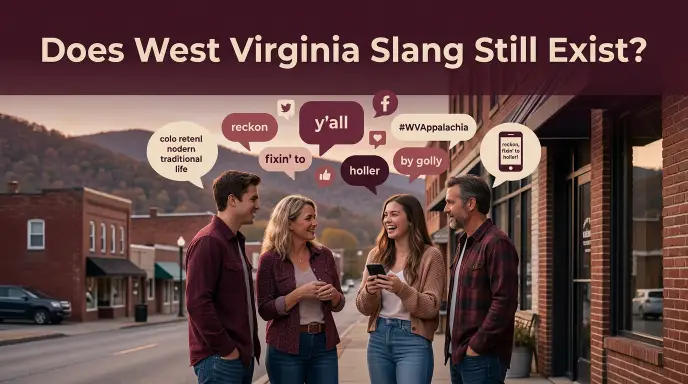
Yes. People still use regional West Virginia expressions, although usage varies by community and age.
Some traditional speech features have become less common. Linguistic research has documented changes in West Virginia speech over time. A Cambridge University study, for example, found that several stereotypical Appalachian features had declined in use.
That does not mean regional speech has disappeared.
People continue to use local words in homes, communities, stories, music, and cultural discussions. West Virginia University also continues to provide educational material about Appalachian Englishes and language variation.
Is West Virginia Slang Rude or Offensive?
Most West Virginia regional expressions are not rude or offensive. They usually function as informal ways to describe people, places, objects, or everyday experiences.
However, tone matters.
A person can use a regional accent or word naturally when speaking with friends and family. An outsider who imitates the accent to make fun of someone may create a very different effect.
This matters because Appalachian speakers have faced negative stereotypes about their speech. West Virginia University has specifically discussed the stigma surrounding Appalachian English and the importance of understanding dialect diversity.
The safest approach is simple: learn the words, respect the speakers, and avoid mocking the accent.
When Should You Avoid Using West Virginia Slang?
You do not need to avoid regional words in normal conversation. Still, some situations call for standard English.
Consider avoiding unfamiliar regional expressions when:
- You are writing a formal school paper.
- You are preparing a professional report.
- You are speaking in a formal business setting.
- Your audience may not understand the regional term.
- The meaning could cause confusion.
For example, “Please open the winder” may sound natural in an informal conversation. In a formal instruction, “Please open the window” gives a clearer message to a broad audience.
The goal is not to hide regional speech. The goal is to choose words that fit the audience.
West Virginia Slang vs. Standard English
| West Virginia/Regional Term | Standard English |
| Crick | Creek |
| Holler | Hollow / small valley |
| Poke | Bag |
| Winder | Window |
| Purdy | Pretty |
| Si gogglin | Crooked / uneven |
| Yonder | Over there |
| Right smart | Quite a lot |
| Gaumy | Smeared / dirty |
This table works as a quick reference, but remember that regional usage can vary.
Why Do People Use West Virginia Slang?
People use regional language for several reasons.
It feels natural
Local expressions often form part of everyday speech. Speakers may use them without thinking about them as “slang.”
It shows local identity
Language can connect people with family, community, and place.
It makes speech expressive
Words such as holler, purdy, and si gogglin can add a strong local flavor to ordinary conversation.
It carries family traditions
Older family members may pass regional words to younger generations through everyday conversation.
Common Misunderstandings About West Virginia Slang
“Everyone in West Virginia talks the same way.”
Not true. Speech varies across the state. West Virginia contains several regional speech patterns.
“West Virginia slang is just incorrect English.”
That view ignores how dialects work. Regional speech follows patterns and carries social and cultural meaning. West Virginia University studies these varieties as legitimate subjects of linguistic research.
“Every Appalachian word comes from West Virginia.”
Not true. Appalachian speech extends across several states, so many expressions cross state lines.
“Young people never use regional words.”
Usage changes, but that does not mean regional language has vanished. Some features have declined while other expressions remain part of local identity and conversation.
“You can use every regional word anywhere.”
Not always. Some words may confuse people outside the region. Context and audience still matter.
FAQ’S
Q1:What is West Virginia slang?
West Virginia slang refers to regional words, expressions, and speech patterns used by some people in West Virginia. Many connect with Appalachian English.
Q2:What is a common West Virginia slang word?
Holler is one well known regional term. It can refer to a small valley or hollow, especially in Appalachian speech.
Q3:What does “crick” mean in West Virginia?
Crick can mean creek, or a small stream. The term also appears in other Appalachian speech varieties.
Q4:What does “holler” mean in West Virginia slang?
Holler usually means a small valley or hollow. People often use it when describing rural mountain areas.
Q5:Is West Virginia slang offensive?
Most regional words are harmless. The problem usually comes from mocking a person’s accent or using stereotypes rather than from the words themselves.
Q6:Is West Virginia slang still used today?
Yes. People still use regional expressions, but usage differs by location, age, and community. Some traditional features have also become less common over time.
Conclusion
West Virginia slang gives readers a useful window into regional speech, Appalachian culture, and local identity. Words such as holler, crick, poke, winder, purdy, yonder, and si gogglin can help you understand conversations that may sound unfamiliar at first.
The key point is that West Virginia does not have one single dialect. Speech varies across the state, and many regional words also appear in other parts of Appalachia.
If you hear an unfamiliar West Virginia expression, look at the context, tone, and surrounding words before deciding what it means. Most importantly, treat regional speech with respect. It represents real communities, family traditions, and local identity.
Dig M ore About!
- JS Meaning Slang: What Does JS Mean in Text?
- Military Slang Insults: Meanings, Terms & Examples
- Gym Slang Funny: Hilarious Gym Terms & Meanings