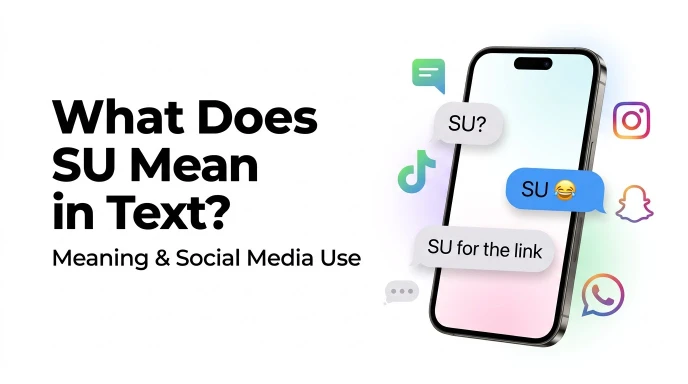
SU usually means “shut up” in casual texting, but it can also mean “swipe up,” “see you,” or “what’s up?” depending on the context. You may see SU in texts, TikTok comments, Snapchat, Instagram, WhatsApp, and other online chats.
The meaning can change a lot from one conversation to another. A friend might type “SU 😂” to show surprise, while an Instagram user might write “SU for the link” to mean “swipe up.”
That difference explains why people search for SU meaning in text. Two letters can have several meanings, and the wrong guess can make your reply sound strange.
The good news is that the surrounding words usually give you a clue. The platform, punctuation, emojis, and relationship between the people can also help you understand what SU means.
SU Meaning in Text
In casual texting, SU most often means “shut up.” People can use it as a direct command, but friends also use it as a playful reaction to surprising or unbelievable news.
For example:
A: I just met your favorite singer.
B: SU 😭
Here, B probably does not want A to stop talking. B uses SU to show surprise.
In another conversation, SU can sound much more direct:
A: You’re still arguing about this?
B: SU.
Here, SU can sound rude because the speaker wants the other person to stop talking.
SU can also have other meanings. On social media, it may mean “swipe up.” In some short chats, people may use it for “see you.” Some users also type SU? as a very short version of “sup?”, meaning “what’s up?” However, sup remains the clearer form for that greeting.
Because several meanings exist, context matters more than the two letters themselves. Slang references commonly list “shut up” and “swipe up” among the main meanings of SU.
What Does SU Stand For?
The full form depends on the situation.
| SU | Meaning | Typical context |
| SU | Shut up | Texting and casual chats |
| SU | Swipe up | Social media stories |
| SU | See you | Short goodbyes |
| SU? | What’s up? | Very casual chats |
| SU | Sign up | Some online contexts |
The first two meanings matter most when you see SU in everyday online communication.
Do not assume that every person uses SU in the same way. Internet slang changes from one community to another.
SU as “Shut Up”
When SU means “shut up,” it can have two very different tones.
It can sound playful:
SU 😂 You actually did that?
Or it can sound rude:
SU. I don’t want to hear this anymore.
The relationship between the speakers makes a big difference.
Close friends may use SU as a joke. A stranger may make the same message feel harsh.
SU as “Swipe Up”
On social media, SU can mean “swipe up.”
People may use it to direct followers toward a link or another piece of content. Cyber Definitions lists “swipe up” as one of the main social media meanings of SU, especially on platforms such as Instagram and Snapchat.
For example:
New video is live! SU to watch.
Here, the person is not telling anyone to stop talking. They are giving a social media instruction.
How Context Changes the Meaning of SU
Context gives you the biggest clue.
Imagine a friend sends:
SU 😭
You need to look at the message before it.
If you just told them shocking news, SU probably means:
“No way!”
If you are arguing, SU may mean:
“Shut up.”
Now imagine seeing:
SU for the full story
on a social media post.
That likely means:
“Swipe up for the full story.”
You can also look at punctuation.
“SU?” may suggest a question or greeting.
“SU.” may sound more serious or direct.
The meaning does not come from the letters alone. The entire message matters.
Where People Use SU
People can use SU across many digital platforms. However, each platform can encourage a slightly different meaning.
SU on TikTok
TikTok users may use SU in comments, replies, captions, or direct messages.
For example:
SU 😭 I cannot believe you posted this.
In this type of comment, SU likely means “shut up” in a playful way.
A viewer may also use the abbreviation to react to surprising information.
TikTok conversations move quickly, so short abbreviations can fit naturally into comments.
Still, TikTok does not give SU one fixed meaning. Always read the rest of the comment.
SU on Snapchat
Snapchat gives SU another important meaning: “swipe up.”
For example:
SU for the link.
The person wants viewers to interact with the story or access linked content.
You may also see SU in private Snapchat chats where it means “shut up.”
So the same app can support different meanings.
The difference comes from the message itself.
SU on Instagram
Instagram users may write SU in Stories, comments, DMs, or captions.
For example:
SU to see the new collection.
Here, SU means “swipe up” in the social media sense.
In a private DM, however, someone could write:
SU 😂 you’re making me laugh.
That version probably means “shut up” as a playful reaction.
SU on WhatsApp
WhatsApp chats often contain informal abbreviations.
A friend might write:
SU, you’re kidding!
That likely means “shut up” as an expression of disbelief.
Someone could also write:
Okay, SU tomorrow.
In this case, the sender may mean “see you tomorrow,” although CU or the full phrase “see you” gives a clearer meaning.
SU in SMS and Text Messages
Regular text messages can use SU in several ways.
A friend may write:
SU! You got the job?
Here, SU shows surprise.
Another person might send:
SU later.
That could mean “see you later,” although this use appears less clearly than the common meanings.
If you receive an unclear message, asking the sender can save you from guessing.
Real Chat Examples of SU
These examples show how the meaning can change with the situation.
Surprise
A: I won first place in the contest.
B: SU 😭 That’s amazing!
A: I know! I still can’t believe it.
Here, SU means something like “No way!” The speaker shows surprise.
Playful Reaction
A: I ate the whole pizza myself.
B: SU 😂
A: Don’t judge me.
B probably does not mean “stop talking.” The response sounds playful.
Rude Command
A: You keep changing the story.
B: SU.
A: Okay, calm down.
Here, SU sounds more aggressive.
Social Media Instruction
A: New video is finally out!
B: Where can I watch it?
A: SU for the link.
Here, SU means “swipe up.”
Instagram Story
A: Do you have the recipe?
B: Yep.
A: Send it?
B: SU on my story.
Here, SU refers to a social media action.
Excited Reaction
A: My favorite band is coming to town.
B: SU!!!
A: I knew you’d be excited.
B: I’m buying tickets today.
The abbreviation shows strong excitement.
Gaming Chat
A: I beat the final boss on my first try.
B: SU 😭
A: I’m serious.
B: That’s wild.
Here, SU expresses disbelief.
Casual Goodbye
A: I have to go now.
B: Okay, SU tomorrow.
A: See you then.
Here, SU may mean “see you,” although the full phrase sounds clearer.
Very Short Greeting
A: SU?
B: Nothing much. You?
A: Just getting home.
Some users may use SU? as a very short version of “sup?” or “what’s up?” This meaning exists in casual chat, but sup? gives the greeting more clearly. Some current slang references list this as a context dependent use rather than a fixed meaning.
Frustrated Conversation
A: You need to stop blaming me.
B: SU, I’m done arguing.
A: Fine.
Here, SU sounds dismissive rather than playful.
How to Reply When Someone Says SU
Your reply should match the meaning and tone.
If you are not sure what the sender means, do not guess too quickly. Read the previous message first.
Funny Replies
If your friend uses SU as a joke, you can reply:
“Make me 😂”
“Nope, I’m talking.”
“You first 😂”
“I knew you’d say that.”
These replies work best when you already have a playful relationship.
Casual Replies
For a normal conversation, try:
“Okay 😂”
“Why?”
“What did I do?”
“Relax.”
These short replies keep the conversation moving.
Friendly Replies
If the message seems playful, you can answer warmly:
“Haha, I’m serious!”
“I promise!”
“You don’t believe me?”
“I’m telling the truth.”
Neutral Replies
If you do not understand the meaning, ask:
“What do you mean by SU?”
Or:
“Do you mean shut up or swipe up?”
That response works especially well when the context does not make the meaning clear.
Is SU Rude or Offensive?
SU can sound rude, but it does not always carry a rude tone.
The phrase “shut up” can work as a direct command. However, friends sometimes use it as a playful reaction.
For example:
SU, you actually met him? 😂
This may sound like:
“No way! You actually met him?”
Compare that with:
SU. I’m tired of listening to you.
That version sounds much harsher.
Is SU Safe to Use With Friends?
It can work between close friends who already understand each other’s humor.
Still, think about the person’s personality. Some people dislike “shut up” even when someone says it as a joke.
Is SU Appropriate at School?
SU may appear in student group chats or casual messages between friends.
However, it does not belong in formal school writing.
Avoid using it in:
- Essays
- Assignments
- Formal presentations
- School applications
- Formal emails
Use clear language instead.
Is SU Appropriate at Work?
SU can sound too casual or rude in professional communication.
A coworker may understand it as a joke, but a manager, client, or new colleague may not.
For professional messages, avoid phrases that can sound dismissive.
Instead of:
SU, you’re right 😂
Try:
You’re right. I didn’t think of that.
Clear wording removes confusion.
Who Uses SU?
SU mainly appears in casual online communication.
You may see it among teenagers, young adults, and other people who regularly use texting slang. However, no age group owns the term.
Older internet users can understand it too.
Gen Z users often mix abbreviations, emojis, memes, and short phrases in online conversations. SU can fit that style because it takes only two letters.
The abbreviation can appear in:
- TikTok comments
- Snapchat chats
- Instagram DMs
- WhatsApp messages
- SMS
- Discord
- Gaming chats
- Group conversations
- Online comments
Its frequency can vary from one community to another.
Some people use SU often. Others prefer the full phrase or another abbreviation.
That is why you should treat SU as a context based slang term rather than a word with one universal meaning.
Origin of SU
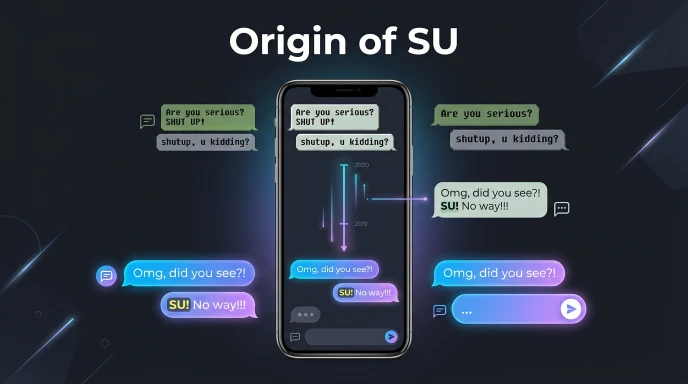
There is no single confirmed origin for every use of SU.
The phrase “shut up” existed long before smartphones and social media. People later shortened common phrases to make digital communication faster.
The “swipe up” meaning developed within social media culture, where users needed short ways to direct followers toward links and other content.
Social media references list swipe up and shut up as major meanings of SU.
The “see you” and “what’s up” uses have less fixed meaning. People often create short forms naturally while texting.
This makes the exact history difficult to pin down.
It is safer to say that SU grew through informal digital communication rather than claim that one person created the abbreviation.
SU Compared With IDK, IDC, IMO, and BRB
These abbreviations all appear in online conversations, but each one does a different job.
| Term | Meaning | Type | Usage | Popularity |
| SU | Shut up / swipe up, depending on context | Abbreviation | Reactions, commands, social media actions | Common in casual online spaces |
| IDK | I don’t know | Abbreviation | Shows uncertainty | Very common |
| IDC | I don’t care | Abbreviation | Shows lack of concern | Very common |
| IMO | In my opinion | Abbreviation | Introduces an opinion | Common |
| BRB | Be right back | Abbreviation | Tells someone you will return | Very well known |
The main difference involves meaning.
IDK communicates uncertainty.
IDK what happened.
IDC communicates a lack of concern.
IDC what they think.
IMO introduces an opinion.
IMO, the first movie was better.
BRB tells someone you are leaving briefly.
BRB, I need some water.
SU needs more context.
SU 😂
could mean “shut up” as a playful reaction.
But:
SU for the link
likely means “swipe up.”
That makes SU more context dependent than many common texting abbreviations.
Real World Usage Example
Imagine two friends talking after school.
One friend tells the other some surprising news.
A: Guess what happened today?
B: What?
A: I ran into our old teacher at the mall.
B: SU 😭
A: I’m serious!
B: No way. What did you talk about?
A: We talked for almost twenty minutes.
In this situation, B uses SU to express surprise.
B does not literally tell A to stop talking.
Now imagine a different situation:
A: You keep interrupting me.
B: SU.
A: That’s rude.
Here, the same two letters have a completely different tone.
This example shows why context matters so much.
Common Mistakes When Using SU
- Assuming SU always means “shut up”: Social media can give SU a different meaning, especially when someone asks followers to swipe up.
- Assuming it always means “swipe up”: A friend may use SU as a playful reaction instead.
- Ignoring punctuation: “SU?” can feel different from “SU!” or “SU.”
- Using it with strangers: “Shut up” can sound rude when you do not know the person.
- Using it in formal writing: SU belongs mainly to casual digital communication.
- Forgetting the platform: A Story post may give you a strong clue that SU means “swipe up.”
- Assuming every person uses the same slang: Online abbreviations vary between communities and age groups.
- Treating a slang definition as universal: Context can change the intended meaning.
Why Do People Use SU?
People shorten phrases online for several reasons.
First, short messages take less time to type.
Second, abbreviations can make conversations feel relaxed.
Third, slang helps people match the tone of their friends or online community.
SU can also add emotion.
Compare:
You are joking.
with:
SU 😂
The second message feels shorter and more emotional.
A person may use SU because they want to show disbelief without typing a full sentence.
On social media, the reason can differ.
SU for the link
does not express disbelief. It gives followers a quick instruction.
So, even though the abbreviation stays the same, its purpose changes.
How to Tell Which Meaning Someone Intended
When you see SU, check these five clues:
Look at the previous message
If the previous message contains shocking news, SU may mean “shut up” as a reaction.
Check the platform
A Story post can point toward “swipe up.”
Look at punctuation
A question mark may suggest a greeting or question.
Notice emojis
An emoji such as 😂 or 😭 can make a “shut up” message feel playful.
Think about your relationship
A close friend may joke with SU. A stranger may use it more directly.
These clues cannot guarantee the meaning, but they can help you make a better guess.
Is SU the Same as STFU?
No.
SU and STFU can both relate to “shut up,” but they do not have exactly the same tone.
STFU stands for “shut the f* up.”** It contains profanity and can sound much more aggressive.
SU can also work as a playful reaction among friends.
For example:
SU 😂
may simply mean:
“No way!”
Because STFU contains profanity, it usually needs more caution.
If you want to keep a message friendly, avoid stronger versions unless you know the audience well.
Is SU the Same as “Sup”?
Not exactly.
Sup? usually means “What’s up?” It works as a casual greeting.
For example:
A: Sup?
B: Not much. You?
Some people may type SU? in a similar way, but the meaning can become unclear.
If you want to greet someone, “sup?” makes your meaning easier to understand.
If you see “SU?” from someone else, look at the conversation before deciding what they mean.
FAQ’s
Q1. What does SU mean in text messages?
SU most commonly means “shut up” in casual texting. People can use it seriously, but friends often use it as a playful reaction to surprising news.
Q2. What does SU mean on TikTok?
On TikTok, SU can mean “shut up” when someone reacts to a video or comment. It can also have another meaning depending on the post, so check the surrounding text before deciding.
Q3. Is SU slang?
Yes. SU works as an informal texting abbreviation. It appears in casual chats, social media, comments, and direct messages rather than formal writing.
Q4. Is SU rude or offensive?
SU can sound rude when it means “shut up.” Friends may use it playfully, but the same abbreviation can sound harsh with strangers or during an argument.
Q5. How should you reply to SU?
First, work out the meaning from context. If it means “shut up” as a joke, you can reply playfully. If you are unsure, simply ask, “What do you mean by SU?”
Q6. What does SU mean on Snapchat?
On Snapchat, SU can mean “swipe up,” especially when someone uses it on a Story to direct viewers toward a link or more content. It can also mean “shut up” in private chats.
Q7. Can SU mean “see you”?
Yes, some people use SU as a short form of “see you,” especially in quick goodbyes. However, this meaning appears less clearly than “shut up” or “swipe up.”
Q8. Can SU mean “what’s up”?
In some casual chats, SU? can work like “sup?” or “what’s up?” This use depends on the sender. “Sup?” remains the clearer way to write the greeting.
Conclusion
SU has more than one meaning in text. In casual conversations, it often means “shut up,” especially when someone reacts to surprising or unbelievable information. Friends may use it playfully, while an angry message can make the same abbreviation sound rude.
On social media, especially in Story style content, SU can also mean “swipe up.” Some people use it for “see you,” while SU? may sometimes work as a very short greeting similar to “sup?”
The best way to understand SU is to look at the whole conversation. Check the platform, previous message, punctuation, emojis, and relationship between the speakers.
Use SU carefully with people you do not know well. For school, work, and other formal situations, clear standard English usually works better.
Once you understand the context, those two letters become much easier to read.
Find Out More About!
What Does STTM Mean in Text? Real Meaning,& Social Media Use
What Does STSU Mean in Text? Real Meaning & Social Media Use
What Does STG Mean in Text? Real Meaning,Social Media Use