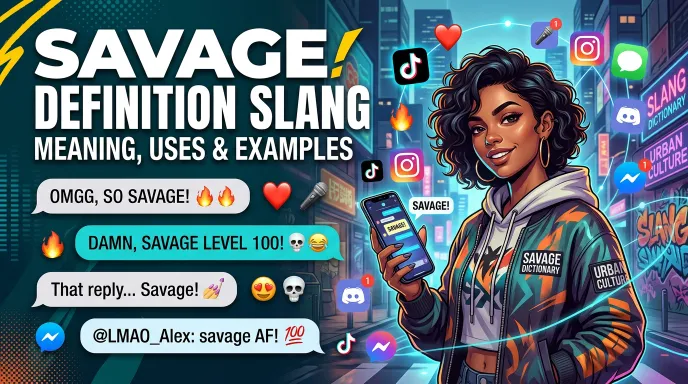
Savage definition slang usually means bold, fearless, brutally honest, or very sharp. In casual online speech, people often use savage to praise a clever comeback, bold move, or strong reaction.
People search for the savage definition slang because the word can have different meanings. In standard English, savage can describe something wild, fierce, or cruel. In slang, the word can sound positive. Someone may call a clever reply “savage” because it feels bold and powerful.
This guide explains the savage definition slang, its meaning in text, common uses, tone, history, examples, and related words. You will also learn when to use the word and when to choose another term.
Quick Answer
- In slang, savage means bold, fearless, brutally honest, or very ruthless. People often use it after a sharp comeback, funny roast, fearless action, or strong response.
For example:
“That comeback was savage!”
Here, savage means the comeback was very sharp and powerful.
What Does Savage Mean in Slang?
Savage has a different feel in slang than it does in formal English.
In casual speech, people often use savage to praise someone who does not hold back. The person may give a blunt answer, make a clever comeback, or take a bold action.
The word can also describe an action instead of a person.
For example:
- “That was a savage reply.”
- “She made a savage comeback.”
- “That roast was savage.”
- “He made a savage move.”
The meaning depends on the situation. In many online conversations, savage has a playful or positive tone.
Savage Can Mean “Brutally Honest”
Sometimes, savage describes a person who speaks the truth without softening it.
Imagine someone asks:
“Do you like my new haircut?”
A friend replies:
“Honestly, the old one looked better.”
That answer may sound harsh. If the group finds it funny, someone might say:
“Bro, that was savage.”
The speaker may not mean that the person acted cruelly. They may simply praise the blunt honesty.
Savage Can Mean “Fearless”
The word can also describe someone who acts with confidence.
For example:
“She challenged the top player without hesitation. Savage.”
Here, savage shows respect for courage and confidence.
What Does Savage Mean in Text?
In text messages, savage often means bold, ruthless, funny, or unexpectedly strong.
People may type the word alone as a reaction:
“Savage 😂”
This short reply can mean:
“That was a very bold or brutal move.”
You may also see phrases such as:
- Savage comeback
- Savage reply
- Savage roast
- Savage move
- Savage response
- Savage behavior
The exact meaning depends on the conversation.
Is Savage a Compliment?
Savage can work as a compliment, but context matters.
Friends often use it in a positive way. They may admire someone’s confidence, humor, or quick response.
For example:
“You told him exactly what he needed to hear. Savage!”
The speaker likely praises the person’s confidence.
However, savage can also describe cruel or aggressive behavior. Someone may use it negatively when a person hurts others or acts without care.
So, check the tone before you use it.
| Situation | Meaning of “Savage” | Tone |
| Funny comeback | Very sharp or clever | Positive |
| Strong gaming move | Powerful or ruthless | Positive |
| Harsh insult | Cruel or mean | Negative |
| Honest reply | Very blunt | Mixed |
| Violent behavior | Brutal or cruel | Negative |
Is Savage Rude or Offensive?
Savage is not always rude or offensive in slang.
Friends often use it as playful praise. Social media users may also use it after a funny comeback or clever joke.
However, savage has older meanings linked to brutality, violence, and ideas about people being “uncivilized.” Some of those historical uses can offend people.
That history still matters.
Using savage for a clever comeback has a different meaning from using it as a label for a group of people. Avoid using the word to label an ethnic, cultural, or Indigenous group.
A safer choice is simple: describe the action instead of labeling people.
Where Is Savage Commonly Used?
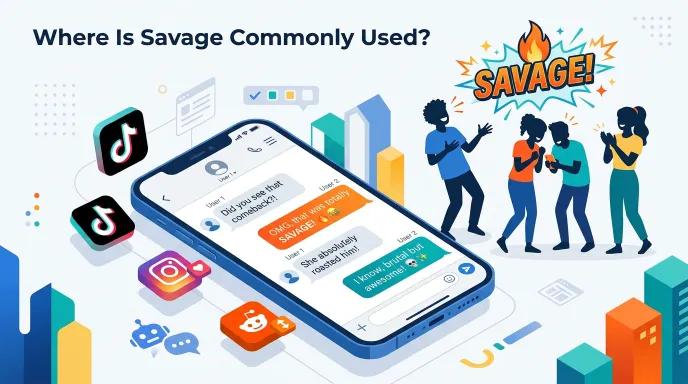
You can see savage in many casual online spaces. Its meaning can change slightly with the setting.
Text Messages
Friends may use savage after a funny or blunt reply.
“You really said that to him?”
“Yep.”
“Savage 😂”
TikTok and Instagram
People often use savage in comments, captions, and reactions.
For example, a video may show someone giving a sharp reply to a rude comment. Viewers may write:
“That was savage.”
The word can also describe confidence, humor, or bold behavior.
Reddit users may use savage when they discuss a clever comeback, joke, or strong opinion.
The tone can range from playful to serious.
Discord
On Discord, friends may call a clever response or gaming move savage.
For example:
“You waited for him to run out of health and then finished the round. Savage.”
Gaming
Gaming communities often use savage for fearless or ruthless plays.
For example:
“That was a savage move.”
Here, the word can praise a smart strategy instead of actual cruelty.
Workplace Chat
Workplace use needs more care.
Friends at work may understand the slang. Still, formal messages should use clearer words.
Try:
- Bold
- Direct
- Clever
- Strong
Real Life Examples of Savage Slang
Examples make slang easier to understand. Here are some common situations.
1. Friendly Example
Alex: “I told Jake his joke was terrible.”
Sam: “Savage!”
Sam finds Alex’s comment funny and blunt.
2. Texting Example
Mia: “She asked why I stopped replying.”
Lena: “What did you say?”
Mia: “I told her I was tired of the drama.”
Lena: “Savage.”
Here, Lena reacts to Mia’s direct answer.
3. Social Media Example
Someone posts a clever response to a rude comment.
A viewer writes:
“That comeback was savage.”
The viewer praises the response.
4. Gaming Example
A player makes a bold move and wins the match.
A teammate says:
“That was savage!”
Here, the word means impressive and ruthless in a playful way.
5. Argument Example
Someone gives a harsh response during an argument.
Another person says:
“That was savage, but maybe too harsh.”
This example shows both sides of the word. It can show praise, but it can also point out harsh behavior.
Savage vs. Brutal vs. Ruthless
These words share some meanings, but they do not always have the same tone.
| Word | Simple Meaning | Common Tone |
| Savage | Bold, sharp, or ruthless | Often playful |
| Brutal | Very harsh or painful | Often negative |
| Ruthless | Showing little mercy | Strong or negative |
| Bold | Confident and daring | Usually positive |
| Fearless | Not afraid | Positive |
| Fierce | Strong and powerful | Often positive |
A funny comeback can sound savage.
A difficult truth can sound brutal.
A person who shows no mercy can seem ruthless.
These words can overlap, but the context changes the feeling.
Origin and History of the Word Savage
The word savage has a much older history than its modern slang use.
The word comes from Middle English and Anglo French forms linked to Late Latin salvaticus. That term referred to something like “of the woods” or “wild.”
Over time, English speakers used savage for things that seemed wild, untamed, fierce, or violent.
The word also gained harmful uses for people whom others viewed as uncivilized. That history can carry racist and colonial ideas. Because of this history, the word needs care in some contexts.
Modern slang adds another meaning.
Online speakers began using savage to praise bold behavior, sharp humor, and ruthless comebacks. The slang became especially visible in internet and meme culture during the 2010s.
Today, many English speakers understand this slang use. However, its popularity can vary by age and online community.
Some people may also see it as an older internet slang term rather than fresh slang.
Why Do People Say Savage?
People use savage because one short word can show a strong reaction.
It can express:
- Surprise
- Admiration
- Humor
- Approval
- Shock
- Respect
- Disbelief
Imagine someone gives a perfect comeback. Saying “That was savage” quickly shows that the response felt sharp and memorable.
The word also adds emotion to casual conversation.
For example:
“Good reply.”
This sounds calm.
“Savage!”
This sounds much more excited.
Common Misunderstandings About Savage
Savage Does Not Always Mean Violent
This is one of the biggest misunderstandings.
In slang, savage often describes words or actions. It does not always describe physical violence.
For example:
“Her comeback was savage.”
This does not mean that she physically attacked someone.
Savage Does Not Always Mean Mean
A savage comment may sound harsh. However, the speaker may use the word as praise.
Context decides the meaning.
Savage Does Not Always Mean Cool
Some people use savage in a positive way. Others use it to criticize behavior that feels cruel or too harsh.
Look at the situation and the words around it.
The Historical Meaning Still Matters
The slang meaning does not remove the word’s older meanings.
When people use savage toward a cultural or ethnic group, the word can become offensive.
That use differs from:
“That comeback was savage.”
When Should You Avoid Using Savage?
You can use savage casually with friends. Some situations call for more care.
Avoid it when:
- You speak to someone you do not know well.
- You write a formal email.
- You speak to a teacher or school official.
- You write a professional report.
- You describe an ethnic or cultural group.
- You discuss a serious violent event.
- You are unsure how someone may understand it.
For formal writing, choose a clearer word.
Instead of:
“That was savage.”
You could write:
“That was very direct.”
Or:
“That response was quite harsh.”
Polite Alternatives to Savage
The best alternative depends on what you want to say.
If you mean confident,
- Bold
- Fearless
- Confident
- Daring
If you mean funny,
- Hilarious
- Clever
- Witty
- Funny
Direct,
- Honest
- Straightforward
- Direct
- Frank
Harsh,
- Harsh
- Severe
- Cutting
- Ruthless
These words can make your meaning clearer.
Can You Use Savage at Work or School?
You can use it in casual conversations with people who understand the slang. However, it may not fit formal communication.
For example, a private chat with a close coworker may allow casual slang.
A formal email should use clear and professional language.
At school, a student might say:
“That comeback was savage.”
That works in casual student conversation.
However, a school essay should use words such as harsh, bold, cruel, or direct, depending on the meaning.
Is Savage Safe for Social Media?
Yes, the slang use of savage is generally safe for casual social media content.
Still, context matters.
A harmless example is:
“That comeback was savage 😂”
A risky use would label an ethnic, cultural, or Indigenous group as “savage.”
Think about who or what you describe before posting.
Is Savage Still Popular?
Savage remains easy to understand for many English speakers. It still appears in casual online conversations.
However, slang trends change over time.
Some younger users may see savage as a 2010s internet slang term. Other users still use it naturally.
Different online groups also use slang in different ways.
A word may sound normal in one group and dated in another.
That does not make savage incorrect. It simply shows that age, platform, and audience can affect how natural the word sounds.
FAQ’S
Q1:What does savage mean in slang?
In slang, savage often means bold, fearless, brutally honest, or impressively ruthless. People commonly use it to praise a sharp comeback or strong action.
Q2:Is savage a bad word?
Not always. The slang use can sound positive or playful. However, the word has older meanings that can become offensive in certain contexts.
Q3:What does savage mean in texting?
In texting, savage often means “that was bold,” “that was brutal,” or “that comeback was really good.”
Q4:Is savage a compliment?
It can be. Friends may use savage as praise after a clever comeback, bold move, or funny roast.
Q5:Can I use savage at work?
You can use it in a casual chat with close coworkers. However, it may not suit formal workplace writing. Words such as bold, direct, or clever often work better.
Q6:Is savage used on TikTok?
Yes. People can use savage in comments, captions, and reactions. They may use it for bold, funny, or sharp moments.
Conclusion
The savage definition slang usually points to something bold, ruthless, fearless, or brutally funny. People often use it after a sharp comeback, clever roast, strong opinion, or impressive move.
The meaning depends on context. A friend may say “savage” as a compliment. Another person may use it to describe harsh behavior.
The word also has older meanings that can become offensive when people use it to describe certain groups.
For casual texting, gaming, and social media, savage can work well when the meaning feels clear. For school, work, or formal writing, choose a more precise word such as bold, direct, clever, or harsh.
Related Slang About!
- Taco Emoji Meaning Slang: What Does 🌮 Mean?
- What Does WYO Mean Slang?
- Slang for a Thousand Dollars: Money Terms Explained