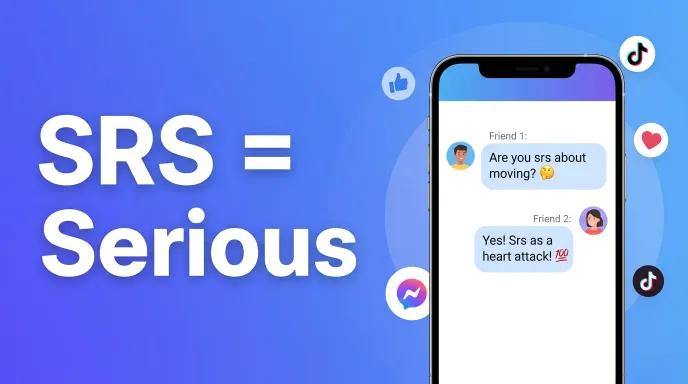
SRS usually means “serious” in texting and online slang. People use it as a short way to show that they are not joking or to ask if another person really means what they said.
If you have seen “srs,” “srs?”, or “are you srs?” in a message, you may wonder what those three letters mean. The answer depends on the sentence, but the texting meaning usually connects to being serious or genuine.
People use SRS in casual chats, social media comments, gaming conversations, and other online spaces. It can make a message quicker to type and can also help show the writer’s tone.
This guide explains srs meaning slang, its full meaning, common uses, tone, examples, related terms, and situations where you should avoid it. You will also learn the difference between SRS and /srs.
Quick Answer
SRS means “serious” in texting and online slang. People use it to say they are serious, not joking, or to ask whether someone else really means what they said. For example, “Are you srs?” means “Are you serious?”
The term works best in casual digital conversations. It does not fit formal writing, school assignments, or professional documents.
What Does SRS Mean in Text?
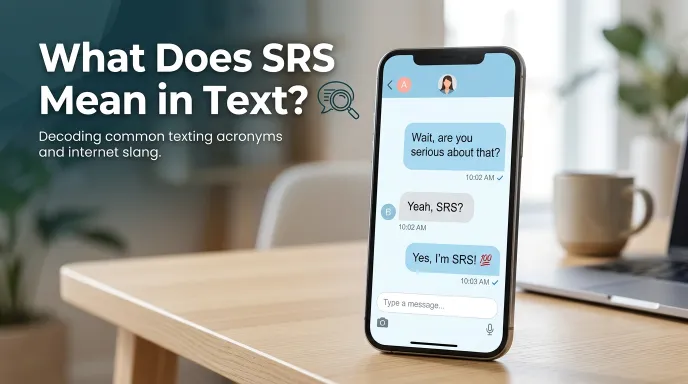
In text messages, SRS is a shortened form of “serious.” It removes several letters while keeping the main sound and meaning easy to understand.
People often use SRS when they want to save time or add a casual online style to a message. You may see it in a question, a statement, or a short reply.
For example:
- “Are you srs?” = “Are you serious?”
- “I’m srs.” = “I’m serious.”
- “Srs, you need to try this.” = “Seriously, you need to try this.”
- “You srs right now?” = “Are you serious right now?”
The exact meaning can change slightly with the sentence. However, the main idea stays the same: the person wants to show or check seriousness.
What Is the Full Form of SRS?
The common slang full form of SRS is “serious.” Some people also use it to represent “seriously” in casual online writing, depending on the sentence.
Here is a simple guide:
| Term | Meaning | Common use |
| SRS | Serious | Texting and chat |
| Srs? | Are you serious? | Asking for confirmation |
| I’m srs | I’m serious | Showing sincerity |
| Srsly | Seriously | Casual online writing |
| /srs | Serious | Tone indicator |
The word “serious” remains the safest interpretation when you see SRS in a normal text conversation.
What Does SRS Mean in Different Contexts?
SRS can work in several ways. The sentence around it helps you understand the intended tone.
SRS as “Serious”
This is the most common slang meaning in texting and chat. A person may use it to show that they mean something and are not joking.
Example:
“Srs, I really need your help.”
This means:
“Seriously, I really need your help.”
SRS as “Are You Serious?”
People also use “srs?” as a short question.
Example:
“You bought another phone?”
“Srs?”
Here, the second person asks, “Are you serious?”
The tone can show surprise, doubt, or disbelief. The relationship between the speakers also matters.
/SRS as a Tone Indicator
You may also see /srs instead of plain SRS. In online communication, /srs can act as a tone indicator. It tells the reader to take the preceding statement seriously. Wiktionary lists /srs as an internet slang tone indicator for a serious manner.
For example:
“I really want to talk about this /srs”
The /srs helps remove doubt about the writer’s tone.
This use differs slightly from ordinary srs. Plain srs works as a shorthand word, while /srs often works as a tone label.
Is SRS Rude, Offensive, or Neutral?
SRS is usually neutral and harmless. The abbreviation itself does not contain an offensive meaning when people use it to mean “serious.”
However, the tone can change based on the message.
For example:
“Srs, thank you for helping me.”
This sounds sincere and friendly.
Now consider:
“Srs? You thought that was a good idea?”
That message may sound annoyed or judgmental.
The abbreviation does not create the rude tone by itself. The surrounding words create most of the emotional meaning.
If you want to sound friendly, use SRS with clear and polite wording.
Where Is SRS Commonly Used?
SRS mainly appears in informal digital communication. Slang references describe it as a text and chat abbreviation, while /srs also appears as an online tone indicator.
You may see SRS in:
- Text messages
- Group chats
- Social media comments
- Online communities
- Gaming chats
- Casual messaging
- Internet forums
- Meme conversations
SRS on Social Media
People may use SRS in comments when they want to show that they really mean something.
For example:
“Srs, this is the best movie I’ve seen this year.”
The writer wants readers to understand that the statement is genuine.
SRS in Gaming
Gamers may use SRS when they want to check whether another player means something.
“Wait, you’re srs about leaving the team?”
Here, SRS means serious.
SRS in Group Chats
Group chats often contain jokes and sarcasm. SRS can help separate a serious message from playful conversation.
“Guys, srs for a minute. We need to decide where we’re meeting.”
The writer uses SRS to signal a change in tone.
Real Life Examples of SRS
The best way to understand SRS is to see it in natural conversations.
Friendly Example
Alex: “Srs, thanks for helping me study.”
Sam: “Of course!”
Here, SRS shows genuine thanks.
Casual Example
Mia: “I just watched the whole season in one night.”
Lena: “Srs? 😂”
Lena uses SRS to show surprise.
Surprised Example
Chris: “I’m selling my gaming setup.”
Jay: “Srs?”
Jay wants to know whether Chris really plans to sell it.
Serious Conversation
Nina: “Srs, I need to talk to you about something.”
This use signals that Nina does not want to joke around.
Gaming Example
Player 1: “I’m quitting this game.”
Player 2: “Wait, srs?”
The second player asks whether the first player really means it.
Social Media Example
Comment: “Srs, this recipe changed my breakfast.”
The writer uses SRS to emphasize a genuine opinion.
SRS vs. /SRS: What Is the Difference?
SRS and /srs can both point to seriousness, but they do not always work in the same way.
| Form | Meaning | Main purpose |
| SRS | Serious | Short form in casual text |
| srs? | Are you serious? | Shows surprise or doubt |
| I’m srs | I’m serious | Shows genuine intent |
| /srs | Serious | Marks the tone of a message |
The slash makes a difference in online tone indicators.
For example:
“That really hurt me /srs”
The writer uses /srs to tell the reader that the statement should not sound like a joke.
SRS vs. Similar Slang
Several online terms can express seriousness, honesty, or agreement. However, they do not mean exactly the same thing.
| Slang | Meaning | Main idea |
| SRS | Serious | Shows seriousness |
| FR | For real | Shows agreement or truth |
| TBH | To be honest | Introduces an honest opinion |
| NGL | Not gonna lie | Introduces a frank statement |
| /j | Joke | Shows that a statement is a joke |
| /srs | Serious | Marks a serious tone |
For example, FR often means “for real,” while SRS focuses more directly on seriousness. Tone indicators such as /j and /srs help readers understand whether an online statement is a joke or serious.
Why Do People Use SRS?
People use SRS because it is short, quick, and easy to understand in casual chats.
Here are some common reasons:
- It saves typing time.
- It keeps messages short.
- It adds an informal online style.
- It can show genuine feelings.
- It can express surprise.
- It can check whether someone is joking.
- It can make a serious point clearer.
Digital conversations often lack facial expressions and voice tone. Because of that, short markers such as /srs can help readers understand the intended tone.
Still, context matters. A person may use SRS seriously, playfully, or with a little sarcasm.
When Should You Avoid Using SRS?
You should avoid SRS when the situation requires clear and formal language.
For example, do not use it in:
- School assignments
- Academic papers
- Formal emails
- Job applications
- Business reports
- Official letters
- Professional documents
Instead of writing:
“SRS, I need more time.”
Use:
“I am serious about needing more time.”
Or, in a professional setting:
“I would appreciate additional time to complete the task.”
Full words make your meaning clearer and more professional.
Can You Use SRS at Work?
You can use SRS in a very casual workplace chat if your team already uses internet slang. Still, the safest choice in professional communication is the full word “serious.”
For example, a message to a close coworker might say:
“Srs, that meeting was longer than expected.”
But a message to your manager should use clearer wording:
“Seriously, that meeting was longer than expected.”
Formal communication benefits from direct language. You should also avoid SRS in official emails and documents.
Can Students Use SRS With Teachers?
Students should generally avoid SRS when writing to teachers. The abbreviation may sound too casual for a school or academic setting.
Instead of:
“Srs, I need more time for this.”
Try:
“I’m serious about needing more time. Could I have an extension?”
The second version sounds clearer and more respectful.
Common Misunderstandings About SRS
SRS can confuse people who do not know internet abbreviations. A few misunderstandings appear often.
SRS Does Not Always Mean “Are You Serious?”
Some people see srs and assume it always means “are you serious?” That is not always true.
Compare:
“I’m srs about this.”
This means “I’m serious about this.”
Now:
“Srs?”
This can mean “Are you serious?”
The sentence structure gives you the clue.
SRS Does Not Automatically Mean Someone Is Angry
A message such as:
“Srs, thank you.”
can sound warm and sincere.
The surrounding words matter more than the abbreviation alone.
SRS Is Not the Same as /SRS
Plain SRS usually works as a shorthand form of “serious.” /srs can act as a tone indicator that tells readers how to interpret the message.
Is SRS Safe for Social Media?
Yes. SRS is generally harmless slang when it means “serious.” People can use it in casual posts, comments, messages, and online conversations.
The main concern involves clarity, not safety.
Someone unfamiliar with online slang may not understand SRS. If your audience includes teachers, parents, customers, or a wider public audience, writing “serious” may work better.
For public content, always think about your readers before choosing slang.
What Does SRS Mean in Other Contexts?
Context can give SRS meanings that have nothing to do with slang.
For example, SRS can refer to technical or professional terms outside texting. CyberDefinitions lists other uses, including Supplemental Restraint System, a vehicle safety term.
That means you should not assume that every SRS you see means “serious.”
Ask yourself:
- Where did you see it?
- What words appear around it?
- Is the conversation casual?
- Does the topic involve texting or social media?
- Could SRS represent a technical term in that context?
If you see SRS in a casual message, “serious” is usually the most useful interpretation.
FAQ’S
Q1:What does SRS mean in slang?
SRS usually means “serious.” People use it in informal texts and online chats to show that they are serious or to ask whether someone else is serious.
Q2:What does SRS mean in text?
In text messages, SRS is a shortened form of “serious.” For example, “Are you srs?” means “Are you serious?”
Q3:What does /SRS mean?
/srs means “serious” and can work as an online tone indicator. It tells readers that the writer intends the statement to sound serious.
Q4:Is SRS rude?
No. SRS is normally neutral. However, the full message can sound rude, annoyed, or sarcastic depending on the words and situation.
Q5:Can I use SRS at work?
You can use it in a very casual workplace chat if your team accepts slang. For formal work messages, use “serious” instead.
Q6:What is the difference between SRS and FR?
SRS means “serious,” while FR usually means “for real.” Both can show sincerity, but they serve different purposes in a conversation.
Conclusion
SRS meaning slang is simple: it usually means “serious” in texting and online conversations. People use it to show that they are not joking, emphasize a genuine statement, or ask whether someone really means what they said.
You may see SRS in texts, group chats, gaming conversations, comments, and other informal online spaces. The form /srs can also work as a tone indicator that marks a statement as serious.
Remember that context matters. “Srs?” can mean “Are you serious?” while “I’m srs” means “I’m serious.”
For casual chats, SRS works well. For school, work, and formal writing, use the full word “serious” for clearer communication.
More to Explore