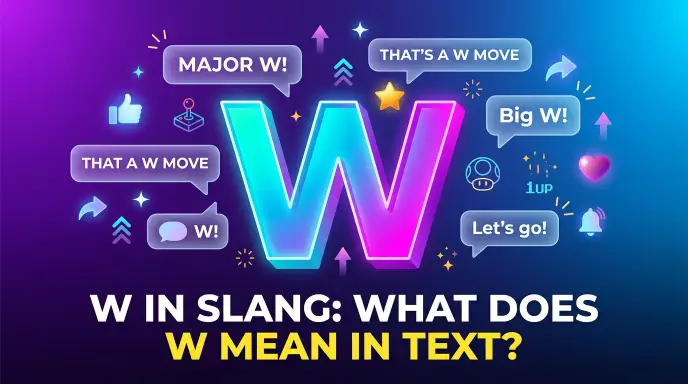
W in slang usually means “win” or “winning.” People use it in texts, comments, gaming chats, and social media to show that something went well or deserves praise.
You may see someone reply with a single “W” after a friend shares good news. You may also see phrases such as “That’s a W,” “Big W,” or “W in the chat.” These phrases all carry a positive meaning, although the exact feeling depends on the context.
People often search for W in slang because one letter can look confusing when it appears alone. In this guide, you will learn what W means in text, how people use it, where it came from, if it sounds rude, and when you should use it.
Quick Answer
- W in slang means “win” and shows success, approval, praise, or a positive result. People use it to celebrate achievements, good decisions, victories, or anything they consider a “win.” It works as the opposite of L, which means “loss.”
What Does W Mean in Slang?
The slang W means “win.” People use the letter as a quick way to praise something or show approval.
For example:
“I passed my exam!”
A friend might reply:
“W!”
The reply means something like “That’s a win!”, “Good job!”, or “Nice!”
W does not always describe a literal victory. Someone can use it for a smart choice, a kind action, a good purchase, an impressive performance, or positive news.
For example:
“I found my old headphones for $5.”
Someone might reply:
“Huge W.”
The person did not win a competition. Instead, the cheap purchase created a positive result.
That flexible use explains why W in slang appears across many parts of online communication.
W Meaning in Text
In text messages, W usually means “win” or “winning.” People often send it as a short reaction to good news.
Here are a few examples:
- “You got the job? W!”
- “W friend.”
- “That was a W.”
- “Big W for you.”
- “Common W.”
- “Take the W.”
Each phrase expresses a positive reaction.
What does a single “W” mean?
A single W can work like a quick compliment.
For example:
A: “I finally finished my project.”
B: “W.”
Person B means that finishing the project counts as a success.
The short reply also fits fast moving group chats and comment sections. People can show support without typing a full sentence.
What Does W Stand For?
The slang W stands for “win.”
You can think of it like this:
W = Win = Success or positive result
The opposite slang term is L, which stands for “loss.”
| Slang | Meaning | General feeling |
| W | Win | Positive |
| L | Loss | Negative |
| Big W | Major win | Very positive |
| Big L | Major loss | Very negative |
This W versus L pattern appears often in gaming, sports talk, memes, and online discussions.
Different Meanings of W
The main slang meaning of W is “win,” but people can use it in several related ways.
1. W Means a Victory
This is the most direct use.
“We won the match. W!”
Here, W refers to an actual victory.
2. W Means Success
Someone can use W for a personal achievement.
“I finally got my driver’s license.”
“W!”
The person celebrates the achievement.
3. W Means Approval
W can also show that someone agrees with or supports an action.
“She stood up for her friend.”
“W.”
The reply praises her action.
4. W Means Something Good
People sometimes use W for something that simply feels positive.
“This pizza is amazing.”
“W pizza.”
The speaker does not mean that the pizza won anything. They mean the pizza is excellent.
Where Is W Commonly Used?
W appears mostly in informal digital communication. You can find it in gaming chats, social media comments, livestreams, group chats, and casual text messages.
W in Texting
Friends may send W after hearing good news.
“I got an A on my test.”
“W!”
W on TikTok
TikTok users may comment “W” when they like a creator’s action, opinion, outfit, joke, or achievement.
“W creator.”
The comment shows approval.
W on Instagram
People can use W in comments or direct messages.
“That outfit is a W.”
This means the outfit looks great or the person made a good style choice.
W on Discord
Discord users often use W in casual community conversations.
“We finally fixed the server issue.”
“W!”
The response celebrates the successful result.
W in Gaming
Gaming gives W a very natural setting.
“We won three games in a row.”
“Three Ws!”
Here, W directly refers to wins.
W in Livestreams
You may also see “W in the chat.” The phrase asks viewers to fill a live chat with the letter W to celebrate something positive. This expression has strong roots in livestream culture, especially Twitch style chat.
Real Life Examples of W in Slang
Context makes slang easier to understand. Here are realistic examples from different situations.
1. Friendly Conversation
Alex: “My sister helped me finish my assignment.”
Sam: “W sister.”
Meaning: Alex’s sister did something helpful, so Sam praises her.
2. Text Message
Mia: “I finally got the apartment!”
Lena: “Big W!”
Meaning: Getting the apartment counts as a major success.
3. Gaming
Player 1: “We won the final round!”
Player 2: “W!”
Meaning: The team won the round.
4. Social Media
“He donated the prize money to charity. W.”
Meaning: The commenter approves of his action.
5. Shopping
“Found these shoes for half price.”
“That’s a W.”
Meaning: The person got a good deal.
6. School
“Our teacher moved the test to Friday.”
“W teacher!”
Meaning: The student likes the decision.
7. Sports
“Our team won 3–0.”
“Huge W!”
Meaning: The team achieved a strong victory.
8. Casual Group Chat
“I brought snacks for everyone.”
“W!”
Meaning: The group appreciates the thoughtful action.
What Does “Big W” Mean?
Big W means a major win or significant success.
It adds more excitement than a simple W.
For example:
“She got her dream job. Big W!”
The phrase shows strong approval and excitement.
You can use Big W for:
- Major achievements
- Important victories
- Great decisions
- Excellent results
- Helpful actions
- Impressive moments
The phrase remains casual, so it fits online conversations better than formal writing.
What Does “W in the Chat” Mean?
“W in the chat” means that people should type W into a live chat to celebrate something positive.
The phrase became closely linked with livestream communities. A streamer or viewer might say it after a victory, funny moment, kind action, or impressive event.
For example:
“He finally beat the hardest level. W in the chat!”
Viewers may respond:
“W W W W”
The repeated letters create a shared celebration.
Is W Rude or Offensive?
W is generally not rude or offensive. It normally carries a positive meaning.
People use it to praise, support, or celebrate something.
For example:
“W friend.”
This sounds like a compliment.
However, people can use W sarcastically. The surrounding conversation helps reveal the intended tone.
For example:
“He forgot his own birthday. W.”
The speaker probably does not praise the mistake. They use W as a joke.
Tone comparison
| Example | Likely meaning |
| “W!” | Celebration |
| “Big W!” | Strong praise |
| “W move” | Good decision |
| “W friend” | Praise |
| “W in the chat” | Group celebration |
| “W 😂” | Often playful |
| “W…” | Could sound sarcastic |
So, W itself remains positive, but people can use it humorously or sarcastically.
Is W Appropriate at Work?
W works best in casual communication. You can use it with close coworkers if your workplace culture welcomes informal slang.
For example, a casual team chat might contain:
“We finished the project early. W team!”
That may feel natural among friendly coworkers.
However, avoid W in formal emails, reports, job applications, or official documents.
Instead of:
“W for the company!”
a professional message could say:
“This is a great result for the team.”
The formal version communicates the same idea with clearer professional language.
When Should You Avoid Using W?
You should avoid W when your audience may not understand internet slang or when the situation requires formal language.
Consider avoiding it in:
- Academic essays
- Job applications
- Formal reports
- Business proposals
- Official emails
- Legal documents
- Formal presentations
You should also consider your audience. Someone unfamiliar with internet slang may see W as nothing more than the letter “W.”
When clarity matters, write “win,” “success,” “great result,” or “well done” instead.
W vs. L: What Is the Difference?
W means win.
L means loss.
For example:
“We won the final. W.”
But:
“We lost the final. L.”
People also use the pair outside sports and gaming.
| Situation | W | L |
| Good decision | W | — |
| Bad decision | — | L |
| Successful match | W | — |
| Failed attempt | — | L |
| Great purchase | W | — |
| Terrible purchase | — | L |
This simple contrast makes the slang easy to understand once you know the two letters.
Why Do People Use W?
People use W because it communicates a positive reaction very quickly.
One letter can replace several phrases, such as:
- “That’s a win.”
- “Great job.”
- “Nice!”
- “Well done.”
- “That’s impressive.”
- “I agree with that.”
- “Good decision.”
The short format works especially well in fast chats and comment sections.
It also creates a sense of shared internet culture. When someone writes “W,” other users who know the slang can understand the reaction immediately.
Common Misunderstandings About W
1. W always means the letter
Not in online slang. Context can turn the letter into a short form for win.
2. W only applies to sports
No. People use it for achievements, decisions, purchases, jokes, opinions, and many other positive situations.
3. W always means serious praise
Not necessarily. Someone can use W as a joke or sarcastic reaction.
4. W and “w/” mean the same thing
No.
W in internet slang usually means win.
W/ commonly means with in informal writing.
For example:
“Dinner w/ Sarah.”
Here, w/ means “with,” not “win.”
Is W Safe to Use on Social Media?
Yes. W is generally harmless slang. It does not normally carry offensive or explicit meaning.
You can use it in casual comments, gaming chats, group messages, and social media conversations.
Still, think about your audience. Formal or professional audiences may prefer standard language.
For casual online communication, a simple “W!” can quickly show support or excitement.
FAQ’S
Q1. What does W mean in slang?
W means “win.” People use it to celebrate success, praise an action, or show approval.
Q2. What does W mean in text?
In text messages, W usually means win or winning. It can describe a successful event, good decision, achievement, or positive result.
Q3. What does W stand for?
W stands for “win” when people use it as internet slang.
Q4. What is the opposite of W in slang?
The opposite of W is L, which means loss. People use L for a failure, bad result, or negative outcome.
Q5. What does Big W mean?
Big W means a major win or important success. People use it to show stronger praise than a simple W.
Q6. Is W rude?
No. W usually sounds positive and supportive. Someone can use it sarcastically, but the context makes that clear.
Conclusion
W in slang means “win” or “winning.” People use it to celebrate success, show approval, praise someone, or describe a positive outcome. The term works well in texts, gaming chats, social media comments, livestreams, and other casual online spaces.
You may see simple forms such as “W,” “Big W,” “W move,” and “W in the chat.” Each one expresses a positive reaction, although the strength of the reaction can vary.
Remember that W works best in informal communication. If you write for school, work, or a formal audience, words such as “win,” “success,” or “well done” will communicate your meaning more clearly.
In short, when someone sends you “W,” they are usually saying: “That’s a win!”
Dig More About!
- Bud Meaning Slang: What Does Bud Mean in Text?
- OD Definition Slang: What Does OD Mean?
- Goofy Meaning Slang: What Does Goofy Mean?