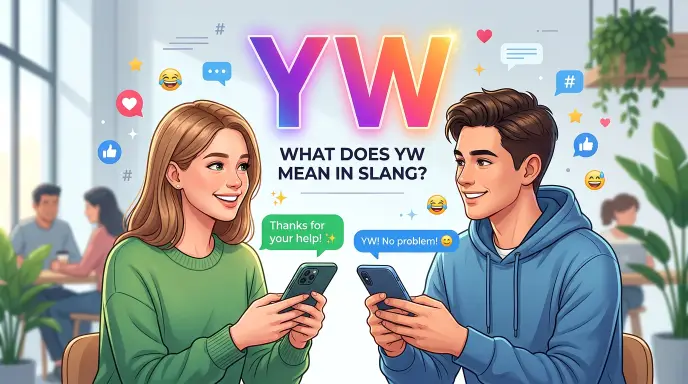
What does yw mean in slang? In texting and online chats, YW usually means “you’re welcome.” People use this short form after someone says “thank you.” It gives a quick, friendly reply without typing the full phrase.
You may see YW in text messages, Instagram DMs, Snapchat chats, TikTok comments, Discord, Reddit, and other casual online spaces. For example, if a friend says, “Thanks for helping me,” you can reply, “YW!” In that case, YW simply means “you’re welcome.”
The abbreviation usually has a friendly or neutral tone. However, punctuation and context can change the feeling. A simple “yw” may sound relaxed, while “YW!!” can show more excitement.
Quick Answer
- YW means “you’re welcome” in slang and texting. People use it as a short, casual reply after someone thanks them.
What Does YW Mean in Text?
YW means “you’re welcome” in most texting and social media conversations.
People use it when someone thanks them for something. The abbreviation saves time and keeps the conversation casual.
For example:
Person 1: Thanks for sending me the notes!
Person 2: YW!
Here, YW means “You’re welcome!”
You may also see it in a very short exchange:
A: Thanks!
B: YW 🙂
The smiley face adds a warm and friendly tone.
People often choose YW because texting favors short replies. You can type two letters instead of three separate words.
YW Full Form in Slang
The common YW full form in texting is “you’re welcome.”
It does not work like an acronym with a completely different phrase. Instead, people take the first letters from:
- Y = You
- W = Welcome
The apostrophe in you’re does not add another letter to the abbreviation.
So:
YW = You’re Welcome
For example:
“Thanks for the birthday wishes!”
“YW!”
The second person uses YW as a quick thank you response.
You can also write the full phrase when you want a warmer or more formal tone:
“You’re welcome!”
Both expressions carry the same basic message.
What Does YW Stand For?
In common texting slang, YW stands for “you’re welcome.”
People use it after someone says:
- Thanks
- Thank you
- Thanks a lot
- Thank you so much
- Appreciate it
- TY
- Thx
For example:
“TY for helping me.”
“YW!”
Here, TY means “thank you,” while YW means “you’re welcome.”
The two abbreviations often appear together because they fit the same type of casual conversation.
Is YW Rude, Offensive, or Neutral?
YW is usually neutral and friendly. The abbreviation does not contain an offensive meaning in its common texting use.
Still, the tone can change based on the situation.
Friendly Use
“Thanks for helping me!”
“YW! 😊”
This sounds warm and polite.
Casual Use
“Thanks!”
“yw”
This sounds relaxed and simple.
Excited Use
“Thank you so much!!”
“YW!!”
The extra punctuation can make the reply feel more energetic.
Very Short Use
“Thanks.”
“YW.”
This reply can sound neutral. In some conversations, the period may make the message feel a little serious or distant.
Sarcastic Use
Context can also change the meaning.
For example:
“Wow, thanks for finally helping me.”
“YW.”
The sender may use YW sarcastically.
The abbreviation itself does not create the sarcasm. The surrounding conversation gives it that tone.
Where Is YW Commonly Used?
People commonly use YW in informal digital communication.
You may see it in:
- Text messages
- Instagram DMs
- Snapchat
- TikTok comments
- Discord
- Group chats
- Online gaming chats
- Facebook Messenger
- Casual emails
The abbreviation fits situations where people already use short forms.
For example:
“Can you send me the link?”
“Sure.”
“Thanks!”
“YW!”
This type of conversation works naturally with short replies.
You may see YW less often in formal business writing. A professional email usually benefits from complete words and clear sentences.
YW Meaning on Snapchat
On Snapchat, YW usually means “you’re welcome.”
Suppose someone sends:
“Thanks for saving that snap!”
You could reply:
“YW!”
The person can understand the message quickly.
Snapchat conversations often use short abbreviations because users send quick messages. YW fits that casual style.
YW Meaning on Instagram
On Instagram, people may use YW in DMs or comments.
For example:
Follower: “Thanks for replying!”
Creator: “YW 😊”
The abbreviation can keep the conversation friendly without adding a long response.
You may also see it after someone thanks another user for:
- Sharing a post
- Sending a link
- Giving advice
- Answering a question
- Tagging them
- Helping with something
The meaning stays simple: “you’re welcome.”
YW Meaning on TikTok
TikTok users can use YW in comments or direct messages.
For example:
User 1: “Thanks for explaining this!”
User 2: “YW!”
Someone may also use it after sharing information:
“Here’s the tutorial you asked for.”
“OMG thanks!”
“YW!”
The abbreviation works well in fast, informal conversations.
However, context still matters. Online communities can create their own meanings for short forms. If the surrounding conversation does not involve thanks or appreciation, check the rest of the message before choosing the meaning.
YW Meaning on Discord
Discord users often use abbreviations because chats can move quickly.
For example:
User 1: “Thanks for helping me with the setup.”
User 2: “YW!”
Gaming communities may use YW after someone shares:
- A game tip
- A useful link
- A strategy
- A file
- A resource
- Help with a problem
The tone usually stays casual.
Real Life Examples of YW Slang

The easiest way to understand YW involves seeing it in different situations.
Friendly Example
Alex: Thanks for helping me with my homework!
Sam: YW! 😊
Meaning: You’re welcome!
The emoji adds a friendly feeling.
Casual Text Example
A: Thanks!
B: yw
Here, the sender gives a quick and relaxed reply.
Social Media Example
Comment: Thanks for sharing this tip!
Reply: YW!
The person acknowledges the thanks.
Gaming Example
Player 1: Thanks for the game advice.
Player 2: YW, good luck!
Here, YW means “you’re welcome.”
Discord Example
User 1: Thanks for sending the server link.
User 2: YW!
The reply keeps the conversation short.
Snapchat Example
Friend: Thanks for reminding me!
You: YW 😂
The emoji makes the response playful.
Casual Group Chat
Friend 1: Thanks for finding the restaurant!
Friend 2: Let’s go! 😂
This version should improve readability because it replaces the abbreviation “YW” with the full phrase “You’re welcome!”.
Sarcastic Example
A: Thanks for answering after three hours.
B: YW.
Here, the response may carry sarcasm because of the first message.
Helpful Example
A: Thanks for sending that article.
B: YW. Hope it helps!
The sender uses YW and then adds a helpful comment.
Friendly Gaming Example
Player 1: Thanks for covering me!
Player 2: YW! We got this.
Here, the reply sounds supportive and upbeat.
YW vs. TY
YW and TY often appear together, but they have opposite roles.
| Slang | Full Form | Meaning |
| YW | You’re welcome | Reply to thanks |
| TY | Thank you | Shows appreciation |
| THX | Thanks | Casual thanks |
| NP | No problem | Casual response |
| NP | No problem | Another way to accept thanks |
| TYSM | Thank you so much | Stronger thanks |
For example:
A: TYSM!
B: YW!
Here, TYSM means “thank you so much,” and YW means “you’re welcome.”
YW vs. NP
YW and NP both work as replies to “thank you.” However, they have slightly different meanings.
YW directly means:
“You’re welcome.”
NP means:
“No problem.”
Compare these examples:
A: Thanks for helping!
B: YW!
This gives a direct response.
Now:
A: Thanks for helping!
B: NP!
This tells the person that the help caused no trouble.
Both work well in casual chats.
YW vs. You’re Welcome
The main difference between YW and you’re welcome comes from style.
| Phrase | Style | Best Use |
| YW | Very casual | Texts and chats |
| You’re welcome | Neutral | Most situations |
| You are welcome | More formal | Formal writing |
| No problem | Casual | Friends and coworkers |
| No worries | Casual and friendly | Informal chats |
| My pleasure | Polite | More formal or warm replies |
If you talk with a friend, YW works well.
If you write to a customer, teacher, manager, or client, “You’re welcome” can sound clearer and more professional.
Origin and Background of YW
YW comes from the phrase “you’re welcome.” People shorten common phrases because short forms make digital conversations faster.
Texting culture helped popularize many abbreviations. People began using short combinations such as LOL, BRB, TY, IDK, and YW in informal digital conversations.
Unlike some slang terms, YW does not need a complex origin story. It simply shortens a common polite phrase.
The meaning remains easy to understand because the two letters match the main words in “you’re welcome.”
Why Do People Use YW?
People use YW for several simple reasons.
It Saves Time
Typing YW takes less time than typing you’re welcome.
It Keeps Chats Casual
The abbreviation fits the relaxed style of texting.
It Gives a Quick Reply
Someone can acknowledge a thank you without writing a full sentence.
It Matches Online Language
People often use abbreviations when they chat with friends or participate in online communities.
It Keeps the Conversation Moving
A short reply can help the conversation continue without adding unnecessary words.
For example:
“Thanks!”
“YW!”
“Anyway, what time are we meeting?”
The conversation moves forward quickly.
When Should You Avoid Using YW?
You should avoid YW when the situation needs formal or professional language.
For example, avoid it in:
- Formal business letters
- Academic papers
- Job applications
- Official documents
- Professional reports
- Formal customer communication
Instead of:
“YW for your help.”
write:
“You’re welcome. I’m glad I could help.”
A complete phrase can create a more polished impression.
You should also consider your relationship with the reader. Friends may understand YW instantly. A new client may prefer a clear and complete reply.
Polite Alternatives to YW
You have many alternatives when you want a different tone.
Casual Alternatives
- No problem
- No worries
- NP
- Anytime
- Sure
- Of course
Friendly Alternatives
- You’re welcome!
- Anytime!
- Happy to help!
- Glad I could help!
More Professional Alternatives
- You’re very welcome.
- My pleasure.
- Glad I could help.
- It was my pleasure.
Choose the phrase that matches the conversation.
Impact of YW on Communication
Short forms can make digital conversations faster and easier. They also help people match the casual style of online chats.
However, abbreviations can sometimes create a colder tone.
Compare:
“YW!”
with:
“You’re very welcome! 😊”
Both replies show the same basic idea. The second reply feels warmer because it contains more words and an emoji.
The first reply works well when the conversation already feels casual.
So, YW can make communication efficient, but context matters.
Is YW Safe for Social Media?
Yes. YW is generally safe for social media. The abbreviation does not contain an offensive or harmful meaning in its common use.
You can use it in:
- Instagram chats
- Snapchat
- TikTok comments
- Discord
- Gaming chats
- Group messages
- Casual texts
Still, you should match your language to your audience.
A friend may enjoy a quick “YW!” A business customer may prefer “You’re welcome!”
The word choice should fit the relationship and setting.
Common Mistakes With YW
Assuming Every YW Means “You’re Welcome”
Most texting uses point to “you’re welcome,” but abbreviations can have other meanings in special contexts.
Using YW in Formal Writing
A short abbreviation can look too casual in academic or professional writing.
Ignoring Tone
A message such as “yw.” can feel less warm than “YW! 😊”
Punctuation and emojis can change the mood.
Confusing YW With TY
Remember:
TY = Thank You
YW = You’re Welcome
They often appear together, but they have opposite roles.
Using Too Many Abbreviations
A message full of short forms can become hard to read.
For example:
“TYSM yw np lol idk.”
Some readers may struggle to follow the message.
Clear communication matters more than saving a few seconds.
FAQ’S
Q1:What does YW mean in slang?
YW usually means “you’re welcome” in slang and texting. People use it after someone thanks them.
Q2:What does YW mean in text?
In text messages, YW means “you’re welcome.” It gives a short and casual response to thanks.
Q3:What does YW stand for?
YW stands for “you’re welcome.” People use the first letters of the two main words to create the abbreviation.
Q4:Is YW rude?
No. YW usually sounds neutral or friendly. The tone can change based on punctuation, context, and the rest of the conversation.
Q5:What does YW mean on Snapchat?
On Snapchat, YW usually means “you’re welcome.” Someone may send it after another person says thanks.
Q6:What is the difference between YW and NP?
YW means “you’re welcome,” while NP means “no problem.” Both can work as casual replies to someone who says thanks.
Conclusion
What does YW mean in slang? In most texting and online conversations, YW means “you’re welcome.” People use it as a quick reply after someone says thank you.
You can find YW in text messages, Instagram DMs, Snapchat, TikTok, Discord, Reddit, gaming chats, and group conversations. The abbreviation usually sounds casual and friendly.
The context still matters. “YW!” can sound warm and upbeat, while “yw.” may feel more neutral. In formal settings, a complete phrase such as “You’re welcome” can make a better choice.
The easiest way to remember it is simple:
TY = Thank You
YW = You’re Welcome
So, when someone sends “YW” after you say thanks, they most likely mean “you’re welcome.”
Dig More About!
- BA Meaning Slang: What Does BA Mean in Text?
- What Does Dale Mean in Spanish Slang? Dale Meaning in Text
- Irish Slang for Idiot: Meaning, Terms & Examples