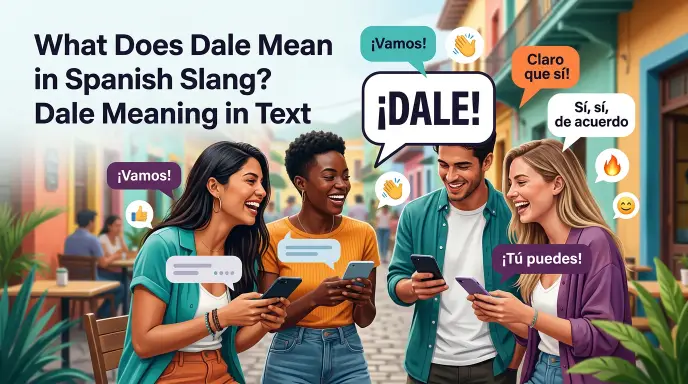
What does dale mean in Spanish slang? If you see someone write “¡Dale!” in a text, comment, or conversation, the word usually means “okay,” “go ahead,” “come on,” or “go for it.” The exact meaning depends on the situation and the speaker’s tone.
English speakers often notice dale in Latin music, social media posts, videos, and conversations with Spanish speakers. The word can sound confusing because one short expression can show agreement, encouragement, urgency, or impatience.
People commonly use dale in casual Spanish, especially in parts of Latin America. Argentina and Uruguay have especially strong everyday uses of the word, but speakers in other Spanish speaking regions also use it.
Quick Answer
- Dale usually means “okay,” “go ahead,” “come on,” or “go for it.” In Spanish slang and casual speech, people use it to agree with someone, encourage them, or tell them to continue.
What Does Dale Mean in Spanish Slang?
Dale is a common Spanish expression that can carry several meanings. You need the context to understand the intended meaning.
For example:
- “Dale!” → “Okay!”
- “Dale, vamos.” → “Come on, let’s go.”
- “Dale, tú puedes.” → “Come on, you can do it.”
- “¿Quieres venir? : Dale.” → “Do you want to come? : Sure.”
- “Dale, hazlo.” → “Go ahead, do it.”
The expression comes from dar, the Spanish verb that means “to give.” In its grammatical form, da + le creates dale, but everyday speakers often use it as an interjection rather than thinking about its literal grammar. SpanishDictionary describes this casual use as a way to encourage someone or express agreement.
So, when someone says dale, do not always translate it word for word. Instead, look at what happens around the word.
Dale Meaning in Text
In texting, dale often works like “okay,” “sure,” “sounds good,” or “go ahead.”
Suppose your friend sends:
“Do you want to meet at 7?”
You might see:
“Dale.”
Here, dale means something close to “Sure” or “Okay.”
The same word can also encourage someone:
“I’m nervous about asking her.”
“Dale, you can do it!”
In this case, dale means “Go for it” or “Come on.”
Texting makes the context even more important because you cannot hear the speaker’s voice. Punctuation can also change the feeling:
- Dale. → Okay. / Sure.
- ¡Dale! → Come on! / Go for it!
- Daleee! → Stronger excitement or encouragement.
- Dale, vamos. → Come on, let’s go.
- Dale, pues. → Okay then / Go ahead then.
Dale Full Form and Definition
Dale does not have a slang “full form” like an acronym such as LOL or BRB.
Instead, dale comes from the Spanish verb dar, meaning “to give.” Grammatically, dale can function as a form of da + le, while everyday Spanish also uses it as an interjection.
As a casual expression, it can communicate:
- Agreement
- Encouragement
- Permission
- Urgency
- Motivation
- Impatience
- Acceptance
SpanishDictionary lists go ahead, go on, come on, and go for it among its common meanings. It also lists okay as a meaning when someone uses the word to agree with an idea.
That makes dale more flexible than a single English translation.
Is Dale Rude, Offensive, or Neutral?
Dale is usually casual and neutral. It does not normally contain an offensive meaning.
However, your tone can change how the word feels.
For example:
Friendly:
“Dale! Let’s do it.”
This sounds positive and relaxed.
Encouraging:
“Dale, you can finish this!”
This sounds supportive.
Impatient:
“Dale, hurry up!”
Here, the speaker wants someone to move faster.
Annoyed:
“¡Dale! We already talked about this.”
The expression can sound frustrated when someone repeats a question or delays an action.
So, the word itself usually does not cause offense. The surrounding words, punctuation, and tone create the stronger meaning.
Where Is Dale Commonly Used?

You can encounter dale in many informal Spanish speaking settings.
Everyday Conversation
People may use it with friends, family members, classmates, and coworkers during casual conversations.
For example:
“Nos vemos a las ocho.”
“Dale.”
That exchange can mean:
“See you at eight.”
“Okay.”
Text Messages
Dale works naturally in short messages because it can communicate agreement with only one word.
“I’ll call you later.”
“Dale.”
The response can mean “Okay” or “Sounds good.”
Social Media
You may also see dale in comments, captions, and replies. A person might write “¡Dale!” to encourage a creator, athlete, friend, or performer.
Music and Pop Culture
English speakers may recognize dale from Latin music and other forms of popular culture. The expression appears often enough in music and entertainment that many people recognize it before they understand its exact meaning.
Sports and Gaming
A fan might write:
“¡Dale, equipo!”
That can mean:
“Come on, team!”
A gamer might also use it to encourage a teammate:
“Dale, we got this!”
In this context, the expression carries energy and motivation.
Real Life Examples of Dale
The best way to understand dale involves seeing it in different situations.
1. Friendly Example
A: “Want to grab coffee later?”
B: “Dale!”
Meaning: “Sure!” or “Sounds good!”
The speaker accepts the invitation in a friendly way.
2. Encouraging Example
A: “I don’t think I can finish this.”
B: “Dale, you can do it!”
Meaning: “Come on, you can do it!”
Here, the speaker gives encouragement.
3. Permission Example
A: “Can I use your phone?”
B: “Dale.”
Meaning: “Sure, go ahead.”
The speaker gives permission.
4. Casual Planning Example
A: “Let’s meet at the mall at six.”
B: “Dale, see you there.”
Meaning: “Okay, see you there.”
5. Gaming Example
Player 1: “Ready for another match?”
Player 2: “Dale!”
Meaning: “Let’s do it!”
The word adds enthusiasm to the response.
6. Social Media Example
Comment: “You should post the full video!”
Reply: “Dale 😎”
Meaning: “Sure, I will.”
The emoji adds a relaxed and friendly feeling.
7. Impatient Example
A: “Give me one more minute.”
B: “Dale, hurry!”
Meaning: “Come on, hurry!”
The speaker wants the other person to act faster.
8. Argumentative Example
A: “You keep saying the same thing.”
B: “Dale, fine.”
Here, dale can sound like “Fine, okay.” The word itself remains casual, but the situation gives it an irritated tone.
Dale in Argentina and Uruguay
Regional usage matters when you study dale.
The word has a particularly strong role in Argentine and Uruguayan Spanish. In these varieties, people can use dale to express agreement, encouragement, impatience, or other conversational reactions. A research paper from Argentina’s CONICET Digital describes dale as a characteristic interjection of River Plate Spanish and identifies several uses, including encouragement, agreement, urgency, and reproof.
A Spanish learning source also notes that people in Argentina and Uruguay commonly use dale as a way to say yes or show agreement.
For example:
“¿Vamos al cine?”
“¡Dale!”
This can mean:
“Are we going to the movies?”
“Sure!”
However, you should not assume that every Spanish speaker uses dale in exactly the same way. Spanish changes across countries and regions.
Why Does Dale Have So Many Meanings?
The main reason comes from context.
English has similar flexible expressions. For example, “come on” can encourage someone, express frustration, or ask someone to hurry.
Spanish dale can work in a similar way.
Compare these examples:
“Dale, tú puedes.”
This sounds encouraging.
“Dale, vamos.”
This pushes someone to move or continue.
“¿Vienes con nosotros? : Dale.”
This expresses agreement.
“¡Dale! Otra vez lo mismo.”
This can express frustration about repetition.
The same word stays the same, but the situation changes its meaning.
Dale vs. Vamos vs. Vale vs. Sale
Several Spanish expressions can look similar to dale, but they do not always work in the same situations.
| Expression | Common meaning | Typical use |
| Dale | Okay, go ahead, come on | Agreement or encouragement |
| Vamos | Let’s go, come on | Movement or encouragement |
| Vale | Okay, all right | Agreement, especially common in Spain |
| Sale | Okay, sounds good | Casual agreement, especially associated with Mexico |
| Sí | Yes | Direct agreement |
Vale deserves special attention because learners sometimes confuse it with dale. Vale is strongly associated with everyday Spanish in Spain, while dale has especially notable uses in Argentina and Uruguay.
The expressions can overlap, but they do not have identical regional patterns.
Is Dale a Slang Word?
Dale can count as casual slang or colloquial speech when people use it as an interjection.
However, calling it “slang” in every situation can oversimplify the word. Dale also has a normal grammatical origin and appears in broader Spanish usage.
For a slang dictionary, the most useful explanation is this:
Dale is a casual Spanish expression that often means “okay,” “go ahead,” “come on,” or “go for it,” depending on context.
That description captures its everyday conversational use without suggesting that the word only belongs to slang.
When Should You Avoid Using Dale?
You can use dale comfortably in many casual conversations, but formal situations require more care.
Avoid relying on it when:
- You write a formal business letter.
- You prepare an academic paper.
- You speak in a highly formal professional setting.
- You communicate with someone who expects formal language.
- You are unsure about the regional meaning.
For example, instead of writing:
“Dale, I will send the document.”
a formal Spanish message might use a clearer expression such as:
“De acuerdo, enviaré el documento.”
The right choice depends on the country, relationship, and setting.
Polite Alternatives to Dale
If you want a more formal or universally clear expression, you can choose another phrase.
Depending on the situation, alternatives include:
- De acuerdo :agreed / all right
- Está bien :okay
- Claro :of course
- Sí :yes
- Por supuesto :certainly
- Adelante :go ahead
- Vamos :let’s go / come on
For casual conversation, dale can sound warmer and more natural in regions where people commonly use it.
Why Do People Use Dale?
People use dale because it communicates a lot with very few words.
A single “dale” can show that someone:
- Accepts an idea
- Supports a friend
- Gives permission
- Wants someone to continue
- Wants someone to hurry
- Agrees with a plan
- Encourages a teammate
That flexibility makes it useful in fast conversations and texting.
It also creates a casual feeling. Friends can use dale without making the conversation sound formal or stiff.
Impact of Dale in Communication
Short expressions such as dale can make conversations feel more natural. They can also add emotion without requiring a long response.
For example:
“Dale!”
feels more energetic than:
“Yes, I agree.”
Likewise:
“Dale, you got this!”
sounds more supportive than a simple:
“Continue.”
Still, short words can create confusion when people do not share the same regional background. A learner may understand dale as “give it,” while a native speaker may intend “okay” or “come on.”
That difference shows why context matters more than a single dictionary translation.
Is Dale Safe for Social Media?
Yes. Dale is generally safe and harmless for normal social media use.
People can use it in casual comments, messages, gaming chats, captions, and conversations. The word does not normally carry an offensive meaning.
However, always consider the context. A phrase such as “Dale, hurry up!” can sound impatient, while “Dale! ❤️” can sound warm and supportive.
If you communicate with people from different Spanish speaking countries, remember that regional preferences can affect how they understand the expression.
Common Mistakes With Dale
English speakers often make a few mistakes when they first encounter dale.
Translating It as “Give Him”
The grammatical origin relates to dar + le, but casual dale often functions as an interjection.
So, if someone texts:
“Dale!”
they probably do not mean:
“Give him.”
Context determines the meaning.
Assuming It Always Means “Okay”
Dale can mean “okay,” but it can also mean “go ahead,” “come on,” or “go for it.”
Ignoring Tone
A friendly “¡Dale!” and an annoyed “¡Dale!” can communicate very different feelings.
Treating Every Spanish Speaking Country the Same
Spanish varies by region. A word that sounds extremely common in one country may sound less common or carry a different conversational feel elsewhere.
Dale Meaning in Text vs. Spoken Spanish
The meaning often stays similar in texting and speech, but spoken Spanish gives you extra clues.
When someone speaks, you can hear:
- Voice pitch
- Speed
- Emotion
- Stress
- Frustration
- Excitement
Text messages remove many of these clues.
For example:
“Dale.”
could mean “Okay.”
But:
“DALE!”
might show strong excitement, urgency, or frustration.
Emoji can also help:
- Dale 👍 → Sounds good.
- Dale 😎 → Sure / cool.
- Dale 😂 → Playful reaction.
- Dale ❤️ → Warm or supportive response.
- Dale! 🔥 → Strong encouragement.
These are not fixed rules. They simply show how online context can influence interpretation.
FAQ’s
Q1:What does dale mean in Spanish slang?
Dale commonly means “okay,” “go ahead,” “come on,” or “go for it.” The intended meaning depends on context, tone, and region.
Q2:What does dale mean in text?
In texting, dale often means “okay,” “sure,” or “sounds good.” It can also encourage someone to continue or take action.
Q3:What does dale stand for?
Dale is not an acronym, so it does not have a slang full form. It comes from the Spanish verb dar and functions as a casual interjection in many conversations.
Q4:Is dale rude?
Usually, no. Dale is generally casual and neutral. However, speakers can use it with an impatient or frustrated tone, so the surrounding context matters.
Q5:Is dale used in Argentina?
Yes. Dale has a particularly common conversational role in Argentina, where people use it for agreement, encouragement, urgency, and other reactions. Research on Argentine Spanish identifies several distinct uses of the expression.
Q6:Is dale used in other Spanish speaking countries?
Yes. People use dale in different Spanish speaking regions, although its frequency and conversational meaning can vary. Argentina and Uruguay have especially recognizable uses of the expression.
Conclusion
So, what does dale mean in Spanish slang? The simplest answer is “okay,” “go ahead,” “come on,” or “go for it.” You need the context to choose the best English translation.
A friend may say “dale” to accept a plan. A teammate may use it to encourage you. Someone who feels impatient may say it to make you hurry. The same expression can serve all these purposes.
The word has a strong presence in casual Spanish, especially in Argentina and Uruguay, but speakers in other regions also use it.
If you see “¡Dale!” in a text, comment, song, or conversation, do not translate it automatically as one fixed word. Look at the sentence, the speaker’s tone, and the situation. In most casual contexts, it carries a simple idea: agreement, encouragement, or a push to keep going.
Read More About!
- On God Meaning Slang: What Does On God Mean?
- W in Slang: What Does W Mean in Text?
- Bud Meaning Slang: What Does Bud Mean in Text?