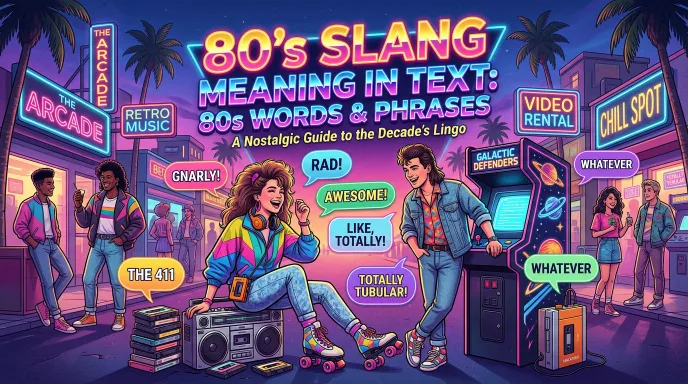
80’s slang refers to the casual words and phrases people used during the 1980s. Many terms described something cool, exciting, strange, impressive, or socially popular.
People still search for 80’s slang because these words appear in old movies, TV shows, songs, books, memes, and retro content. Some terms also appear in modern social media posts that copy the style of the 1980s.
This guide explains 80’s slang in simple English. You will learn what popular 80s words meant, where people used them, and which ones still sound natural today. You will also see real examples and simple comparisons.
Quick Answer
- 80’s slang means informal words and phrases that people commonly used during the 1980s. Popular examples include rad, gnarly, totally tubular, yuppie, the 411, and grody. Some words showed approval, while others described people, information, or unpleasant things.
- The exact meaning depends on the word and the situation.
What Does 80’s Slang Mean?
80s slang does not describe one single word. Instead, it covers many informal expressions from the decade.
Young people used slang in everyday conversations, music, movies, school, parties, and youth culture. Different groups also created their own expressions. Surf culture, skate culture, hip hop, Valley Girl speech, and urban life all shaped the language of the period.
Some expressions sounded positive:
- Rad :very cool or excellent
- Awesome :very impressive or exciting
- Gnarly :very difficult, intense, or extremely cool
- Totally tubular :very cool or excellent
Other terms described people or situations:
- Yuppie :a young urban professional with a well paying career
- Grody :disgusting or unpleasant
- The 411 :information or the latest details
The decade had many different slang styles. That means not every 80s expression came from the same group or place.
Popular 80’s Slang Words and Phrases
Here are some well known examples.
| 80s Slang | Simple Meaning | Example |
| Rad | Very cool | “That jacket is rad.” |
| Gnarly | Intense, difficult, or cool | “That wave was gnarly.” |
| Totally tubular | Very cool | “That trick was totally tubular.” |
| Grody | Gross or disgusting | “That bathroom looks grody.” |
| The 411 | Information | “Give me the 411.” |
| Yuppie | Young urban professional | “He works downtown and lives like a yuppie.” |
| Awesome | Great or impressive | “That concert was awesome.” |
| Dude | Person, friend, or man | “Dude, check this out.” |
| Bodacious | Excellent, impressive, or bold | “That was a bodacious move.” |
| Valley Girl speech | A style linked to young Southern California speakers | “Like, totally!” |
Not every word started in the 1980s. Some older terms became popular with 80s speakers. Gnarly, for example, dates much further back, but its slang meanings include both something very bad or difficult and something cool or excellent.
Rad: What Did It Mean?
Rad meant something very cool, exciting, or impressive.
People often used it to show strong approval.
For example:
“That skateboard is rad.”
The speaker likes the skateboard and thinks it looks great.
You could also say:
“That was a rad concert.”
Here, rad means the concert was excellent.
Today, many people understand rad, but the word can sound strongly retro. It works well when you want an old school 80s feel.
Gnarly: A Slang Word With Two Sides
Gnarly has more than one slang meaning.
It can describe something difficult, unpleasant, or intense. It can also describe something exciting or excellent.
For example:
“That road was gnarly.”
The speaker may mean that the road was difficult or dangerous.
Now consider:
“That skate trick was gnarly!”
Here, the speaker shows excitement and admiration.
Merriam Webster lists both negative and positive slang meanings for gnarly. Context tells you which meaning fits.
Totally Tubular: What Does It Mean?
Totally tubular means very cool, excellent, or exciting.
The phrase connects strongly with 1980s surf and youth culture.
For example:
“That new skateboard is totally tubular!”
The speaker thinks the skateboard looks great.
Modern speakers may use this phrase as a joke or as a playful way to sound like someone from the 1980s.
You probably would not use it in a serious business email.
Grody: What Did It Mean?
Grody means disgusting, dirty, or unpleasant.
For example:
“Those old shoes look grody.”
The speaker thinks the shoes look dirty or gross.
The term existed before the 1980s, but it became strongly associated with youth speech and Valley Girl culture during that era. Merriam Webster traces its first known use to around 1965.
What Did “The 411” Mean?
The 411 meant information, news, or the latest details.
The expression came from the use of 411 for directory assistance in the United States and Canada. By the early 1980s, people also used 411 as slang for information. Merriam Webster notes early print evidence from the 1980s.
For example:
“Give me the 411 on the party.”
That means:
“Tell me what I need to know about the party.”
Today, younger speakers may understand the phrase, but many people see it as retro slang.
What Did Yuppie Mean?
Yuppie describes a young, college educated professional with a well paying career who lives and works in or near a large city.
The word became prominent in the early 1980s. Merriam Webster gives 1980 as its first known use. The term likely comes from young urban professional plus the ending ie.
For example:
“The movie shows a group of wealthy yuppies living in the city.”
The word can sound neutral, humorous, or critical depending on the context.
It also connects with 1980s discussions about money, career success, city life, and consumer culture.
Is 80’s Slang Rude or Offensive?
Most 80s slang is harmless, but some words can sound rude or negative.
The tone depends on the expression.
For example:
- Rad usually sounds positive.
- Awesome usually sounds positive.
- Grody describes something unpleasant.
- Yuppie can sound neutral or critical.
- Gnarly can sound positive or negative.
You should also consider the history of each word. A term may have different meanings today than it had decades ago.
When you discuss people or groups, choose words carefully. Avoid using old slang as a label for someone if the term could insult them.
Where Was 80’s Slang Commonly Used?
80s slang appeared in many parts of everyday life.
School and Teen Conversations
Teenagers used casual expressions with friends at school, parties, malls, and other social places.
Example:
“That new arcade game is rad.”
Surf and Skate Culture
Surfing and skateboarding helped popularize words such as gnarly and phrases such as totally tubular.
These words often described tricks, waves, boards, and exciting experiences.
Music and Pop Culture
Music helped spread slang to large audiences. Movies and television also gave certain expressions wider attention.
People sometimes copied phrases from characters, songs, and youth trends.
Valley Girl Culture
Southern California youth culture helped popularize a style often called Valley Girl speech.
The 1982 song “Valley Girl” by Moon Unit Zappa helped bring this speech style to a wider audience. Dictionary.com notes that this style grew from Southern California and that the song helped popularize it.
Hip Hop Culture
Hip hop grew from the South Bronx in the late 1970s and reached a global audience by the end of the 1980s. Its language and cultural influence grew during the decade.
This shows why we should not treat all 80s slang as one style. Different communities shaped different parts of 1980s language.
Real Life Examples of 80’s Slang
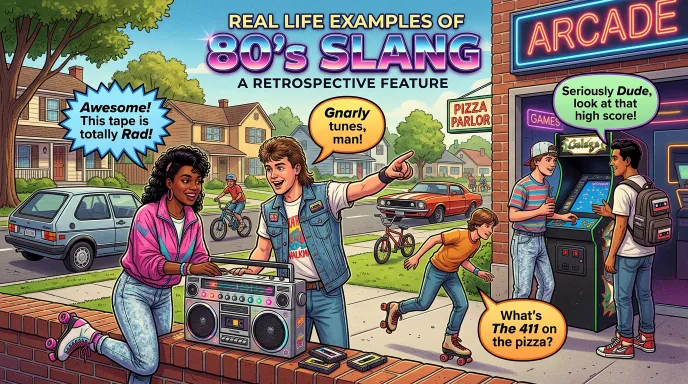
Here are simple examples that show how these terms can work.
Friendly Conversation
“Dude, your new bike is rad!”
Here, rad shows excitement and approval.
Casual Conversation
“Give me the 411. What happened last night?”
Here, the 411 means information.
Surf or Skate Context
“That wave looks gnarly!”
The speaker may mean the wave looks intense or challenging.
Funny Retro Example
“Like, totally! That movie was awesome.”
This example copies a playful 80s Valley Girl style.
Describing Something Gross
“That old fridge smells grody.”
Here, grody means disgusting or unpleasant.
Talking About a Professional
“The movie follows a young yuppie in New York.”
Here, yuppie describes a young urban professional.
80’s Slang vs. Modern Slang
80s slang and modern slang can express similar ideas, but they often use different words.
| 80s Expression | Modern Equivalent | Basic Meaning |
| Rad | Cool | Excellent or impressive |
| The 411 | Info / details | Information |
| Grody | Gross | Disgusting |
| Totally tubular | Awesome | Very good |
| Gnarly | Insane / intense | Very difficult or exciting |
| Dude | Bro / dude | Friend or person |
| Yuppie | Young professional | Young career focused adult |
Some modern speakers still use older terms. However, many 80s expressions now sound nostalgic, humorous, or deliberately retro.
Why Did People Use 80’s Slang?
People used slang for many of the same reasons people use slang today.
Slang can:
- Show friendship
- Create group identity
- Make speech more casual
- Add humor
- Show excitement
- Reflect music and youth culture
- Make a speaker sound trendy
- Help people connect with a specific community
A teenager might say rad because the word felt natural within their social group.
A surfer might use gnarly to describe a difficult wave.
A city professional might hear yuppie as a label for a new social group.
Slang gives people more than information. It can also show identity and attitude.
Are 80’s Slang Words Still Used Today?
Yes, but many 80s slang terms now have a retro feel.
Words such as awesome and dude remain familiar. Other expressions, such as totally tubular, may sound more playful or nostalgic.
People often use old slang today when they want to:
- Create an 80s theme
- Make a joke
- Talk about retro culture
- Write a period story
- Recreate an old school style
- Make social media content feel nostalgic
You may also see these words in movies, TV shows, memes, costumes, and retro themed events.
When Should You Avoid 80’s Slang?
80s slang works best in casual situations.
You should avoid heavy slang when you write:
- A formal school assignment
- A business report
- A professional email
- A job application
- A serious academic paper
- A formal presentation
You can still discuss 80s slang in these settings. Just explain the words clearly.
For example, instead of writing:
“The character was totally tubular.”
A formal analysis could say:
“The character used a popular 1980s expression to show excitement.”
That version gives the reader more information.
80’s Slang in Social Media
People often use 80s slang on social media for fun rather than everyday communication.
You might see words such as rad, gnarly, or totally tubular in:
- TikTok captions
- Instagram posts
- Reddit discussions
- Retro YouTube videos
- Memes
- 80s themed content
For example:
“This 80s arcade setup is totally tubular!”
The speaker uses the phrase to create a playful retro mood.
Common Misunderstandings About 80’s Slang
Not Every Slang Word Started in the 1980s
Some words became popular during the decade but existed earlier.
Gnarly offers a good example. The word dates back centuries, while its slang meanings developed later.
Not Everyone Used the Same Slang
Different groups used different expressions.
A surfer might use gnarly in a different way from a young professional who heard yuppie in news coverage.
Old Slang Does Not Always Sound Natural Today
A word can remain understandable without remaining common.
Someone may understand totally tubular but rarely say it in everyday conversation.
FAQ’S
Q1:What is 80’s slang?
80’s slang refers to informal words and phrases that people used during the 1980s. Some terms came from youth culture, music, surfing, skateboarding, hip hop, and everyday speech.
Q2:What was the most popular 80s slang?
Popular examples include rad, gnarly, awesome, dude, grody, the 411, and totally tubular. Popularity varied by region and social group.
Q3:What does “rad” mean in 80s slang?
Rad means very cool, excellent, or impressive. People often used it to show strong approval.
Q4:What does “gnarly” mean?
Gnarly can mean difficult, unpleasant, or intense. It can also mean cool or excellent. Context tells you which meaning fits.
Q5:What does “the 411” mean?
The 411 means information or the latest details. The expression grew from the use of 411 for directory assistance in the United States and Canada.
Q6:What does “yuppie” mean?
Yuppie describes a young, college educated professional with a well paying career who lives in or near a large city.
Conclusion
80’s slang gives us a fun look at the language and culture of the 1980s. Words such as rad, gnarly, grody, the 411, and yuppie each carry a different meaning and cultural background.
Some expressions still sound natural today. Others now feel old fashioned, playful, or nostalgic. Context also matters because the same word can carry different meanings.
If you want to use 80s slang in modern writing, choose words that match your audience and purpose. For casual conversations, social media, retro content, and creative writing, these expressions can add personality.
For formal writing, use clear modern English instead.
The main takeaway is simple: 80s slang is more than a list of old words. It reflects the people, communities, music, and youth culture that shaped the decade.
Related Slang About!
- Gym Slang Funny: Hilarious Gym Terms & Meanings
- Slang From 90s: Popular 90s Words & Phrases
- Area Between Anus and Scrotum Slang: Meaning & Terms