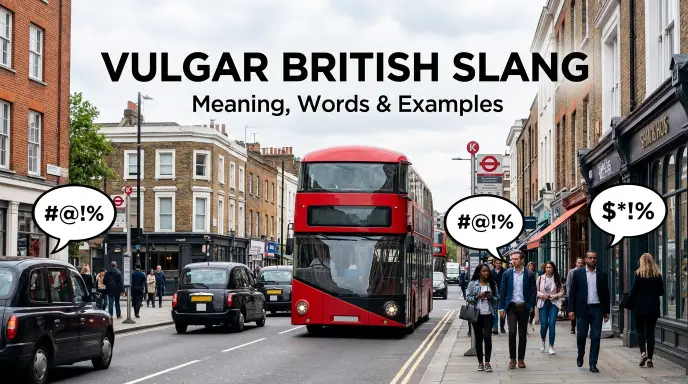
Vulgar British slang refers to rude, offensive, crude, or socially inappropriate words and phrases that people use in informal British speech. Some terms sound playful among friends, while others can insult, shock, or offend.
People often search for vulgar British slang because they hear unfamiliar words in British TV shows, films, social media posts, online chats, or everyday conversations. British slang can also vary by region, age group, and social setting.
This guide explains common vulgar British slang in simple English. You will learn what these terms mean, how people use them, how strong they sound, and when you should avoid them. You will also see realistic examples and polite alternatives.
Quick Answer
- Vulgar British slang means rude, crude, or offensive informal language that people may use in Britain. These expressions can describe people, situations, body parts, sex, anger, surprise, or frustration. Some sound mildly rude, while others carry a much stronger insult.
- The key point is context. A word may sound funny between close friends but deeply offensive in a workplace or public setting.
What Does Vulgar British Slang Mean?
Vulgar British slang combines two ideas:
- Vulgar means crude, rude, or socially unacceptable.
- British slang means informal language linked to British speech and culture.
Together, the phrase covers informal British expressions that many people consider rude or offensive.
Not every British slang word counts as vulgar. Words such as mate, cheers, and knackered usually sound informal rather than vulgar.
Vulgar terms carry a stronger edge. Speakers may use them to show anger, humor, surprise, frustration, or disrespect.
Why Does Context Matter?
Context can change how a phrase sounds.
For example, two close friends may joke with a rude expression and understand the playful intent. The same expression can sound hostile when a stranger says it during an argument.
Tone also matters. A person can soften a phrase with humor or make it harsher through an angry voice.
Common Types of Vulgar British Slang
British vulgar slang covers several groups of expressions. Each group can carry a different level of offense.
| Type | What it can express | Typical tone |
| Swearing | Anger, surprise, frustration | Rude |
| Insults | Dislike or criticism | Rude to offensive |
| Body related slang | Body parts or bodily functions | Crude |
| Sexual slang | Sexual topics | Often vulgar |
| Strong exclamations | Shock or excitement | Informal to very rude |
| Humorous insults | Teasing between friends | Context dependent |
Some terms have more than one meaning. Always check the surrounding sentence before deciding what someone means.
Common Vulgar British Slang Words and Phrases
Below are examples that readers may encounter in British media or online conversations. Their strength can vary by speaker and situation.
Bloody
Bloody can act as an intensifier. It can add emphasis to a statement.
Example:
“That was a bloody long day.”
Many speakers consider it mild compared with stronger British swear words. However, formal settings still call for cleaner language.
Bollocks
Bollocks can refer to nonsense, rubbish, or something that a speaker considers untrue. It can also refer literally to testicles, which gives the word its vulgar edge.
Example:
“That’s a load of bollocks.”
The phrase often expresses strong disbelief or annoyance.
Bugger
Bugger has several meanings in British English. People may use it as an exclamation, insult, or verb.
Example:
“Bugger! I forgot my keys.”
Its strength depends on context. Some speakers treat it as fairly mild, while others may find it offensive.
Wanker
Wanker acts as a strong insult. A speaker may use it to call someone foolish, unpleasant, or contemptible.
Example:
“Don’t be a wanker.”
This term can sound aggressive. Avoid it in professional or respectful conversations.
Pissed
In British English, pissed commonly means drunk. In American English, people often use it to mean angry.
Example:
“He got pissed after the party.”
This difference can confuse British and American English speakers.
Taking the piss
Taking the piss means mocking someone, making fun of something, or behaving in a way that tests someone’s patience.
Example:
“Are you taking the piss?”
The phrase can sound playful among friends. It can also show clear irritation.
Piss off
Piss off means go away or leave me alone. It can also express anger.
Example:
“Piss off and leave me alone.”
This phrase sounds rude. Use a softer expression when you want to remain polite.
Are Vulgar British Slang Words Offensive?
Some are offensive, while others sound mild or humorous. The level of offense depends on the exact word, the speaker, the listener, and the situation.
A useful way to think about vulgar slang is to place it on a rough scale:
Mild → Rude → Strong → Highly offensive
Not every speaker places the same word at the same point on that scale.
Age also matters. Younger speakers may recognize a term from social media or entertainment without using it themselves. Older speakers may judge the same word more harshly.
Cultural background can matter too. A phrase that sounds normal to one group may sound disrespectful to another.
Vulgar British Slang in Different Settings
The same slang can create very different reactions depending on where you use it.
| Setting | Vulgar slang | Better approach |
| Close friends | Sometimes acceptable | Read the group’s tone |
| Private chat | Depends on the audience | Consider the recipient |
| TikTok comments | Common in some communities | Avoid personal insults |
| Gaming chat | Often appears | Keep disagreements respectful |
| School | Usually a poor choice | Use neutral language |
| Workplace | Usually inappropriate | Choose professional wording |
| Interview | Avoid it | Use standard English |
| Family | Depends on family norms | Consider age and comfort |
Social media can make vulgar British slang look more normal than it actually feels in daily life.
A viral phrase does not automatically become polite language.
Is Vulgar British Slang Funny or Serious?
It can be either.
Some people use rude slang for comedy. British comedy often plays with exaggeration, sarcasm, insults, and strong language. A character may use a vulgar phrase to create a funny reaction.
However, humor does not remove the possible offense.
For example, calling a close friend a rude name may work as playful teasing. Calling a stranger the same name can start an argument.
The relationship between speakers matters.
Real Life Examples of Vulgar British Slang
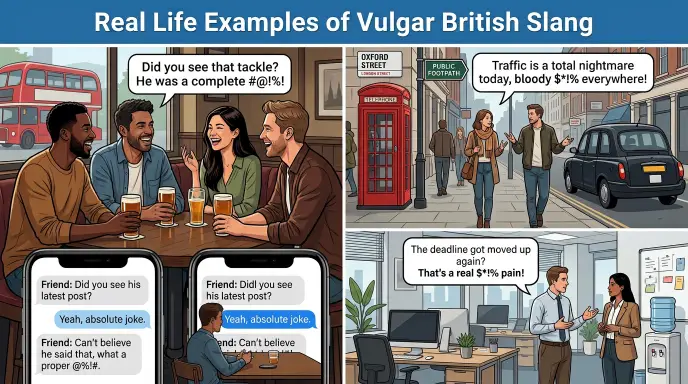
Here are realistic examples that show how context changes the meaning.
Friends joking
Sam: “You forgot your wallet again.”
Alex: “Oh, bollocks. I knew I forgot something.”
Here, the speaker expresses frustration rather than attacking another person.
Strong insult
Tom: “That bloke kept cutting everyone off.”
Jay: “What a wanker.”
The speaker uses wanker as a direct insult.
Asking if someone jokes
Ella: “You paid £100 for that?”
Ben: “Yeah.”
Ella: “Are you taking the piss?”
Here, the phrase expresses disbelief.
Talking about alcohol
Mark: “Where’s Dan?”
Chris: “He’s completely pissed.”
In British English, the speaker most likely means that Dan has had too much alcohol.
Asking someone to leave
Person A: “You keep bothering me.”
B: “Fine.”
A: “Just piss off.”
This example carries a clear angry tone.
Origin and History of British Vulgar Slang
British vulgar slang does not come from one single source. Different expressions developed across different periods, regions, communities, and forms of popular culture.
Some terms have long histories in English. Others gained wider attention through music, television, comedy, films, newspapers, and later the internet.
British slang also changes over time. A word that once sounded extremely shocking may lose some force for younger speakers. Another term may remain strongly offensive for generations.
Regional speech adds another layer. London slang may differ from expressions associated with Scotland, Wales, Northern England, or other parts of Britain.
Because slang history can involve disputed dates and changing meanings, it helps to avoid claiming that every term began in one exact year.
British vs American Vulgar Slang
British and American English share many swear words, but speakers do not always use them in the same way.
One useful example is pissed.
| Expression | British English | American English |
| Pissed | Usually drunk | Usually angry |
| Pissed off | Angry or annoyed | Angry or annoyed |
| Taking the piss | Mocking or joking at someone’s expense | Not a common everyday phrase |
| Bollocks | Nonsense or testicles | Less common |
| Wanker | Strong insult | Less common |
This difference can create confusion in films, shows, games, and online chats.
Always consider the speaker’s variety of English.
Similar British Slang Terms
Several informal British expressions may appear near vulgar slang, but they do not all carry the same level of offense.
- Mate :friend or person you know
- Bloke :man
- Lad :young man or boy
- Knackered :very tired
- Gutted :very disappointed
- Dodgy :suspicious or unreliable
- Taking the piss :mocking or teasing
- Pissed off :angry or annoyed
The last two can sound rude, but their strength depends on context.
When Should You Avoid Vulgar British Slang?
Avoid strong vulgar slang when you do not know how the listener will react.
You should especially avoid it in:
- Job interviews
- School assignments
- Business emails
- Customer service conversations
- Formal meetings
- Professional presentations
- Conversations with strangers
- Situations involving children
- Sensitive discussions
You should also avoid using vulgar insults against someone simply because you heard the phrase online.
Understanding slang does not mean you need to repeat it.
Polite Alternatives to Vulgar British Slang
You can often express the same feeling without rude language.
| Vulgar expression | Polite alternative |
| Piss off | Please leave me alone |
| Bollocks | That’s nonsense |
| Taking the piss | Are you joking? |
| Pissed off | Annoyed |
| Bloody hell | Oh wow / Oh no |
| What a wanker | What a rude person |
These alternatives work better when you need to sound respectful.
Why Do People Use Vulgar British Slang?
People use vulgar slang for many reasons.
To show emotion
Strong words can make anger, surprise, or frustration sound more intense.
To create humor
Friends may use rude expressions as part of jokes or playful teasing.
To sound informal
Some people use slang to create a relaxed style with friends.
To fit a social group
A particular group may share slang that helps members feel connected.
To add emphasis
A vulgar word can make a statement sound stronger.
Still, people should consider their audience before using strong language.
Common Misunderstandings About British Vulgar Slang
“Every British slang word is rude.”
No. British English includes plenty of harmless informal words.
“If people laugh, the word cannot offend anyone.”
Not always. Humor depends on context and relationships.
“British and American slang mean the same thing.”
Not always. Words such as pissed show how meanings can differ.
“Online slang works everywhere.”
No. A phrase that works in a private group chat may sound inappropriate at work.
“Vulgar means meaningless.”
No. Vulgar slang can communicate emotion, humor, anger, or social identity. The issue usually concerns tone and appropriateness.
FAQ’S
Q1:What is vulgar British slang?
Vulgar British slang refers to informal British words and phrases that sound crude, rude, offensive, or socially inappropriate.
Q2:Is British slang always vulgar?
No. Many British slang terms sound friendly or harmless. Words such as mate, bloke, and knackered do not automatically count as vulgar.
Q3:What is the most common British swear word?
There is no single answer that fits every speaker or region. British English has many swear words, and their frequency and strength vary by age, location, and social group.
Q4:Is “bloody” a swear word in Britain?
Bloody can function as a mild swear word or intensifier in British English. Many speakers consider it much less offensive than stronger terms.
Q5:What does “taking the piss” mean?
Taking the piss usually means mocking someone, making fun of something, or treating a situation in a way that annoys another person.
Q6:Can I use vulgar British slang at work?
It is safer to avoid strong vulgar slang at work. Professional settings usually call for clear and respectful language.
Q7:Why does British slang sound different from American slang?
British and American English developed different speech patterns, cultural influences, and slang traditions. Some shared words also gained different meanings in each variety.
Conclusion
Vulgar British slang covers rude, crude, and sometimes offensive informal expressions from British English. The strength of each term can change with context, tone, age, region, and the relationship between speakers.
Some expressions work as jokes between close friends. Others can sound aggressive or insulting. A phrase that appears often in a British comedy show may still feel inappropriate in real life.
When you encounter vulgar British slang, look at the whole sentence and the situation. That approach helps you understand the speaker without assuming that every slang term has the same level of offense.
Discover More About!
- New York Slang Meaning in Text: A Simple Guide
- Maje Spanish Slang Meaning in Text
- Spoiled in Spanish Slang Meaning in Text