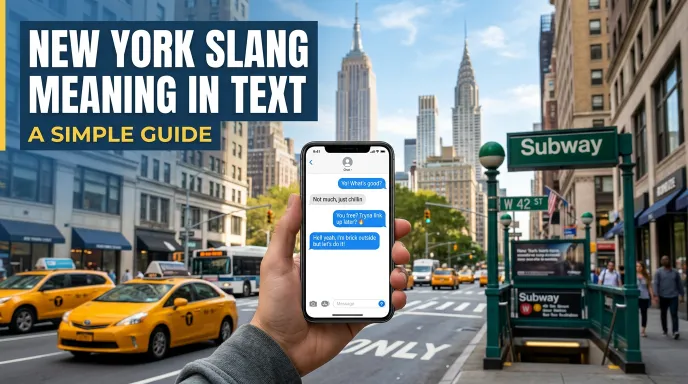
New York slang in text refers to the casual words and phrases people use in messages, chats, and social media. These expressions can make a message sound more natural, friendly, or connected to New York culture.
Some New York slang words have meanings that may confuse people from other places. A phrase can also change meaning based on the conversation, tone, or situation. That is why context matters when you read New York slang in a text.
This simple guide explains common New York slang, what each term means, and how people use it in everyday messages. It also gives clear examples so you can understand these expressions without guessing.
Quick answer:
- New York slang means informal words and phrases linked to New York speech and culture. Examples include deadass, mad, bodega, brick, and son.
What Does New York Slang Mean?
New York slang includes casual words and expressions that people connect with New York City. These terms often reflect the city’s fast pace, diverse communities, humor, and strong local identity.
Some words describe places or everyday experiences. Others show emotion, agreement, surprise, or friendship.
For example:
- Deadass can mean “seriously” or “I am telling the truth.”
- Mad can mean “very” or “a lot.”
- Brick can describe extremely cold weather.
- Bodega means a small neighborhood shop or convenience store.
- Son can work as a casual way to address a friend or another person.
Not every New Yorker uses every slang term. Age, neighborhood, background, and social group can affect word choice.
That point matters. You should not treat one phrase as a rule for every person in New York.
Common New York Slang Words and Their Meanings
New York slang has many terms, but some words appear often in conversations, social media posts, music, and casual speech.
| New York Slang | Meaning | Example |
| Deadass | Seriously; honestly | “Deadass, I forgot my keys.” |
| Mad | Very; a lot | “That place has mad good food.” |
| Brick | Extremely cold | “It’s brick outside today.” |
| Bodega | Small neighborhood store | “I’m stopping at the bodega.” |
| Son | Friend or casual form of address | “Son, you have to see this.” |
| Buggin’ | Acting irrationally or overreacting | “You’re buggin’ right now.” |
| Frontin’ | Pretending or acting fake | “Stop frontin’ like you knew.” |
| Wildin’ | Acting in a wild or unreasonable way | “He’s wildin’ in the comments.” |
| Odee | Very much; extremely | “That test was odee hard.” |
| Guap | Money | “He saved some guap for the trip.” |
Context can change the tone of these words. A term that sounds friendly between friends may sound rude when a stranger uses it.
What Does “Deadass” Mean in New York Slang?
Deadass usually means seriously, honestly, or genuinely.
People often use it to show that they mean what they say. It can also add strong emphasis to a statement.
Examples:
- “Deadass, that was the best pizza I had all week.”
- “Are you deadass right now?”
- “I’m deadass tired.”
The phrase can sound casual and direct. Friends may use it in texts, conversations, comments, and social media posts.
You should avoid it in formal writing. A school paper, business email, or professional report needs clearer standard English.
What Does “Mad” Mean in New York Slang?
In New York speech, mad can mean very or a lot.
This use differs from the standard meaning of “angry.”
For example:
- “That place has mad people.”
- “This pizza is mad good.”
- “I have mad work today.”
The meaning comes from the sentence. If someone says, “He is mad,” they may mean angry. If someone says, “That was mad funny,” they mean very funny.
That difference can confuse people who do not know the slang.
What Does “Brick” Mean in New York Slang?
When someone says brick in New York slang, they can mean that the weather feels extremely cold.
For example:
“It’s brick outside. Wear a jacket.”
People often use this term during very cold weather. The word works well in casual conversations, texts, captions, and social media posts.
It does not mean that the weather contains actual bricks. The context gives the word its slang meaning.
What Does “Bodega” Mean?
A bodega refers to a small neighborhood store, especially one that sells snacks, drinks, groceries, household items, and other everyday products.
Bodegas play an important role in New York City culture. People often stop at them for quick food, drinks, coffee, or basic items.
Examples:
- “I’m going to the bodega for a drink.”
- “The bodega downstairs is open late.”
- “Grab some snacks from the bodega.”
Unlike some slang terms, bodega does not always function as slang. Many people use it as an ordinary word for a type of neighborhood store.
Where Is New York Slang Commonly Used?
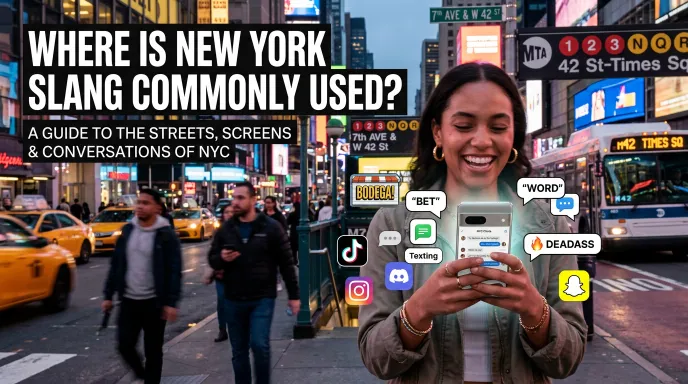
New York slang appears in many casual settings. However, people do not use every term in every situation.
You may see or hear New York expressions in:
- Everyday conversations
- Text messages
- TikTok videos
- Instagram captions
- Reddit discussions
- YouTube videos
- Music and lyrics
- Podcasts
- Comedy
- Gaming chats
- Discord conversations
- Sports discussions
- Online comments
The setting can affect the meaning and tone.
For example, friends may use deadass as a joke. A creator may use brick in a winter video. Someone may use mad to add emphasis to a sentence.
Is New York Slang Rude or Offensive?
Most New York slang is casual rather than automatically offensive. Still, some terms can sound rude, aggressive, or disrespectful when you use them in the wrong situation.
Tone matters a lot.
For example, “You’re buggin’” may sound playful between close friends. The same phrase can sound confrontational during an argument.
Keep these points in mind:
- Friends may use slang casually.
- Strangers may not understand every expression.
- Some words can sound aggressive.
- Formal settings need standard language.
- Context can change the emotional effect.
New York speech often sounds direct. People who come from quieter or more formal speech communities may mistake that direct style for anger.
Real Life New York Slang Examples
The best way to understand slang involves seeing it in natural situations.
Friendly Conversation
Alex: “You coming with us?”
Sam: “Deadass, I thought you already left.”
Here, deadass adds emphasis. Sam wants to make the statement sound serious.
Casual Texting
Mia: “How cold is it?”
Jay: “Brick outside 😭”
Here, brick describes very cold weather.
Talking About Food
Chris: “That pizza was mad good.”
Drew: “I know. I’m going back tomorrow.”
Here, mad means very.
Argumentative Context
Person 1: “You said you finished it.”
Person 2: “Why are you buggin’? I said I would finish it today.”
Here, buggin’ suggests that the other person is overreacting.
Social Media
“Deadass, NYC food hits different.”
The speaker uses deadass to strengthen the statement.
Gaming or Discord
“Bro, you’re wildin’ 😂”
The phrase can describe someone who makes a surprising or unreasonable move.
New York Slang vs Standard English
New York slang works well in casual settings, but standard English works better in formal communication.
| Casual New York Slang | Standard English |
| Deadass | Seriously |
| Mad good | Very good |
| Brick outside | Extremely cold outside |
| You’re buggin’ | You are overreacting |
| Frontin’ | Pretending |
| Guap | Money |
You can use slang when the situation feels relaxed. For school assignments, job applications, professional emails, and formal reports, choose standard English.
Where Did New York Slang Come From?
New York slang does not come from one single source.
New York City has long brought together people from many cultural and language backgrounds. Different communities have influenced the way people speak across neighborhoods and generations.
Music also plays a major role. Hip hop, rap, radio, television, comedy, and online creators have helped spread New York expressions beyond the city.
Some terms also connect with African American English, Caribbean English, immigrant communities, and regional American speech. Each term has its own history, so you should not claim that every New York slang word comes from one group.
The history of some terms remains unclear or has several competing explanations. In those cases, it makes more sense to say the origin remains uncertain than to present one story as fact.
New York Slang vs Other American Slang
New York slang can overlap with slang from other parts of the United States. That overlap makes it difficult to label every casual expression as uniquely New York.
For example, people outside New York may also use words such as deadass or mad.
The difference often comes from frequency, local speech patterns, pronunciation, and cultural context.
A useful rule is simple: a word can have New York connections without belonging only to New York.
When Should You Avoid New York Slang?
You should avoid strong slang when the situation requires formal or respectful language.
Avoid it in:
- Job interviews
- Business emails
- Academic papers
- Formal presentations
- Official applications
- Professional reports
- Serious workplace communication
You should also avoid copying a phrase just because you heard it online.
Slang can carry cultural and regional meaning. Using a phrase without understanding its tone may make your message sound forced.
When you speak with someone from New York, listen to how they use the term first. Then decide if it fits your own conversation.
Polite Alternatives to New York Slang
You do not need slang to sound friendly. Standard English can work well when you want a clear and respectful tone.
Try these alternatives:
- Deadass → Seriously
- Mad good → Very good
- Brick → Extremely cold
- You’re buggin’ → You are overreacting
- Frontin’ → You are pretending
- Guap → Money
These alternatives work better in school, work, and formal communication.
Why Do People Use New York Slang?
People use slang for several simple reasons.
It Shows Local Identity
Local words can help people express a connection to their city, neighborhood, or community.
It Makes Conversation Shorter
A slang word can express an idea quickly. For example, brick can describe very cold weather without a long explanation.
It Adds Emotion
Words such as deadass can make a statement sound more serious.
It Creates Humor
New York expressions often appear in jokes, memes, videos, and playful conversations.
It Builds Connection
Friends may share slang as part of their social group. The language can make a conversation feel more relaxed.
Common Misunderstandings About New York Slang
New York slang can confuse people because many terms have more than one meaning.
“Mad” Does Not Always Mean Angry
In “I’m mad,” the word can mean angry. In “That was mad funny,” it means very.
“Brick” Does Not Mean a Building Material
When someone says “It’s brick outside,” they usually mean the weather feels extremely cold.
“Deadass” Does Not Mean Something Literal
The phrase usually adds seriousness or emphasis. Context gives it the right meaning.
Not Every New Yorker Uses the Same Slang
New York City contains many communities and neighborhoods. Speech can vary by age, background, location, and social group.
Is New York Slang Safe to Use on Social Media?
Yes, most everyday New York slang works safely in casual social media content. Still, you should understand the meaning before using a term.
TikTok, Instagram, Reddit, and other platforms can spread regional expressions quickly. A phrase that started in one community may reach users across the world.
Keep the tone in mind. A slang term may sound funny in a meme but disrespectful in a serious discussion.
If you do not understand a word, check its meaning before using it.
FAQ’S
Q1:What is New York slang?
New York slang includes informal words and phrases linked to New York City and its many communities. Some terms also spread across the United States.
Q2:What does “deadass” mean?
Deadass usually means seriously, honestly, or genuinely. People often use it to emphasize that they mean what they say.
Q3:What does “brick” mean in NYC slang?
Brick can describe extremely cold weather. For example, “It’s brick outside” means it feels very cold outside.
Q4:Does “mad” mean angry in New York slang?
Not always. In phrases such as “mad good,” mad can mean very or a lot. Context tells you which meaning fits.
Q5:Is New York slang appropriate at work?
Some mild slang may work in relaxed workplace conversations, but you should choose standard English for formal emails, reports, interviews, and important professional communication.
Q6:Does every New Yorker use the same slang?
No. New York has many communities, neighborhoods, age groups, and cultural backgrounds. Slang can vary widely across the city.
Conclusion
New York slang gives people a quick and expressive way to communicate. Words such as deadass, mad, brick, bodega, and buggin’ can add local flavor to casual conversations.
Still, context matters. The same word can sound funny among friends but confusing or too informal in a professional setting.
If you see newyork slang online, look at the full sentence before deciding what a word means. Pay attention to tone, platform, and the relationship between the speakers.
The best way to use slang involves understanding it first. When you know the meaning and context, you can decide if the expression fits the conversation.
Related Slang About!
- Güero in Spanish Slang: Meaning in Text
- Maje Spanish Slang Meaning in Text
- Spoiled in Spanish Slang Meaning in Text