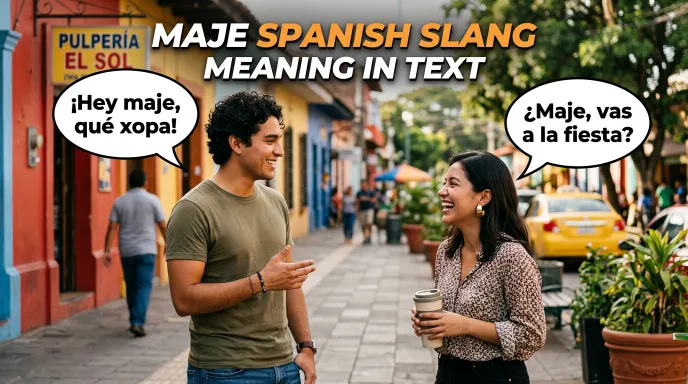
Maje Spanish slang usually means “dude,” “guy,” “man,” or “bro” in informal Spanish, especially in parts of Central America. Depending on the country and context, maje can also describe someone as foolish, gullible, or easy to fool.
People often search for maje Spanish slang after seeing the word in a text, video, song, or social media post. The meaning can feel confusing because the same word can sound friendly in one sentence and insulting in another.
This guide explains what maje means, where people use it, how its tone changes, and when you should avoid it. You will also see simple examples that show how native speakers may use the word in everyday conversation.
Quick Answer
Maje is a Central American slang word that can mean “dude,” “guy,” “man,” or “bro.” In some contexts, it can also mean “fool,” “sucker,” or “gullible person.” The speaker’s tone and the situation help you understand the intended meaning.
For example:
¿Qué hubo, maje?
“What’s up, dude?”
But:
No seas maje.
“Don’t be foolish.”
So, maje does not have one fixed English translation. Context matters.
What Does Maje Mean in Spanish Slang?
In casual speech, maje often works like “dude,” “bro,” “man,” or “guy.” Friends may use it when they talk to each other or mention another person.
For example:
Maje, ¿vamos al cine?
“Dude, are we going to the movies?”
The word can sound relaxed and friendly in this type of sentence.
However, maje also has a negative meaning. The Asociación de Academias de la Lengua Española (ASALE) lists meanings connected with a foolish person, an unknown person, and a person who deserves criticism in some regional uses.
That difference makes the surrounding words important.
| Meaning | Simple English | Typical tone |
| Maje | Dude / bro | Friendly |
| Maje | Guy / person | Casual |
| Maje | Fool / gullible person | Negative |
| Maje | Sucker | Insulting |
The safest way to understand maje involves looking at the complete sentence.
Maje Full Meaning and Definition
Maje does not work like a normal English abbreviation. It has no “full form” made from separate letters.
Instead, maje functions as a regional Spanish word with several meanings. ASALE records the word in several countries and gives meanings that include a foolish person, an unknown person, and a man or woman in certain Central American varieties.
SpanishDictionary also lists maje as a colloquial Central American term for “dude,” “guy,” “bloke,” or “sucker.”
So if someone asks, “What does maje stand for?”, the simple answer is:
Maje does not stand for anything. It is a slang word with different regional meanings.
Is Maje Rude or Offensive?
Maje can sound friendly, neutral, or insulting. The relationship between the speakers and the tone of the conversation matter a lot.
Among close friends, maje can work like “bro” or “dude.” It can show familiarity without a serious insult.
For example:
Ey, maje, ¿qué haces?
“Hey, dude, what are you doing?”
The same word can sound negative when someone uses it to call another person foolish.
For example:
No seas maje.
“Don’t be stupid.”
ASALE lists a derogatory meaning for maje in Honduras and Nicaragua. It also records meanings related to a foolish person in several countries.
A Simple Tone Guide
- Friendly: “Hey, dude!”
- Casual: “That guy over there.”
- Teasing: “You fool!”
- Negative: “What an idiot.”
- Insulting: “You sucker.”
Do not assume that every use carries the same level of offense.
Where Is Maje Commonly Used?
Maje has strong connections with Central American Spanish. ASALE records regional uses in Mexico, Guatemala, El Salvador, Honduras, Nicaragua, and Costa Rica.
SpanishDictionary also lists Central American use in Guatemala, El Salvador, Honduras, Nicaragua, Costa Rica, and Panama.
Usage can change from one country to another. A word that sounds normal among friends in one place may sound unusual or more negative somewhere else.
You may encounter maje in:
- Casual conversations
- Text messages
- Social media comments
- Online communities
- Videos from Central America
- Music and entertainment
- Informal chats between friends
You should not treat maje as universal Spanish slang. Spanish has many regional words, and local speakers may understand the term differently.
Maje in Text Messages and Social Media
People can use maje in texting in much the same way they use it in spoken conversation.
A friend might write:
Maje, ¿ya llegaste?
“Bro, did you get there?”
Another person might write:
Ese maje siempre llega tarde.
“That guy always arrives late.”
The second example does not automatically mean “idiot.” The speaker may simply refer to a guy in an informal way.
Social media adds another layer. A comment can sound playful, serious, or insulting depending on the rest of the message.
Look at the words around maje before deciding what the writer means.
Real Life Examples of Maje
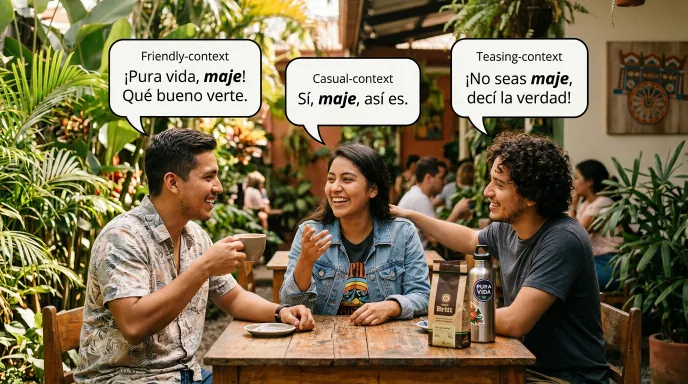
The following examples show how the meaning can change.
Friendly Example
Maje, ¿quieres comer algo?
“Dude, do you want to eat something?”
Here, maje sounds friendly.
Casual Example
Ese maje vive cerca de mi casa.
“That guy lives near my house.”
Here, the speaker simply refers to a person.
Teasing Example
Maje, ¿cómo olvidaste tus keys?
“Dude, how did you forget your keys?”
The speaker may tease a friend without trying to insult them.
Negative Example
No seas maje y revisa el mensaje.
“Don’t be foolish. Check the message.”
Here, the word has a negative tone.
Social Media Example
Ese maje es muy gracioso.
“That guy is really funny.”
The word can still sound casual even when someone talks about another person.
Friendly Group Chat
Majes, ¿a qué hora nos vemos?
“Guys, what time are we meeting?”
The plural form can refer casually to a group.
Where Did Maje Come From?
The history of maje needs careful treatment because popular explanations about its origin do not always agree.
ASALE confirms the word and its regional meanings, but its dictionary entry does not give a simple single origin story.
Some discussions connect maje with the idea of a foolish or gullible person. The word later developed or gained casual uses for a person or friend in parts of Central America.
Costa Rican Spanish also has the related form mae. Sources commonly describe mae as a casual way to refer to a person, similar to “dude” or “man.”
Because the history has different explanations, it makes more sense to focus on documented regional meanings than to claim one definite origin without strong evidence.
Maje vs. Mae vs. Dude
English speakers often compare maje with words such as “dude,” “bro,” and “man.” Spanish speakers may also connect it with the Costa Rican form mae.
| Word | Basic idea | Style |
| Maje | Dude / guy / bro | Informal |
| Mae | Dude / person | Informal, strongly linked with Costa Rican Spanish |
| Dude | Guy / friend | Informal English |
| Bro | Brother / close friend | Very casual |
| Amigo | Friend | More standard Spanish |
These words do not match perfectly.
For example, amigo directly means “friend,” while maje can refer to a guy or person even when the speaker does not know him well.
The Costa Rican form mae also has its own regional identity. Do not assume that every Spanish speaking country uses maje and mae in exactly the same way.
When Should You Avoid Using Maje?
Avoid maje when you need formal, respectful Spanish.
You may want to avoid it with:
- A teacher
- A professor
- A customer
- A manager
- A government official
- A new professional contact
- Someone you do not know well
A casual word can sound too familiar in a formal setting.
You should also avoid copying maje just because you saw it online. If you do not know how local speakers use it, a safer Spanish word can help you avoid an awkward moment.
In formal communication, use the person’s name or a respectful form of address instead.
Polite Alternatives to Maje
If you want a safer word, choose one based on what you mean.
If You Mean “Friend”
Use:
- Amigo — friend
- Compañero — companion or classmate, depending on context
If You Mean “Person”
Use:
- Persona — person
- Hombre — man
- Mujer — woman
If You Mean “Dude” in Casual English
You can use maje when local context supports it. However, amigo gives you a more widely understood option when you want to express friendship.
Why Do People Use Maje?
People use maje because it can make casual speech feel more natural and familiar.
Among friends, it can create a relaxed tone. It can also help speakers address someone without using their name.
For example:
Maje, ven aquí.
“Dude, come here.”
The word also carries regional identity. A local slang word can show where a speaker comes from or which community they connect with.
However, maje can also show annoyance. That is why the sentence, tone, and relationship matter more than the word alone.
Common Misunderstandings About Maje
Several mistakes can lead to confusion.
1. Maje Always Means “Dude”
Not always. The word can also refer to a foolish or gullible person.
2. Maje Always Means “Idiot”
That also misses the casual use. In Central American speech, maje can refer to a guy or work as a friendly form of address.
3. Every Spanish Speaker Uses It
Spanish varies by region. Maje has strong Central American connections, so you should not expect identical usage across all Spanish speaking communities.
4. Maje Equals Amigo
The two words can overlap in casual conversation, but they do not have the same meaning. Amigo directly means “friend,” while maje can mean “dude,” “guy,” or a foolish person.
5. Maje Always Sounds Rude
Context decides the tone. Friends can use it casually, while another speaker may use it as an insult.
Is Maje Safe to Use on Social Media?
Maje is generally fine to discuss or quote on social media, but using it yourself depends on the audience.
If you speak with friends who know the regional slang, the word may feel natural.
If you post for a broad international audience, some readers may not understand the intended meaning. Others may understand the negative sense instead.
For public posts, keep the context clear.
For example:
¡Qué onda, maje!
A reader familiar with Central American slang may understand the friendly tone.
A reader unfamiliar with the term may need more context.
FAQ’S
Q1:What does maje mean in Spanish slang?
Maje can mean “dude,” “guy,” “man,” or “bro” in informal Central American Spanish. It can also describe a foolish or gullible person in some contexts.
Q2:Is maje a bad word?
Not always. Friends may use it casually, but the word can sound insulting when someone uses it to call another person foolish.
Q3:Is maje used in Mexico?
ASALE records maje in Mexico with meanings related to a foolish person and an unknown person. Usage can vary by region and context.
Q4:What does maje mean in Honduras?
In Honduras, maje can refer to a person or guy in informal speech. It can also carry a negative meaning when someone uses it for a contemptible or foolish person.
Q5:Is maje the same as mae?
They have related casual uses, but they are not identical in every country. Mae has a strong connection with Costa Rican Spanish, while maje appears across several Central American varieties.
Q6:Can I use maje with my teacher?
It is better to avoid it in formal situations. Use a respectful form of address instead, especially if you do not know how the person views the slang.
Conclusion
Maje Spanish slang can mean “dude,” “guy,” “man,” or “bro” in casual Central American Spanish. In other situations, it can describe someone as foolish, gullible, or a sucker.
The key is context. A friend may say maje in a warm and casual way. Another speaker may use the same word as an insult.
The term has strong regional connections, so Spanish speakers from different countries may not use it in exactly the same way. If you want to use it yourself, learn how local speakers use it first.
For formal conversations, choose a more standard and respectful word.
More Slang Meanings
- New York Slang Meaning in Text: A Simple Guide
- Güero in Spanish Slang: Meaning in Text
- Spoiled in Spanish Slang Meaning in Text