
Güero is a common Spanish word, especially in Mexico, that usually describes a person with blond or fair hair or lighter skin. In casual speech, people can also use güero as a friendly nickname, similar to “buddy,” “pal,” or sometimes “honey.”
If you searched for guero in Spanish slang, you may have seen the word in a text, video, comment, or conversation. The meaning can change with the situation. A person may use güero to describe someone’s appearance, call a friend by a nickname, or show affection.
This guide explains guero in Spanish slang in simple English. You will learn what güero means, how people pronounce it, where they use it, if it can sound rude, and how güero differs from güera. You will also see natural examples that show how context changes the meaning.
Quick Answer
Güero usually means “blond,” “fair haired,” or “light skinned” in Mexican Spanish and some Central American varieties. In casual Mexican speech, people can also use it as a friendly nickname that means something like “buddy,” “pal,” or “honey.”
The word does not always carry the same tone. A friend may use güero warmly, while a stranger may use it simply to describe someone’s appearance.
What Does Güero Mean in Spanish Slang?
Güero refers to a person with blond or fair hair and can also describe someone with lighter skin. The word has strong links to Mexican Spanish, although dictionaries also record its use in parts of Central America.
For example:
“Ese güero trabaja aquí.”
“That blond guy works here.”
In this sentence, güero describes the man’s appearance.
The word can also work as a nickname:
“¿Qué onda, güero?”
“What’s up, buddy?”
Here, the speaker may not focus on the person’s hair color at all. The word can simply sound familiar and friendly. SpanishDictionary.com notes this casual use in Mexico.
That difference matters when you translate guero in Spanish slang. English speakers may expect one fixed meaning, but Spanish speakers can use the word in several ways.
What Is the Full Meaning of Güero?
Güero does not work like an English texting abbreviation. It has a regular Spanish meaning and a casual slang like use.
The main meanings include:
| Meaning | Simple English meaning | Typical use |
| Güero | Blond or fair haired man/person | Describing appearance |
| Güera | Blonde or fair haired woman/person | Describing appearance |
| Güero | Buddy or pal | Friendly conversation |
| Güera | Honey or sweetheart | Affectionate conversation |
The masculine form is güero. The feminine form is güera.
The spelling also matters. Spanish normally writes the word as güero, with a diaeresis over the ü. Many English language searches drop the accent and type guero instead.
Both forms may appear online, but güero follows the standard Spanish spelling.
Güero vs. Güera: What Is the Difference?
Güero usually refers to a male person, while güera usually refers to a female person. Spanish speakers change the ending to match grammatical gender and common usage.
For example:
“El güero” = the blond/fair haired man
“La güera” = the blonde/fair haired woman
You may see both forms in Mexican conversations.
A person could say:
“La güera de la tienda me ayudó.”
This means:
“The blonde woman at the store helped me.”
The speaker uses güera because the person they describe is female.
Is Güero Rude or Offensive?
Güero is not automatically rude or offensive. The tone depends on the speaker, the relationship, and the reason for using the word.
In Mexico, someone may use güero as a normal description of a person’s appearance. A friend may also use it as a nickname. SpanishDictionary.com lists casual uses such as “buddy” and “honey.”
However, appearance based labels can feel uncomfortable in some situations.
For example, calling someone güero among friends may sound natural. A stranger who repeatedly points out someone’s skin tone or appearance may create a different impression.
So, focus on context and tone.
When Can Güero Sound Friendly?
A Mexican friend might say:
“¿Qué onda, güero?”
The phrase can sound similar to:
“What’s up, buddy?”
The speaker may use güero as a familiar nickname.
When Can Güero Sound Less Friendly?
Imagine a stranger points at someone and says:
“Ese güero.”
The phrase could simply identify the person. Yet the tone may sound blunt if the speaker focuses on appearance in an uncomfortable way.
The word itself does not tell you the speaker’s intention. The situation does.
Where Is Güero Commonly Used?
Güero appears most strongly in Mexican Spanish and also occurs in parts of Central America. SpanishDictionary.com lists Mexico and Central American countries such as Guatemala, El Salvador, Honduras, Nicaragua, Costa Rica, and Panama for some uses.
You may encounter it in:
- Everyday conversations
- Family conversations
- Mexican movies and TV
- Spanish language social media
- Text messages
- Mexican music and entertainment
- Online discussions about Mexican culture
- Conversations between Spanish speaking friends
The word does not belong only to the internet. People use it in spoken conversation too.
That point helps explain why guero in Spanish slang can look different from modern internet abbreviations such as LOL or BRB. Güero is a Spanish word with regional and conversational uses.
How Is Güero Used in Texting and Social Media?
People can use güero in texts, comments, direct messages, and social posts just as they use it in speech.
For example:
“¿Qué onda, güero?”
A natural translation could be:
“What’s up, buddy?”
Another message might say:
“El güero de la foto es mi hermano.”
That means:
“The blond guy in the photo is my brother.”
The first example uses güero as a friendly form of address. The second uses it to describe a person.
Social media does not create a completely new meaning here. Instead, online users often bring everyday Spanish into digital conversations.
Real Life Examples of Güero
Examples make the meaning much easier to understand.
Friendly Example
“Güero, ¿vienes con nosotros?”
Possible meaning:
“Buddy, are you coming with us?”
The speaker uses güero casually.
Appearance Example
“El güero está esperando afuera.”
Possible meaning:
“The blond guy is waiting outside.”
Here, güero helps identify a person.
Affectionate Example
“Güera, ¿quieres algo del supermercado?”
Possible meaning:
“Honey, do you want anything from the store?”
This use can sound affectionate. SpanishDictionary.com lists güera as a term of endearment in Mexican Spanish.
Casual Social Media Example
“¿Qué onda, güero? 😂”
Possible meaning:
“What’s up, buddy? 😂”
The emoji can make the message feel playful.
Descriptive Example
“La güera de la mesa pidió la cuenta.”
Possible meaning:
“The blonde woman at the table asked for the bill.”
Here, the word works as a description rather than a nickname.
How Do You Pronounce Güero?
Güero sounds roughly like “GWEH roh.” SpanishDictionary.com gives the pronunciation as gweh roh and lists the Spanish spelling as güe ro.
The two dots over the ü tell the reader to pronounce the u sound.
You can break the word into two parts:
güe + ro
Think:
GWEH roh
The pronunciation can vary slightly by speaker and region, but this guide gives a useful starting point for English speakers.
Where Did Güero Come From?
Güero has a long history in Spanish and strong regional use in Mexico. It does not come from a recent social media trend.
Modern dictionaries identify güero as a regional term connected with blond, fair haired, or fair skinned people, especially in Mexico and parts of Central America.
The exact historical origin of the word can be more complicated than its modern meaning. Because sources do not always give the same explanation for its history, it is better not to claim one simple origin story as fact.
What we can say with confidence is that güero has a well established place in Mexican Spanish and continues to appear in everyday speech. Its friendly nickname use also appears in Mexican conversational Spanish.
Güero vs. Rubio: Are They the Same?
Güero and rubio can both describe blond or fair haired people, but they do not always carry the same regional feel.
| Word | Basic meaning | Common use |
| Güero | Blond, fair haired, sometimes light skinned | Strong Mexican/Latin American regional use |
| Rubio | Blond or fair haired | General Spanish vocabulary |
| Güera | Blonde, fair haired woman | Feminine form of güero |
| Rubia | Blonde, fair haired woman | Feminine form of rubio |
Collins lists güero as blond(e) and fair, with regional use in Mexico and Central America.
So, güero can carry a stronger regional and conversational flavor than a simple English translation such as “blond.”
When Should You Avoid Using Güero?
Avoid using güero when you do not know how the person feels about appearance based nicknames. This matters even more in formal or unfamiliar situations.
You should use extra care when speaking to:
- A stranger
- A teacher
- A manager
- A customer
- Someone in a formal setting
- Someone whose cultural background you do not know
In formal situations, you can simply use the person’s name.
For example, instead of:
“Güero, can you check this?”
use the person’s name or a neutral phrase.
Among close friends, the word may sound completely natural. With someone you do not know, a neutral form of address works better.
Why Do People Use Güero?
People use güero for several simple reasons.
To Describe Someone
A speaker may need to identify a person quickly.
“The güero near the door.”
The word gives a simple physical description.
To Show Familiarity
Friends may use güero like a nickname.
“Hey, güero!”
This can create a relaxed, friendly tone.
To Show Affection
In some Mexican conversations, güero or güera can act as a term of endearment.
To Match Local Speech
People often use regional words because they feel natural in everyday conversation. Güero fits that pattern in Mexican Spanish.
Is Güero Safe to Use on Social Media?
Güero is generally safe to discuss or use on social media, but context still matters. The word itself does not automatically contain offensive language.
Still, do not assume that every person wants an appearance based nickname.
A respectful social media message might use güero when the speaker already has a friendly relationship with the person.
If you do not know the person, use their name instead.
This simple rule can prevent misunderstandings.
Common Misunderstandings About Güero
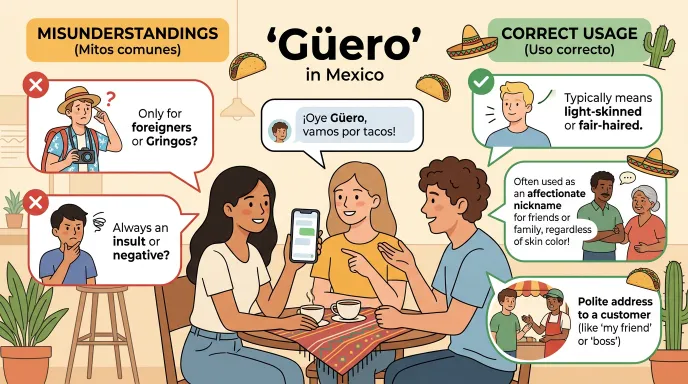
Güero Always Means “White Person”
Not exactly. Güero commonly refers to blond or fair haired people and can also relate to lighter skin. The meaning depends on regional use and context.
Güero Always Means “Blond”
Not in every conversation. Mexican speakers can also use it as a friendly nickname such as buddy or honey.
Güero Is Only Internet Slang
No. People use güero in everyday spoken Spanish too.
Güero and Güera Mean Exactly the Same Thing
They share the same basic idea, but güero usually refers to a male person and güera to a female person in common use.
Every Spanish Speaking Country Uses Güero the Same Way
No. Regional usage matters. Dictionaries especially connect the word with Mexico and parts of Central America.
FAQ’S
Q1:What does güero mean in Spanish slang?
Güero commonly means blond, fair haired, or light skinned. In Mexican casual speech, people can also use it as a friendly nickname meaning something like “buddy” or “pal.”
Q2:Is güero a bad word?
No. Güero is not automatically a bad or offensive word. The speaker’s tone and relationship with the person matter.
Q3:What does güera mean?
Güera is the feminine form of güero. It can describe a blonde or fair haired woman. Mexican speakers can also use it as a friendly or affectionate nickname.
Q4:Does güero mean white?
Not exactly. The word often describes blond or fair hair and can also refer to lighter skin. It does not work as a perfect one word translation for “white.”
Q5:Can I call my Mexican friend güero?
You can use it if your friend uses or welcomes that type of nickname. Since the word can describe appearance, consider the relationship and context before using it.
Q6:How do you pronounce güero?
A simple English approximation is “GWEH roh.” The Spanish pronunciation guide lists güero as gweh roh.
Conclusion
Güero in Spanish slang usually refers to a blond, fair haired, or lighter skinned person, especially in Mexican Spanish. In casual Mexican speech, it can also work as a friendly nickname similar to “buddy,” “pal,” or “honey.”
The key is context. If someone says güero while describing a person, they may mean “blond” or “fair haired.” If a friend says “¿Qué onda, güero?” they may simply mean “What’s up, buddy?”
The feminine form güera commonly refers to a woman. Both forms appear in everyday speech, texts, social media, and other casual conversations.
If you are unsure if someone will welcome an appearance based nickname, use their name instead. That choice keeps your communication clear and respectful.
Dig Deeper About!
- New York Slang Meaning in Text: A Simple Guide
- Maje Spanish Slang Meaning in Text
- Spoiled in Spanish Slang Meaning in Text